


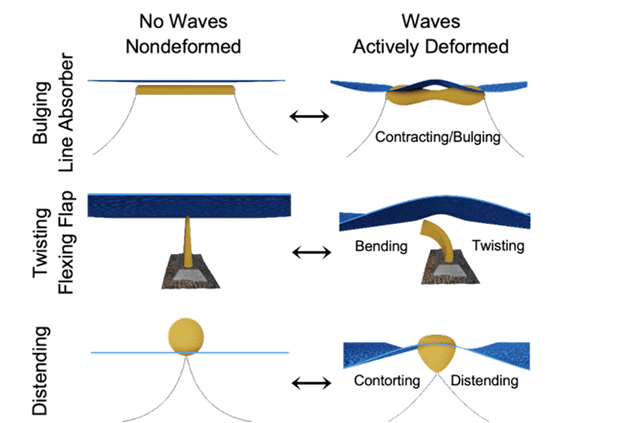
Researchers are working on new wave energy converter designs to harness energy from ocean waves. A diagram showing how the DEEC-Tec flexWEC can harness energy from ocean waves. (Image credit: NREL)
If you’ve ever seen a surfer wipe out, you know how powerful ocean waves are. Lately, researchers have been looking into how the ocean’s energy can be harnessed to provide energy to land-based homes and businesses. One method is through a device called a wave energy converter (WEC).
Most WECs are based on large, rigid bodies that float in the water and move relative to each other as waves pass. The ocean wave energy is absorbed, and the energy is centralized into a conversion mechanism, like a rotary generator. But the National Renewable Energy Laboratory (NREL) is looking into ways to advance the WEC’s design and development. NREL is working on a design that aggregates many small energy converters to create a single structure. Using this new approach, the domain of distributed embedded energy converter technologies (DEEC-Tec) could help with creating energy generation with ocean waves.
The DEEC-Tec concept is innovative because of how it creates flexible ocean wave energy converters, sometimes known as flexWECs. Unlike standard WECs, flexWECs have inherently broad-banded ocean wave energy absorption and conversation abilities. This allows them to harvest energy across a wide range of ocean wave heights and frequencies. Putting many small energy converters together forms a structure that undulates like a snake and can bend and expand. The structure bends and twists as ocean waves roll past, while each energy converter turns a portion of the ocean wave energy into electricity.
“Our goal with DEEC-Tec is to vastly broaden how we currently conceptualize and envision the use of ocean wave energy,” said NREL researcher Blake Boren, who has been studying wave energy converters for over 10 years. “There is a tremendous range of possibilities for how we can develop these DEEC-Tec-based wave energy converters, and we are accelerating that exploration process.”
Other advantages of a flexWEC include being able to absorb and convert ocean wave energy across a broader range of wave conditions, enough resiliency to ride out and absorb excess and dangerous surges from large storms and rough seas, easy installation, reduced maintenance schedules, near-continuous control structural control, and having converters made from recycled materials or simple polymers instead of heavier, more expensive materials.
DEEC-Tec sounds good on paper and while it does have a lot of potential there’s still more research that needs to be done. Currently, NREL researchers are studying which materials, designs, electronic systems, and manufacturing methods will advance DEEC-Tec concepts for marine renewable energy. The technology has great potential, but as it is, there’s more work to be done before ocean waves can be a reliable renewable energy source.
Have a story tip? Message me at: http://twitter.com/Cabe_Atwell