


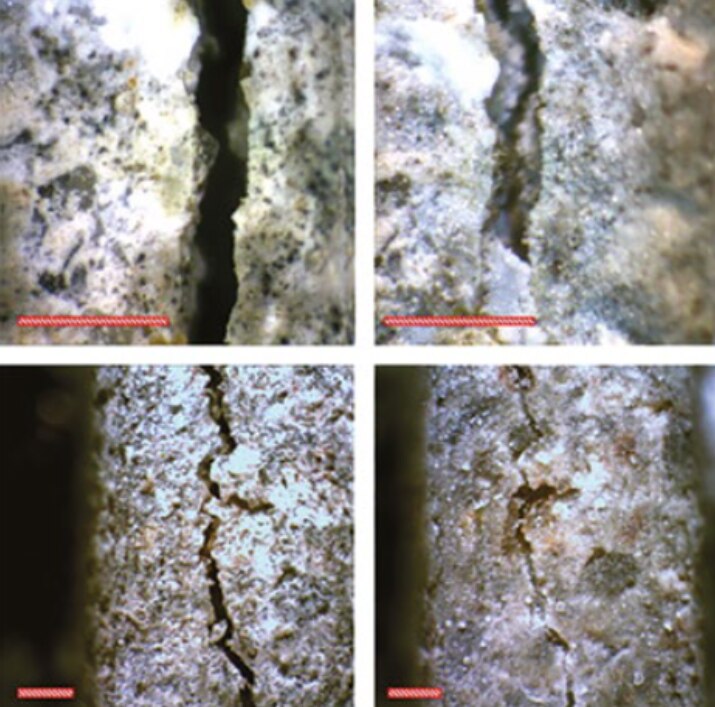
Image showing concrete repairing itself. The left side was photographed when it cracked, and the right side shows the repair after 28 days. (Image Credit: Kanellopoulos et al.)
In the future, tiny smart materials could repair cracks in concrete bridges or be injected into a human to treat health problems. These materials, which change and adapt to their environment, could ultimately improve human lives. However, they might need regulation to prevent any issues from arising. Animate materials are already being used in paint and concrete that repairs itself. It’s expected to have more applications later on.
Two techniques are implemented for self-repairing concrete. One concept contains capsules in the concrete that split open whenever damage has occurred. These capsules discharge a bitumen-based substance when exposed to water and air. Afterward, it materializes and fills up the damaged area. The other approach uses capsules full of bacteria that produce calcite, a mineral that repairs the damage. This technology has already been tested on UK roads.
These materials are integrated into phone screens that self-repair when they crack. It’s also used in electronics, allowing the materials to reform damaged circuits, restoring functionality.
It’s beneficial for health applications too. Tiny robots could be injected into a human’s bloodstream to collect data, make small incisions, and repair damage. Propelling occurs from tiny motors powered by chemical reactions. They have the potential to deliver drugs to a tumor. This effectively reduces the risk of damage to other areas brought on by chemotherapy or radiotherapy.
Another interesting application involves smart clothing. Integrating the materials into clothing can change its shape or color based on the wearer’s mood. People recovering from surgery or an injury greatly benefit from their use. Sensors in wearable tech could collect data that shows how they’re recovering, which is then shared with the patient and their doctor.
According to the Royal Society report, smart materials might pose a problem for regulators. They are expected to function without human assistance, causing them to behave unpredictably. There are also safety, ethical and practical concerns.
Building animate materials for diverse applications could also be a project for the new UK science body. It’s modeled on the DARPA in the US. It could carry out some uncertainties but would be extremely rewarding if it’s effective.
Have a story tip? Message me at: http://twitter.com/Cabe_Atwell
