element14 Community
element14 Community
    Register Log In
  • Site
  • Search
  • Log In Register
  • Community Hub
    Community Hub
    • What's New on element14
    • Feedback and Support
    • Benefits of Membership
    • Personal Blogs
    • Members Area
    • Achievement Levels
  • Learn
    Learn
    • Ask an Expert
    • eBooks
    • element14 presents
    • Learning Center
    • Tech Spotlight
    • STEM Academy
    • Webinars, Training and Events
    • Learning Groups
  • Technologies
    Technologies
    • 3D Printing
    • FPGA
    • Industrial Automation
    • Internet of Things
    • Power & Energy
    • Sensors
    • Technology Groups
  • Challenges & Projects
    Challenges & Projects
    • Design Challenges
    • element14 presents Projects
    • Project14
    • Arduino Projects
    • Raspberry Pi Projects
    • Project Groups
  • Products
    Products
    • Arduino
    • Avnet & Tria Boards Community
    • Dev Tools
    • Manufacturers
    • Multicomp Pro
    • Product Groups
    • Raspberry Pi
    • RoadTests & Reviews
  • About Us
  • Store
    Store
    • Visit Your Store
    • Choose another store...
      • Europe
      •  Austria (German)
      •  Belgium (Dutch, French)
      •  Bulgaria (Bulgarian)
      •  Czech Republic (Czech)
      •  Denmark (Danish)
      •  Estonia (Estonian)
      •  Finland (Finnish)
      •  France (French)
      •  Germany (German)
      •  Hungary (Hungarian)
      •  Ireland
      •  Israel
      •  Italy (Italian)
      •  Latvia (Latvian)
      •  
      •  Lithuania (Lithuanian)
      •  Netherlands (Dutch)
      •  Norway (Norwegian)
      •  Poland (Polish)
      •  Portugal (Portuguese)
      •  Romania (Romanian)
      •  Russia (Russian)
      •  Slovakia (Slovak)
      •  Slovenia (Slovenian)
      •  Spain (Spanish)
      •  Sweden (Swedish)
      •  Switzerland(German, French)
      •  Turkey (Turkish)
      •  United Kingdom
      • Asia Pacific
      •  Australia
      •  China
      •  Hong Kong
      •  India
      • Japan
      •  Korea (Korean)
      •  Malaysia
      •  New Zealand
      •  Philippines
      •  Singapore
      •  Taiwan
      •  Thailand (Thai)
      • Vietnam
      • Americas
      •  Brazil (Portuguese)
      •  Canada
      •  Mexico (Spanish)
      •  United States
      Can't find the country/region you're looking for? Visit our export site or find a local distributor.
  • Translate
  • Profile
  • Settings
Industrial Automation
  • Technologies
  • More
Industrial Automation
Blog Space Agencies Simulated an Asteroid Impact
  • Blog
  • Forum
  • Documents
  • Quiz
  • Events
  • Polls
  • Files
  • Members
  • Mentions
  • Sub-Groups
  • Tags
  • More
  • Cancel
  • New
Join Industrial Automation to participate - click to join for free!
  • Share
  • More
  • Cancel
Group Actions
  • Group RSS
  • More
  • Cancel
Engagement
  • Author Author: Catwell
  • Date Created: 17 May 2019 4:21 PM Date Created
  • Views 542 views
  • Likes 3 likes
  • Comments 0 comments
  • test
  • simulation
  • esa
  • nasa
  • cabeatwell
  • jaxa
  • asteroid
  • impact
  • innovation
Related
Recommended

Space Agencies Simulated an Asteroid Impact

Catwell
Catwell
17 May 2019

image

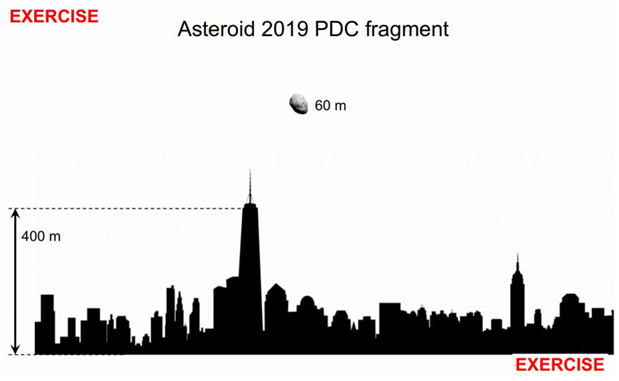
The Asteroid they planned on impacting Earth. (Image credit: ESA Operations)


On April 29, 2019, space experts from NASA, Federal Emergency Management Agency (FEMA) and the European Space Agency (ESA) created a simulation on a potential asteroid strike, creating experiments based on how to manage a disaster if one to ever occur. It took place at the yearly IAA Planetary Defense Conference and ran over five days, with a timeframe of eight years, but by the end, the simulation took a twist.

It all started with the fictional encounter of the 2019 PDC on March 26, 2019, which had a one-in-50,000 chance of striking Earth thanks to its irregular orbit. As the years ticked by in the simulation, the chances of PDC 2019 slamming into Earth steadily increased up until the 600-foot wide asteroid finally collided onto the planet's surface. In 2021, NASA had launched a reconnaissance mission, to gather data on the asteroid's size, composition and orbit. Three years later, NASA sent out three probes to impact the asteroid in an attempt to re-direct it from Earth. Even though the main body of the asteroid was steered away from the planet, a large 50-80 meter piece of asteroid broke off and was still on target to impact Earth.

image

A map of the simulated asteroid impact as it blasted over New York City. (Image Credit: NASA)

At first, the simulated target was meant to be close to Denver, Colorado, and researchers had already predicted the devastation of the impact would make the land impossible to live on. During the final day of the simulation, which is on April 29, 2027, the 200-foot fragment that broke off was set to crash into New York City's Central Park in only 10 days. The fragment sped into the atmosphere at astonishing high-speeds of 43,000 mph before exploding just one mile above the city, creating a 20-megaton explosion, 1,000 times more powerful than the atomic bomb dropped on Hiroshima. Cities like Manhattan, Brooklyn, the Bronx, Queens, and parts of New Jersey and Nassau County experienced hostile conditions from the blast. Staten Island was mostly intact, and the city was evacuated as it faced asteroid annihilation.

Scientists creating the simulation models could have chosen anywhere in the US to place the asteroid impact, but New York was chosen due to the smaller chances of the asteroid making impact as a result of the Earth's large size and given how much of it is covered by water.

An impact as large as the one used in the simulation would completely demolish a 15-km radius, devastating Manhattan in the process.  The blast in the air would mean there wouldn't be any survivors within 32 square miles, with damage reaching up to 68 kilometers from the site of impact.

Managing these types of disasters would require more than the advice of experts dealing with these events. Using these simulations will also help to provide answers on what can be done when a problem arises in these events. Asteroids are the only type of disaster we can prevent, which is also something we can find out about years ahead of time.

Technologies like powerful telescopes located in various places around the world and the Near-Earth Object Coordination Centre are all being put to use to help locate asteroids that may slam into Earth. NASA's DART spacecraft will also be beneficial to help protect humanity from asteroids.


Have a story tip? Message me at: cabe(at)element14(dot)com

http://twitter.com/Cabe_Atwell

  • Sign in to reply
element14 Community

element14 is the first online community specifically for engineers. Connect with your peers and get expert answers to your questions.

  • Members
  • Learn
  • Technologies
  • Challenges & Projects
  • Products
  • Store
  • About Us
  • Feedback & Support
  • FAQs
  • Terms of Use
  • Privacy Policy
  • Legal and Copyright Notices
  • Sitemap
  • Cookies

An Avnet Company © 2025 Premier Farnell Limited. All Rights Reserved.

Premier Farnell Ltd, registered in England and Wales (no 00876412), registered office: Farnell House, Forge Lane, Leeds LS12 2NE.

ICP 备案号 10220084.

Follow element14

  • X
  • Facebook
  • linkedin
  • YouTube