


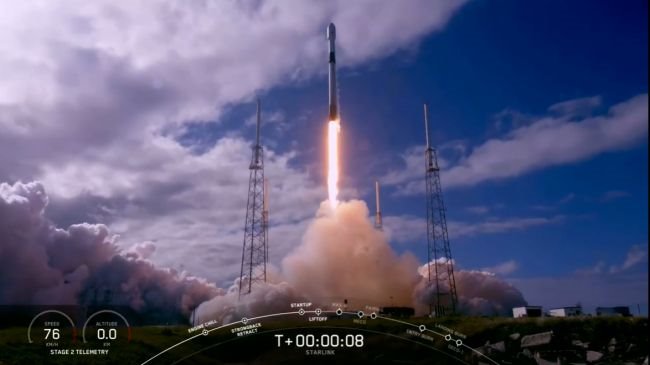
SpaceX’s Falcon 9 rocket launched into space, carrying 60 Starlink satellites into orbit on November 11th. (Image Credit: SpaceX)
It must be a busy place just outside the Earth's atmosphere. It's about to get a little more crowded too.
SpaceX launched its second batch of 60 new Starlink internet satellites into orbit from Cape Canaveral Air Force Station on November 11th, aboard the Falcon 9 rocket. SpaceX hopes the new broadband internet will provide affordable and reliable internet coverage around the globe.
Falcon 9 took off at 9:56AM EST, and about an hour later, the satellites were deployed into orbit. The rocket’s first stage landed on SpaceX’s drone ship landing platform, called “Of Course I Still Love You” in the Atlantic Ocean.
Earlier this year, the company sent the first batch of satellites into space as a test. There were issues with some satellites, as they weren’t operational. Since then, SpaceX has modified the software to improve functionality. Elon Musk sent a tweet by using the Starlink network, but it will still need at least a few hundred more satellites for moderate coverage.
Ordinary satellite internet providers have their satellites high up in orbit, stationed in the geostationary orbit (22,000 miles above the Earth). This means the signal travels over such a long distance, causing speeds to be equivalent to dial-up.
SpaceX will be aiming to provide a low latency connection at just 15ms. Most of the satellites will be in very-low Earth orbit (VLEO), located at just 217 miles above the Earth, which should help improve connectivity and offer internet coverage at an affordable price.
The company planned on launching a few thousand satellites to help power the Starlink network, but that number has significantly increased to 50,000 satellites. SpaceX hopes have 2,000 satellites in orbit by the end of the year. Musk mentioned that SpaceX requires at least 400 satellites in orbit for minor internet coverage and 800 for moderate coverage.
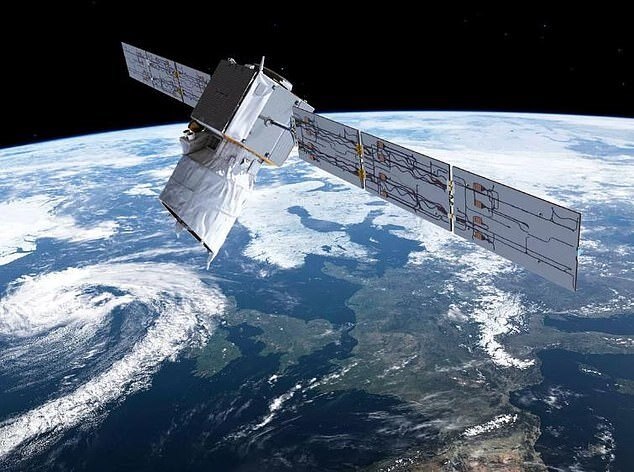
Elon Musk said it would take another 12 launches of Starlink satellites to provide internet coverage around the globe. (Image Credit: SpaceX)
A majority of astronomers have voiced their concerns with SpaceX’s Starlink satellites. They believe the lights could affect their research and make it difficult for night sky observers. When the first batch launched in May, astronomers noticed they were bright enough to be visible in the night sky, giving them the impression that Starlink satellites could be mistaken for stars.
After the first batch launch, Musk tweeted about sending a note to the Starlink team regarding albedo reduction, which is a measurement of light reflected by the satellites. Musk also mentioned that he and SpaceX value science and will come up with a solution so that it doesn’t affect astronomical research.
Meanwhile, astronomers are eagerly waiting for the second batch of satellites to reach their designated orbit location to see how bright they will be in the night sky.
When the Starlink satellites reach the end of their life, they will deorbit themselves over the course of a few months, using its ion engine to achieve this. If the satellite propulsion system isn’t operating, it will burn up in the Earth’s atmosphere in 1-5 years, in significantly less time than satellites in higher altitudes. This deorbit process prevents the satellites from becoming space junk, keeping all other satellites and spacecraft intact.
Have a story tip? Message me at: cabe(at)element14(dot)com
http://twitter.com/Cabe_Atwell