


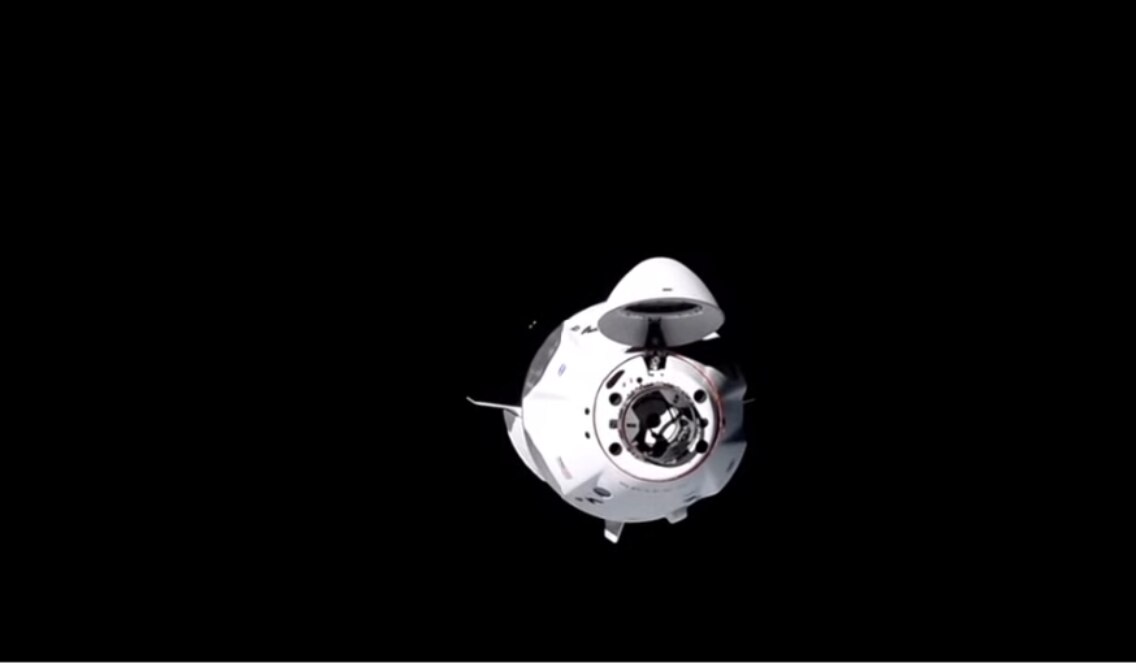
For the first time, SpaceX’s Resilience spacecraft arrived at the International Space Station with four Expedition 64 crewmembers, including a Baby Yoda plush doll. (Image Credit: NASA TV)
For the first time, SpaceX’s Crew Dragon capsule, named Resilience, successfully docked with the International Space Station’s Harmony module after a 27-hour flight. The spacecraft launched on a Falcon 9 rocket from NASA’s Kennedy Space Center on Sunday, November 15th, and arrived Monday, November 16th at 11:01 p.m. EST with four Expedition 64 crewmembers, including a Baby Yoda plush doll.
At 1:10 a.m., the hatch opened up, and NASA astronauts Victor Glover, Mike Hopkins, and Shannon Walker, and Soichi Noguchi of JAXA, floated out of SpaceX’s spacecraft and into the space station. The crew joined two Russians and one American who arrived last month on Russia’s Soyuz MS-17 spacecraft.
"SpaceX, this is Resilience. Excellent job, right down the center," Commander Mike Hopkins told mission control after the docking. "SpaceX and NASA, congratulations. This is a new era of operational flight to the International Space Station from the Florida coast."
A few hours after launching, the Crew-1 astronauts showed a Baby Yoda doll tethered to a wall of the spacecraft. When the doll started floating around, it indicated to the astronauts that the launch phase was over, which meant that zero gravity had been reached. Traditionally, crew members use toys or small dolls to signal when they enter orbit. They chose the Baby Yoda doll to provide levity during a hectic year brought on by a pandemic, civil unrest, and the elections.
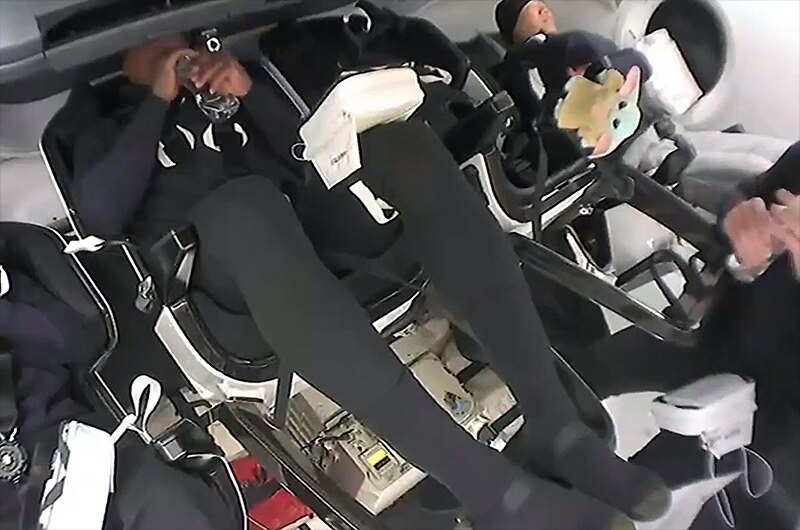
The Baby Yoda, seen floating in the image, was used as a zero-gravity indicator. (Image Credit: NASA TV)
The three Americans and one Japanese astronaut are staying at the orbiting lab until their replacements arrive on another Dragon capsule in April 2021. SpaceX and later on, Boeing, are sending astronauts to and from the ISS. NASA depended on Russia to send astronauts to and from the space station with the Soyuz rockets and spacecraft. To lessen its dependence on Russia, the space agency contracted SpaceX and Boeing to develop commercial vehicles.
Resilience’s arrival marks the first time a commercial spacecraft delivered astronauts to the space station for a long-duration stay. However, the Crew-1 mission is not the first to use a commercial vehicle to send astronauts to the ISS. SpaceX’s Crew Dragoon-Demo 2 test flight brought two NASA astronauts for a two-month stay.
Have a story tip? Message me at: http://twitter.com/Cabe_Atwell