


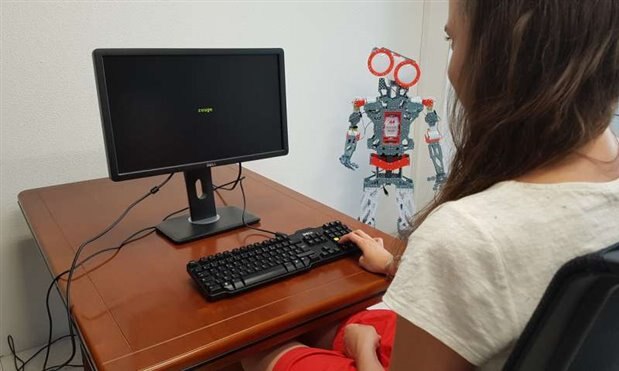
Researchers from French and Swiss institutions find mean robots helped people concentrate and performed better on a Stroop Task. The experiment had participants take a Stroop Test after interacting with both a nice and mean robot. (Photo via Spatola)
Years of science fiction movies have altered our view on robots, and this latest study doesn’t help matters. Researchers from French and Swiss institutions recently discovered that a mean robot can help people concentrate. Led by Nicolas Spatola at the University of Clermont Auvergne in France, the purpose of the study is to figure out if humans respond to pressure from robots the say way other humans do. During experiments designed to measure the impact of a robot watching someone completing a task, they learned people actually performed better when the robot was mean.
For the experiment, researchers asked people to complete a Stroop Task, which is a psychological task where participants are shown a single word printed in a random color on a video screen. They are then asked to determine the color of the word rather than its meaning. For example, the word “red” will be shown in blue ink, and the person must pick blue as the color, not red. The point of the test is to track your attention and cognitive ability.
After they completed the test, participants were asked to have a conversation with a Meccanoid robot, a customizable personal robot. After asking it a question, the robot would either respond in a kind or rude manner. Following their brief chat, the test would be performed again, but this time the robot they conversed with earlier stood on watch.
Once the experiment was finished, researchers found people who talked to the mean robot performed slightly better during the second phase of testing. As for the people who spoke with the kind robot, they performed the same as the control group, which didn’t speak with the robot at all. Researchers believe speaking with the mean robot made people more alert, which allowed them to perform better on the test.
On the other hand, robots can also impact your decisions and opinions as a similar study showed. A study conducted at the University of Plymouth tested how adults and children take on similar tasks when in the presence of both their peers and humanoid robots. The results showed adults are more likely to have their opinions influenced by their peers, but children are more likely to listen to the robots. Even when the bots intentionally gave them false information, they were more than happy to follow.
So, does this mean jobs will start employing robots to make sure we stay on task? Probably not. For one, it’s not guaranteed to work in every situation. For another, it’s just plain unhealthy. “It would be wrong and a bit dystopian to conclude that if we put a bad robot in every place, everyone will perform better,” says Spatola. “Imagine a robot sitting in your office insulting you every day – it will not be good for your long-term performance.” Seems like we’re safe, at least for now.
Have a story tip? Message me at: cabe(at)element14(dot)com
