


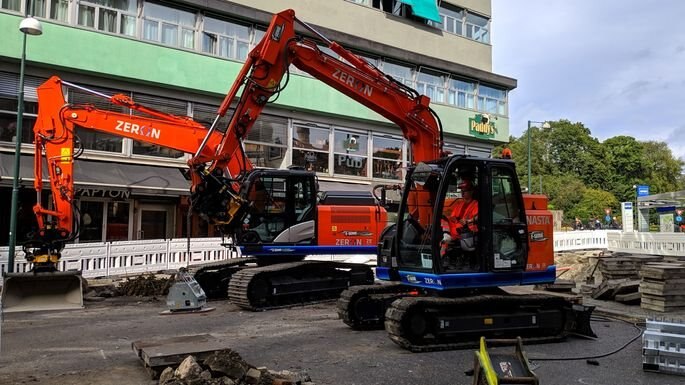
Suncar’s ZE85 battery-powered electric excavator can help free up CO2 emissions on construction sites. (Image Credit: Suncar)
Cities like Oslo emit 21% of CO2 emissions from heavy-duty construction machinery, which is a huge amount, and it wouldn’t be surprising if older machines in other cities emit much more. The new ZE85 battery-powered electric excavator, developed by Suncar HK, is now fully operational on a zero-emission construction site in Oslo, Norway. Presented in May 2019 at bauma19 in Munich, the very first electric excavator contains a CCS fast-charging interface, which enables a full charge in less than an hour.
Local authorities in Oslo passed laws that require all new public buildings to be built with fossil-fuel-free construction machines. The European Commission has taken action by setting guidelines in the “Buying green” and “Green Public Procurement” areas while attempting to limit the use of emissions on construction sites. This has caused manufacturers to step in by equipping their heavy-duty construction machines with a battery-powered electric drive. Even though some companies prefer to do the development and conversion process themselves, others work with third-party partners like Suncar HK. For example, companies like Liebherr and Hitachi use Suncar’s system in their vehicles.
One of the key advantages of using the ZE85, which is based on Hitachi’s digger design, is that it’s capable of rapid recharge. It would only take approximately 45 minutes to charge with the CCS (Combined Charging System) connection. The system enables DC-fast-charging of high-voltage batteries of 280 kW. The CCS protocol that’s also used in electric cars is integrated into the modular DC charging system, known as “Interflow.” The ZE85 electric excavator can also be charged via the CEE three-phase current socket, which is readily available on construction sites. This new system can also be installed in other battery-powered vehicles with 800 VDC and 350 A maximum charging current.
According to Suncar HK, the ZE85 can operate for up to four hours. When combined with the quick charging time, the eight-tonne vehicle should last throughout the working day without any issues. If there is no fast charging technology available, it can just recharge via the CCS connection.
Oslo, Norway isn’t the only city that has put a ban on diesel construction machines and passenger cars from city centers. Other places like Barcelona, London, and Beijing have already stipulated laws that will go into effect in the future. We could also see a few other countries around the world, putting such laws in place later on once they see how using electric construction machinery on a worksite can effectively reduce CO2 emissions.
Have a story tip? Message me at: cabe(at)element14(dot)com
