


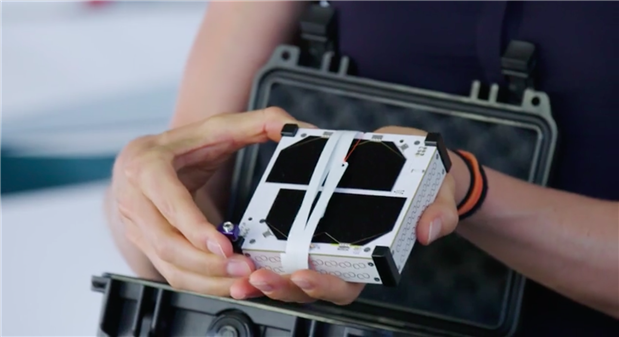
Swarm’s 1/4U SpaceBEE Satellites feature radar reflectors and GPS, allowing them to be tracked in orbit. (Image credit: Swarm Technologies)
Back in January, aerospace startup Swarm Technologies launched four picosatellites, known as SpaceBEE’s, with the idea of bringing low-cost space-based internet connectivity to billions of people around the world. An excellent endeavor for sure, but sending things into space requires thorough preparation and a mountain for paperwork, which includes getting a federal license (in the US) from the FCC. Swarm failed to gain that approval but launched their SatBEEs aboard an Indian PSLV-XL rocket, which the FCC highly frowned upon.
The FCC requires approval, as they are responsible for allocating the radio frequencies each satellite will use, they also have a hand in limiting or negating how much space debris is shot into orbit. Those are just some of the issues companies have with picosatellites, they are difficult to track because of their size, in the case of Swarm’s SatBEEs, is about 1/4U- smaller than typical CubeSats.
To get around the tracking issue, Swarm outfitted their tiny satellites with experimental passive radar reflectors developed by the Naval Warfare Systems Command, which increased the satellite’s profile by a factor of ten. Swarm also outfitted them with GPS modules that broadcast their position on-demand, allowing for near pinpoint tracking accuracy via the SSN (Space Surveillance Network) operated by NORAD.

SpaceX’s Falcon 9 rocket will launch several of Swarm Technologies’ SatBEEs into orbit in November. (Image credit: SpaceX via Wikipedia)
While the FCC is still fuming over Swarm’s illegal launch (they are still deciding whether to take any action against them), the government communications agency has awarded the company a Special Temporary Authorization license that’s valid from September 24, 2018, to March 24, 2019. In non-technical language- they can launch whatever they want (regarding SatBEEs) using the assigned frequency (137.95MHz) within that timeframe.
To take advantage of that new authorization, Swarm has contracted with SpaceX, which is slated to launch that payload at some point in November. The SatBEEs will fly alongside 70 other nearly 70 other tiny satellites (CubeSats/MicroSats) as part of a ride-share mission dubbed SSO-A (Sun-Synchronous Low Earth Orbit) Smallsat Express.
Have a story tip? Message me at: cabe(at)element14(dot)com