


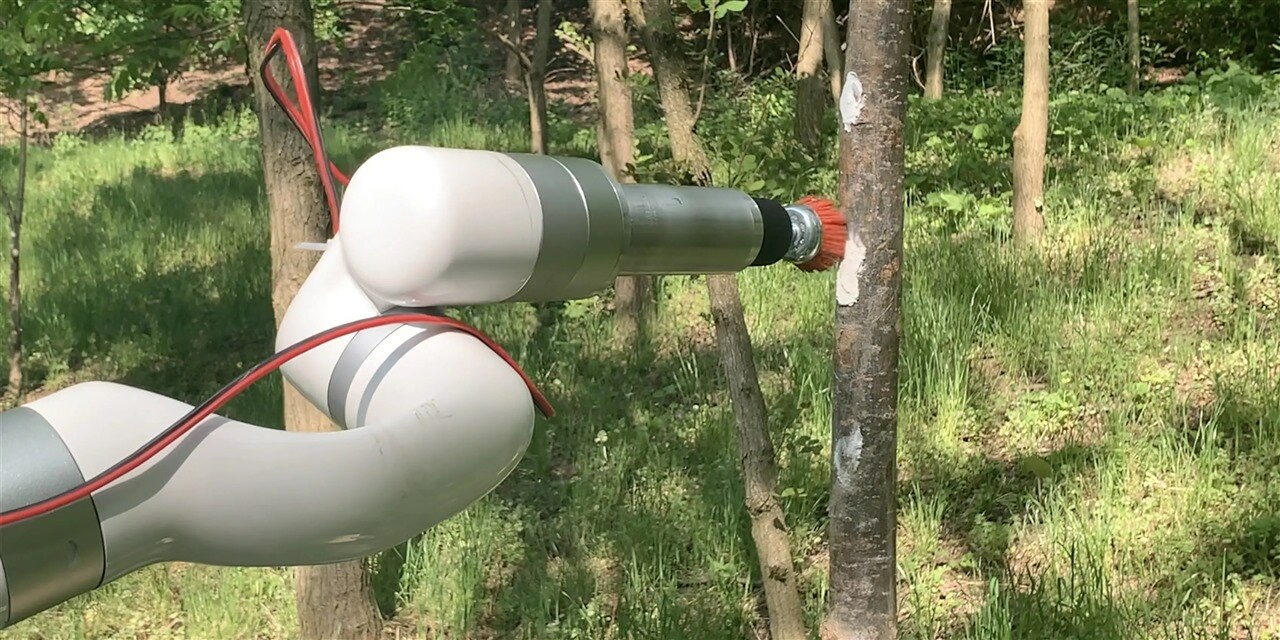
TartanPest has a robotic arm that removes a spotted lanternfly egg mass from trees in fields or forests. (Carnegie Mellon University)
The spotted lanternfly, an invasive pest, can be very tiresome, annoying, and destructive. And humans turn to crushing remedies or pesticides to eliminate them. Carnegie Mellon University researchers developed TartanPest, an autonomous robot that uses AI to hunt down and destroy those pests' eggs on trees before hatching and wreaking havoc on the environment.
"Currently, spotted lanternflies are concentrated in the eastern portion of the nation, but they are predicted to spread to the whole country," said Carolyn Alex, an undergraduate researcher on the TartanPest team. "By investing in this issue now, we will be saving higher costs in the future."
The spotted lanternfly has expanded its population in the eastern US since 2014, threatening over 100 different tree and plant species. A majority of the plants these pests devour are significant in the logging and grape industries. While they don't pose a health risk to humans or animals, the insects cost farmers in Pennsylvania $324 million annually and led to 2,800 job losses.
The researchers created TartanPest by attaching a robotic arm to the base of an electric Amiga micro tractor. This handy robot relies on computer vision to move through fields and forests, detecting possible egg masses. TartanPest then uses a deep learning model to compare these masses to a database of 700 images captured by iNaturalist to verify their existence. It could ultimately spell out doom for these plant-eating pests if the egg masses, containing 30-50 eggs, come from the spotted lanternfly because the robot's arm will remove them from trees, furniture, rusty metal surfaces, or rocks.
The greatest thing about TartanPest's nest hunting and egg-killing procedure is that it quickly and effectively slows down the pest population growth without resorting to adult annihilation. The team says their robot can "increase the efficiency of farms, lower costs, lower chemical pollution of crops [from pesticides], and save labor costs for farms."
Have a story tip? Message me at: http://twitter.com/Cabe_Atwell