element14 Community
element14 Community
    Register Log In
  • Site
  • Search
  • Log In Register
  • Community Hub
    Community Hub
    • What's New on element14
    • Feedback and Support
    • Benefits of Membership
    • Personal Blogs
    • Members Area
    • Achievement Levels
  • Learn
    Learn
    • Ask an Expert
    • eBooks
    • element14 presents
    • Learning Center
    • Tech Spotlight
    • STEM Academy
    • Webinars, Training and Events
    • Learning Groups
  • Technologies
    Technologies
    • 3D Printing
    • FPGA
    • Industrial Automation
    • Internet of Things
    • Power & Energy
    • Sensors
    • Technology Groups
  • Challenges & Projects
    Challenges & Projects
    • Design Challenges
    • element14 presents Projects
    • Project14
    • Arduino Projects
    • Raspberry Pi Projects
    • Project Groups
  • Products
    Products
    • Arduino
    • Avnet & Tria Boards Community
    • Dev Tools
    • Manufacturers
    • Multicomp Pro
    • Product Groups
    • Raspberry Pi
    • RoadTests & Reviews
  • About Us
  • Store
    Store
    • Visit Your Store
    • Choose another store...
      • Europe
      •  Austria (German)
      •  Belgium (Dutch, French)
      •  Bulgaria (Bulgarian)
      •  Czech Republic (Czech)
      •  Denmark (Danish)
      •  Estonia (Estonian)
      •  Finland (Finnish)
      •  France (French)
      •  Germany (German)
      •  Hungary (Hungarian)
      •  Ireland
      •  Israel
      •  Italy (Italian)
      •  Latvia (Latvian)
      •  
      •  Lithuania (Lithuanian)
      •  Netherlands (Dutch)
      •  Norway (Norwegian)
      •  Poland (Polish)
      •  Portugal (Portuguese)
      •  Romania (Romanian)
      •  Russia (Russian)
      •  Slovakia (Slovak)
      •  Slovenia (Slovenian)
      •  Spain (Spanish)
      •  Sweden (Swedish)
      •  Switzerland(German, French)
      •  Turkey (Turkish)
      •  United Kingdom
      • Asia Pacific
      •  Australia
      •  China
      •  Hong Kong
      •  India
      • Japan
      •  Korea (Korean)
      •  Malaysia
      •  New Zealand
      •  Philippines
      •  Singapore
      •  Taiwan
      •  Thailand (Thai)
      • Vietnam
      • Americas
      •  Brazil (Portuguese)
      •  Canada
      •  Mexico (Spanish)
      •  United States
      Can't find the country/region you're looking for? Visit our export site or find a local distributor.
  • Translate
  • Profile
  • Settings
Industrial Automation
  • Technologies
  • More
Industrial Automation
Blog The Embroidered Computer: A textile circuit board
  • Blog
  • Forum
  • Documents
  • Quiz
  • Events
  • Polls
  • Files
  • Members
  • Mentions
  • Sub-Groups
  • Tags
  • More
  • Cancel
  • New
Join Industrial Automation to participate - click to join for free!
  • Share
  • More
  • Cancel
Group Actions
  • Group RSS
  • More
  • Cancel
Engagement
  • Author Author: Catwell
  • Date Created: 25 Mar 2019 7:03 PM Date Created
  • Views 942 views
  • Likes 2 likes
  • Comments 0 comments
  • fabric
  • textile
  • caebatwell
  • embedded
  • fashion
  • art
  • innovation
Related
Recommended

The Embroidered Computer: A textile circuit board

Catwell
Catwell
25 Mar 2019

Artists Irene Posch and Ebru Krubak have engineered The Embroidered Computer, an interactive 8-bit computer made of embroidery materials and traditional stitching techniques and patterns.


The design invites artistic abilities to weave through technology on an electronic circuit board. (Image Credit: Irene Posch)image
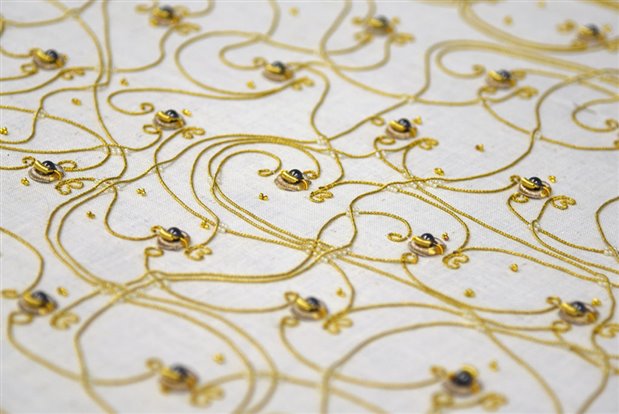
 

The 8-bit programmable computer is made up of metal threads, gold, silver, glass, metal beads and copper, functioning similarly to decorative textile. Its appearance is meant to look artistic and explores the different designs surrounding current digital and electronic technologies and how we interact with them.


It 's also made of relays, as used during the years of early computers before semiconductors were created. The gold materials are generally used for their highly conductive properties and are put into certain patterns to carry out electronic functions, acting as an 8-bit computer. Their pattern, while traditional and decorative, define how they function. Users can interact with the computer by programming the textile to compute commands for them.


Overhead view of the textile circuit. (Image Credit: Irene Posch)image


Additionally, researchers have used fabric as circuits in the past. This was achieved by incorporating washable electronic circuits into fabrics, allowing inventive technologies to come into play with smart textiles and wearable textile electronic devices. This method prints graphene inks and 2D materials on fabric, creating electronic circuits that are both wearable and can last through 20 cycles in a washing machine. The technology can allow applications of smart fabrics to be created, including personal health wearable computing, fashion, military clothing, and wearable energy harvesting and storage.  The team designed low-boiling point inks so they can be printed onto polyester fabric. The roughness of the fabric can also improve the device's performance significantly, allowing researchers to design electronic circuits.


Chinese researchers have also designed a textile made of electrical wiring that can stand harsh climates they call it a fabric circuit board (FCB). Various components like microchips can be placed into the circuit and stay connected when the circuit is bent. It's made of multiple filaments of pre-stretched elastic yarn and polyurethane-coated copper fibres. The material can be stretched during normal wear and tear before the fibres break off. The fabric can also be used in multiple layers like an ordinary circuit board can. Polyurethane insulation wrapped around the copper helps to achieve this and currents can flow through the fibres like an ordinary circuit board.


In 1804, the invention of the Jacquard Loom made it possible to design more modem computers due to the use of its binary system that can store data, read it and reproduce it again. This inspired Charles Babbage to create the Analytical Engine which is the first general-purpose computer.


Have a story tip? Message me at: cabe(at)element14(dot)com

http://twitter.com/Cabe_Atwell

  • Sign in to reply
element14 Community

element14 is the first online community specifically for engineers. Connect with your peers and get expert answers to your questions.

  • Members
  • Learn
  • Technologies
  • Challenges & Projects
  • Products
  • Store
  • About Us
  • Feedback & Support
  • FAQs
  • Terms of Use
  • Privacy Policy
  • Legal and Copyright Notices
  • Sitemap
  • Cookies

An Avnet Company © 2025 Premier Farnell Limited. All Rights Reserved.

Premier Farnell Ltd, registered in England and Wales (no 00876412), registered office: Farnell House, Forge Lane, Leeds LS12 2NE.

ICP 备案号 10220084.

Follow element14

  • X
  • Facebook
  • linkedin
  • YouTube