element14 Community
element14 Community
    Register Log In
  • Site
  • Search
  • Log In Register
  • Community Hub
    Community Hub
    • What's New on element14
    • Feedback and Support
    • Benefits of Membership
    • Personal Blogs
    • Members Area
    • Achievement Levels
  • Learn
    Learn
    • Ask an Expert
    • eBooks
    • element14 presents
    • Learning Center
    • Tech Spotlight
    • STEM Academy
    • Webinars, Training and Events
    • Learning Groups
  • Technologies
    Technologies
    • 3D Printing
    • FPGA
    • Industrial Automation
    • Internet of Things
    • Power & Energy
    • Sensors
    • Technology Groups
  • Challenges & Projects
    Challenges & Projects
    • Design Challenges
    • element14 presents Projects
    • Project14
    • Arduino Projects
    • Raspberry Pi Projects
    • Project Groups
  • Products
    Products
    • Arduino
    • Avnet & Tria Boards Community
    • Dev Tools
    • Manufacturers
    • Multicomp Pro
    • Product Groups
    • Raspberry Pi
    • RoadTests & Reviews
  • About Us
  • Store
    Store
    • Visit Your Store
    • Choose another store...
      • Europe
      •  Austria (German)
      •  Belgium (Dutch, French)
      •  Bulgaria (Bulgarian)
      •  Czech Republic (Czech)
      •  Denmark (Danish)
      •  Estonia (Estonian)
      •  Finland (Finnish)
      •  France (French)
      •  Germany (German)
      •  Hungary (Hungarian)
      •  Ireland
      •  Israel
      •  Italy (Italian)
      •  Latvia (Latvian)
      •  
      •  Lithuania (Lithuanian)
      •  Netherlands (Dutch)
      •  Norway (Norwegian)
      •  Poland (Polish)
      •  Portugal (Portuguese)
      •  Romania (Romanian)
      •  Russia (Russian)
      •  Slovakia (Slovak)
      •  Slovenia (Slovenian)
      •  Spain (Spanish)
      •  Sweden (Swedish)
      •  Switzerland(German, French)
      •  Turkey (Turkish)
      •  United Kingdom
      • Asia Pacific
      •  Australia
      •  China
      •  Hong Kong
      •  India
      •  Korea (Korean)
      •  Malaysia
      •  New Zealand
      •  Philippines
      •  Singapore
      •  Taiwan
      •  Thailand (Thai)
      • Americas
      •  Brazil (Portuguese)
      •  Canada
      •  Mexico (Spanish)
      •  United States
      Can't find the country/region you're looking for? Visit our export site or find a local distributor.
  • Translate
  • Profile
  • Settings
Industrial Automation
  • Technologies
  • More
Industrial Automation
Blog The Third Generation of MIT’s Cheetah is defying Nature
  • Blog
  • Forum
  • Documents
  • Quiz
  • Events
  • Polls
  • Files
  • Members
  • Mentions
  • Sub-Groups
  • Tags
  • More
  • Cancel
  • New
Join Industrial Automation to participate - click to join for free!
  • Share
  • More
  • Cancel
Group Actions
  • Group RSS
  • More
  • Cancel
Engagement
  • Author Author: Catwell
  • Date Created: 31 Jul 2018 3:15 PM Date Created
  • Views 462 views
  • Likes 5 likes
  • Comments 0 comments
  • security
  • mit
  • robotics
  • robot
  • on_campus
  • motion
  • cabeatwell
  • university
  • safety
Related
Recommended

The Third Generation of MIT’s Cheetah is defying Nature

Catwell
Catwell
31 Jul 2018

image

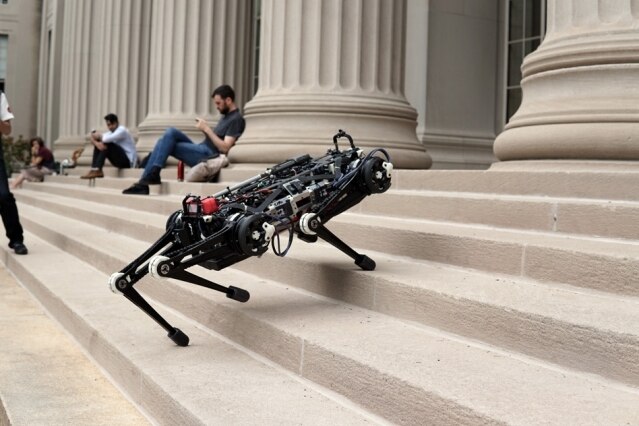
MIT’s engineers built a robot a while back that is meant to save lives. Although named after one of the fastest feline in the world, this robot is excelling where the feline cannot. Cheetah 3 climbing stairs in a public space. (Image via mit.edu)


For every new machine or product invented, choosing a name must be the toughest part. The name of a robot is not often obvious and easy to decide; yet, it helps in promoting the new creation. For some reasons, scientists or engineers seem to agree that flora and fauna are great places to find names for most new technologies. For example, one of the most sold smartphones on the market is named after a fruit, the richest man according to Forbes named his company after the largest forest in the world, the US army calls some of its aircrafts “falcon,” and it doesn’t stop there. Now the question is: how is the name picked? In some cases, the name of the new technology is based on its functions while in other cases the name derives from its attributes. But maybe sometimes the name of a robot comes from everything the animal it refers to doesn’t do like it is the case for the robot Cheetah 3 of MIT.


Originally designed by Prof. Sang-Bae Kim and a group of researchers from MIT’s Biomimetics lab, the Cheetah-bot had a more entertaining. However, the latest version of the robot is more practical and might be a better version of the animal in some ways. Nonetheless, both the feline and the robot are fast; in fact, the robot Cheetah 3 is considered the fastest of its kind at a running speed of 14mile per hour. Not comparable to the animal which can run up to 61 miles per hour, but still worthy of recognition for a robot. Maybe the speed can be improved given that Cheetah will be used to save lives in situations and places where humans can’t reach. Also, like the animal, Cheetah 3 cannot see in the dark. The feline is known to hunt only during the day due to its poor eyesight. However, Professor Kim doesn’t seem to believe it to be a limitation.


In the design of Cheetah 3, there is no camera or vision-related sensor, leaving the robot without eyes. Professor Kim explains that eyes on a robot demand accuracy of position which cannot always be offered; especially during rescue missions. To compensate for the lack, Cheetah 3 is made to avoid obstacles on its way while jumping just as fast. In addition, Cheetah 3 can climb contrary to its flesh version. Cheetahs unfortunately or fortunately cannot climb a tree, possibly the reason for their low survival rate. Luckily, Cheetah 3 does not have that issue. In a recent demonstration (earlier this year), Cheetah was not only able to climb stairs but to do it while pieces of woods were scattered all over the stairs. To do it, the robot uses what the researchers refer to as “blind locomotion” which translates as “feeling the ground.” Like a blind man uses his cane to evaluate surfaces, forms and distances, the robot uses a set of algorithms, contact detection and model predictive control, to help it evaluate its environment, and make a decision accordingly.


Although fierce and feared, the cheetah is a wild cat which must overcome a lot of limitations to survive. And, the same resilience has been perfectly represented in the design of the Cheetah-bot.


You don't have permission to edit metadata of this video.
Edit media
x
image
Upload Preview
image


See more news at:

http://twitter.com/Cabe_Atwell

  • Sign in to reply
element14 Community

element14 is the first online community specifically for engineers. Connect with your peers and get expert answers to your questions.

  • Members
  • Learn
  • Technologies
  • Challenges & Projects
  • Products
  • Store
  • About Us
  • Feedback & Support
  • FAQs
  • Terms of Use
  • Privacy Policy
  • Legal and Copyright Notices
  • Sitemap
  • Cookies

An Avnet Company © 2025 Premier Farnell Limited. All Rights Reserved.

Premier Farnell Ltd, registered in England and Wales (no 00876412), registered office: Farnell House, Forge Lane, Leeds LS12 2NE.

ICP 备案号 10220084.

Follow element14

  • X
  • Facebook
  • linkedin
  • YouTube