


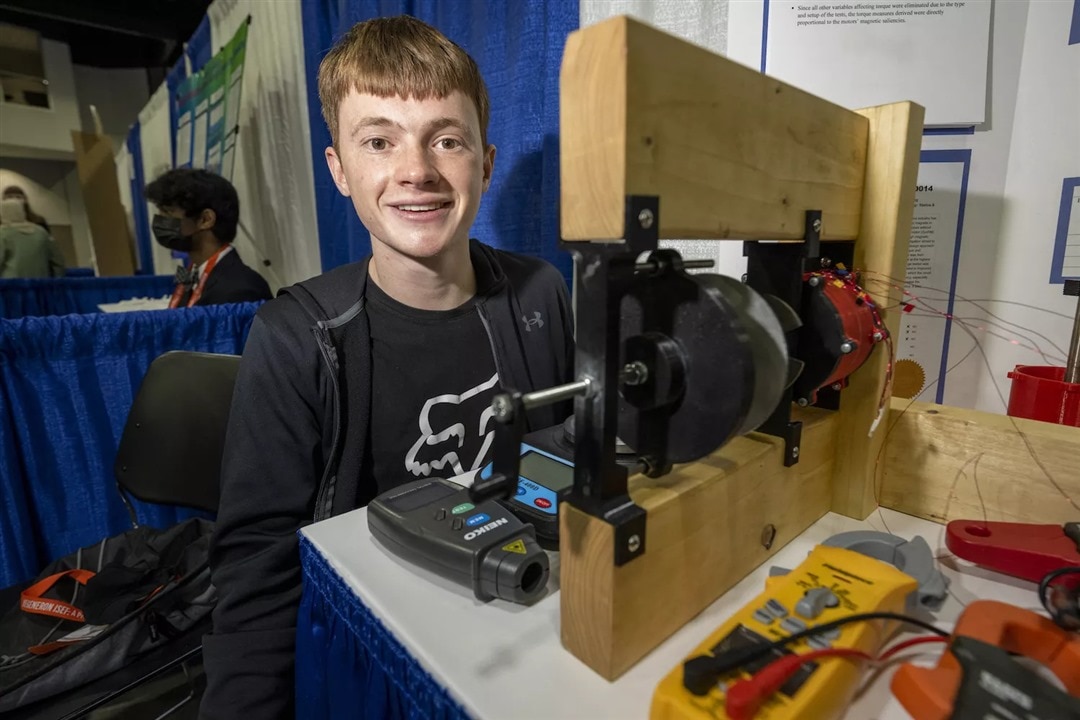
Robert Sansone won first place in the ISEF for his magnet-free synchronous motor. (Image Credit: Society for Science)
17-year-old high school student Robert Sansone placed first in the Regeneron International Science and Engineering Fair (ISEF) for his magnet-free synchronous motor that could revolutionize the EV industry. While researching electric vehicles, he discovered claims that synchronous reluctance motors can solve issues related to mining and extracting rare earth minerals required for electric vehicles. However, these motors lack the efficiency and torque required to work well with permanent magnet counterparts.
The rotor, placed within a stator made of coils of wire, in a synchronous reluctance motor is composed of iron or steel with slots. The motor's steel means it has low reluctance since magnetic fields move through it easier than air. Meanwhile, the slots give high reluctance. The maximum difference between low and high reluctance should be achieved, which boosts the motor's saliency ratio, a factor that generates torque. Sansone's design utilizes a novel configuration to boost that saliency ratio.
During tests, his design modifications reached 39% greater torque and 31% higher efficiency at 300 rpm. At 750 rpm, it reached 37% higher efficiency and 40% higher torque. It's still too soon to determine how this performs compared to current permanent magnet motors. That's because he developed the motor with 3D-printed components that would otherwise melt if they underwent higher RPM testing. Sansone is now developing another version to compare it to a permanent magnet design.
He also plans to make three additional design modifications for the performance improvement of a traditional synchronous reluctance motor. Version 15, the one that won the ISEF award, has one of those changes incorporated. Version 16, the one being worked on, will have two changes incorporated. Lastly, he expects to incorporate all three in version 17.
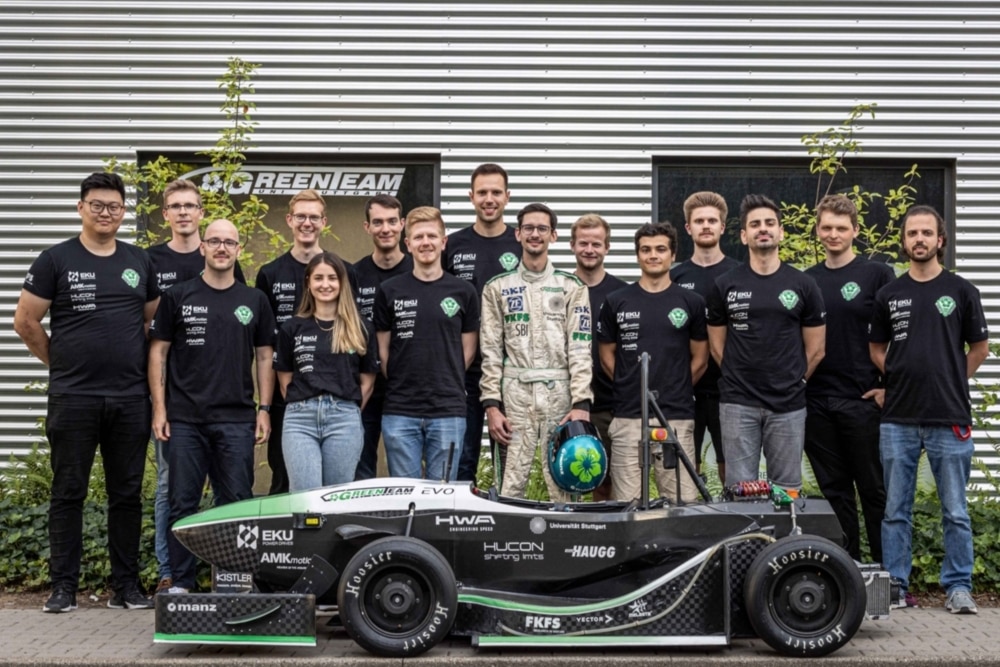
The GreenTeam electric racing vehicle set a new world record, going from 0-62 mph in 1.461 seconds. (Image Credit: Maximilian Partenfelder/GreenTeam)
Twenty University of Stuttgart students built GreenTeam, an electric racing car that went from 0-62 mph in 1.461 seconds, setting a new record. According to the school's website, the vehicle's peak acceleration is nearly identical to the force experienced by astronauts upon a rocket's reentry into the earth's atmosphere. On September 23rd, Guinness World Records confirmed the new record at a Renningen, Germany, test track. This was GreenTeam's second try at setting the record this year after preparing for nearly a year. The team canceled their first attempt in early September due to technical difficulties.
GreenTeam set the record in 2012 when it took 2.681 seconds to achieve that speed. Afterward, the Netherlands and Switzerland won the award before Germany claimed it in 2015, achieving 1.779 seconds. In 2016, a Swiss team set a new record with a time of 1.513 seconds.
MIT student Daniel Larsen solved a key theorem about Carmichael numbers when he was just a senior high school student. It all started a few years ago when Larsen stumbled upon a Yitang Zhang documentary and constantly thought about the twins prime conjecture, a problem that Zhang and other mathematicians wished to solve. This states that many pairs of primes exist that differ by two.
Zhang concluded that many pairs of primes exist, which differ by under 70 million. Then, mathematicians also attempted to shrink that bond. So James Maynard and Terence Tao solved stronger gaps between primes, decreasing it to 246. Larsen attempted to understand the math involved in Maynard and Tao's work but realized the papers were too complex to understand. He didn't give up and went from one result to the next.
In November 2021, Larsen sent Andrew Granville an e-mail with a paper attached proving that he solved the Carmichael numbers theory. Larsen referred to Maynard and Tao's results to solve the problem. In that case, he changed Maynard's methods, combining them with techniques utilized by Granville, Carl Pomerance, and Red Alford. As a result, Larsen's prime numbers varied in size, which was sufficient to generate Carmichael numbers within his desirable intervals. Larsen's work has also shown that it could work for smaller intervals rather than just proving a Carmichael number needs to exist between X and 2X.
Have a story tip? Message me at: http://twitter.com/Cabe_Atwell