element14 Community
element14 Community
    Register Log In
  • Site
  • Search
  • Log In Register
  • Community Hub
    Community Hub
    • What's New on element14
    • Feedback and Support
    • Benefits of Membership
    • Personal Blogs
    • Members Area
    • Achievement Levels
  • Learn
    Learn
    • Ask an Expert
    • eBooks
    • element14 presents
    • Learning Center
    • Tech Spotlight
    • STEM Academy
    • Webinars, Training and Events
    • Learning Groups
  • Technologies
    Technologies
    • 3D Printing
    • FPGA
    • Industrial Automation
    • Internet of Things
    • Power & Energy
    • Sensors
    • Technology Groups
  • Challenges & Projects
    Challenges & Projects
    • Design Challenges
    • element14 presents Projects
    • Project14
    • Arduino Projects
    • Raspberry Pi Projects
    • Project Groups
  • Products
    Products
    • Arduino
    • Avnet & Tria Boards Community
    • Dev Tools
    • Manufacturers
    • Multicomp Pro
    • Product Groups
    • Raspberry Pi
    • RoadTests & Reviews
  • About Us
  • Store
    Store
    • Visit Your Store
    • Choose another store...
      • Europe
      •  Austria (German)
      •  Belgium (Dutch, French)
      •  Bulgaria (Bulgarian)
      •  Czech Republic (Czech)
      •  Denmark (Danish)
      •  Estonia (Estonian)
      •  Finland (Finnish)
      •  France (French)
      •  Germany (German)
      •  Hungary (Hungarian)
      •  Ireland
      •  Israel
      •  Italy (Italian)
      •  Latvia (Latvian)
      •  
      •  Lithuania (Lithuanian)
      •  Netherlands (Dutch)
      •  Norway (Norwegian)
      •  Poland (Polish)
      •  Portugal (Portuguese)
      •  Romania (Romanian)
      •  Russia (Russian)
      •  Slovakia (Slovak)
      •  Slovenia (Slovenian)
      •  Spain (Spanish)
      •  Sweden (Swedish)
      •  Switzerland(German, French)
      •  Turkey (Turkish)
      •  United Kingdom
      • Asia Pacific
      •  Australia
      •  China
      •  Hong Kong
      •  India
      •  Korea (Korean)
      •  Malaysia
      •  New Zealand
      •  Philippines
      •  Singapore
      •  Taiwan
      •  Thailand (Thai)
      • Americas
      •  Brazil (Portuguese)
      •  Canada
      •  Mexico (Spanish)
      •  United States
      Can't find the country/region you're looking for? Visit our export site or find a local distributor.
  • Translate
  • Profile
  • Settings
Industrial Automation
  • Technologies
  • More
Industrial Automation
Blog Tiniest robot is the size of a human egg cell
  • Blog
  • Forum
  • Documents
  • Quiz
  • Events
  • Polls
  • Files
  • Members
  • Mentions
  • Sub-Groups
  • Tags
  • More
  • Cancel
  • New
Join Industrial Automation to participate - click to join for free!
  • Share
  • More
  • Cancel
Group Actions
  • Group RSS
  • More
  • Cancel
Engagement
  • Author Author: Catwell
  • Date Created: 8 Aug 2018 2:56 PM Date Created
  • Views 741 views
  • Likes 1 like
  • Comments 1 comment
  • mit
  • robotics
  • robot
  • on_campus
  • cabeatwell
  • university
  • medical
Related
Recommended

Tiniest robot is the size of a human egg cell

Catwell
Catwell
8 Aug 2018

image

The robot can travel to hard-to-reach places and analyze data for diagnostic purposes. Diagram of the robotic system - as small as a human cell! (Image via MIT)


The tiniest robots developed by researchers at MIT are as small as a human egg cell and are capable of floating in the air and/or can stay suspended in liquid. This was made possible by attaching tiny 2D electronics to colloids, which are very, very small and measure one-billionth to one-millionth of a meter. They can sense the surrounding environment they're in, store data and perform tasks. 


What's even better and more fascinating is that these tiny robotic systems are able to be self-powered - they don't rely on or need a battery, but instead, use photodiode semiconductors to power up both computation and memory circuits. That tiny amount of power is enough for their systems to sense information about the environment they're in, store the data in their memory and finally, have their data read out after being retrieved. The entire process is done by converting light into an electrical charge that's small, but efficient enough to keep the sensors running while storing information.


These tiny robots will have a job to fulfill sometime in the future in hard to reach places, most commonly, either in a pipeline or the human body.  The main method to have a pipeline checked out for any issues is to have a work crew present, driving along the pipeline and inspecting it with costly instruments. The robotic device would only need to be inserted into the pipes at one end so it can flow through it and retrieved at the other end. The device would then provide a record of what it encountered along the way including anything that's reflective of contaminations and indicates the location of any areas that have issues in the pipes. The current devices do not have a timing circuit that could help to establish specific locations of data readings, but it's currently in development and will be added later.
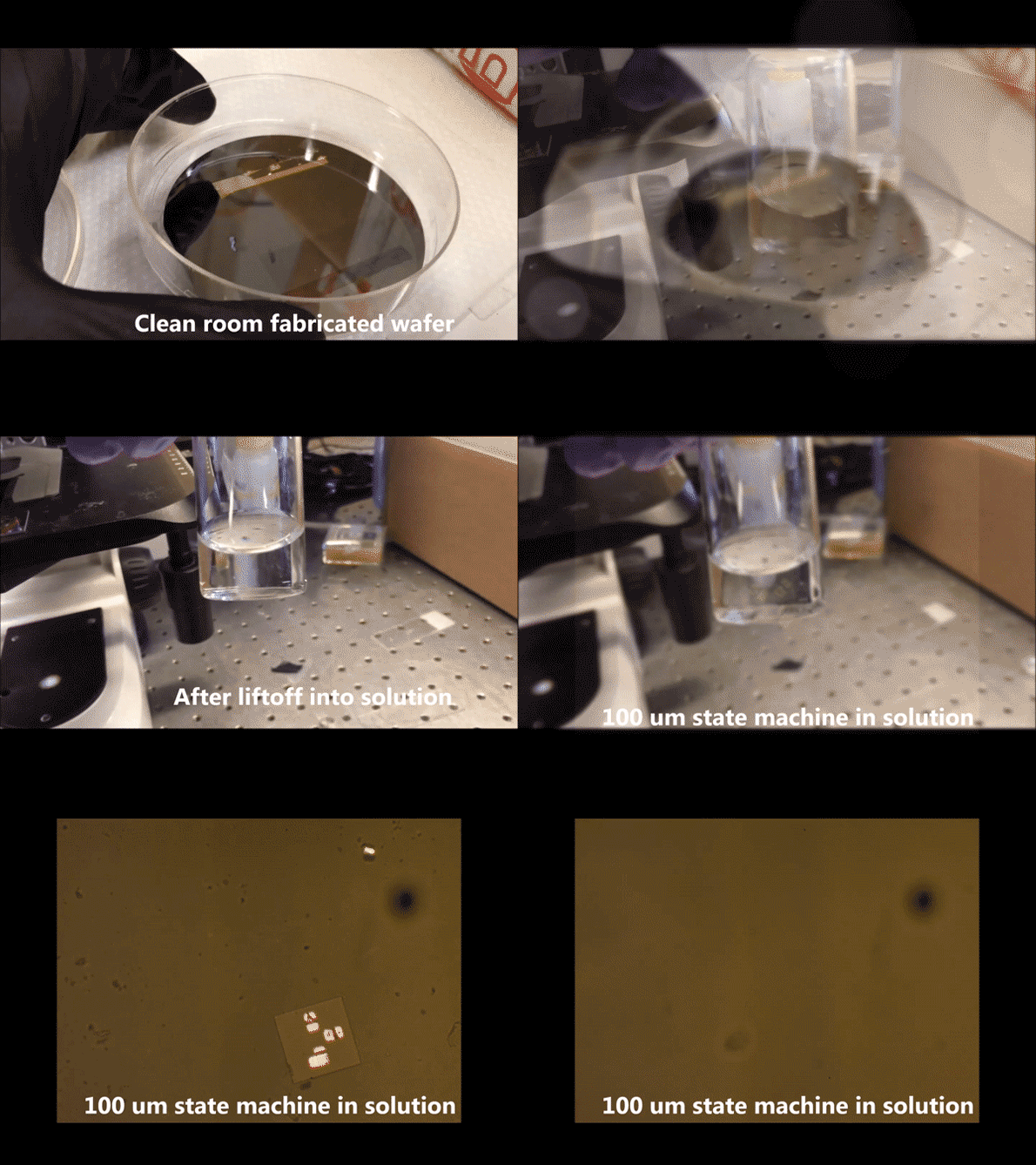
image
The robotic devices can float on the surface and retrieve data about the environment it's in. (Image via MIT)


The device could also be passed through the human digestive tract to diagnose and find any signs of inflammation or any potential diseases in the digestive system. It can even float in the air to measure compounds inside a chemical processor or refinery. Once it has been retrieved, information collected on the sensors can be downloaded and analyzed.


In the future, the team is hoping to add in communications to allow data to be delivered without the need for any physical contact with the device.

Have a story tip? Message me at: cabe(at)element14(dot)com

http://twitter.com/Cabe_Atwell


  • Sign in to reply
  • moinocencio
    moinocencio over 7 years ago

    Interesting. Curious to see how will they give memory to such a small device

    • Cancel
    • Vote Up 0 Vote Down
    • Sign in to reply
    • More
    • Cancel
element14 Community

element14 is the first online community specifically for engineers. Connect with your peers and get expert answers to your questions.

  • Members
  • Learn
  • Technologies
  • Challenges & Projects
  • Products
  • Store
  • About Us
  • Feedback & Support
  • FAQs
  • Terms of Use
  • Privacy Policy
  • Legal and Copyright Notices
  • Sitemap
  • Cookies

An Avnet Company © 2025 Premier Farnell Limited. All Rights Reserved.

Premier Farnell Ltd, registered in England and Wales (no 00876412), registered office: Farnell House, Forge Lane, Leeds LS12 2NE.

ICP 备案号 10220084.

Follow element14

  • X
  • Facebook
  • linkedin
  • YouTube