element14 Community
element14 Community
    Register Log In
  • Site
  • Search
  • Log In Register
  • Community Hub
    Community Hub
    • What's New on element14
    • Feedback and Support
    • Benefits of Membership
    • Personal Blogs
    • Members Area
    • Achievement Levels
  • Learn
    Learn
    • Ask an Expert
    • eBooks
    • element14 presents
    • Learning Center
    • Tech Spotlight
    • STEM Academy
    • Webinars, Training and Events
    • Learning Groups
  • Technologies
    Technologies
    • 3D Printing
    • FPGA
    • Industrial Automation
    • Internet of Things
    • Power & Energy
    • Sensors
    • Technology Groups
  • Challenges & Projects
    Challenges & Projects
    • Design Challenges
    • element14 presents Projects
    • Project14
    • Arduino Projects
    • Raspberry Pi Projects
    • Project Groups
  • Products
    Products
    • Arduino
    • Avnet & Tria Boards Community
    • Dev Tools
    • Manufacturers
    • Multicomp Pro
    • Product Groups
    • Raspberry Pi
    • RoadTests & Reviews
  • About Us
    About the element14 Community
  • Store
    Store
    • Visit Your Store
    • Choose another store...
      • Europe
      •  Austria (German)
      •  Belgium (Dutch, French)
      •  Bulgaria (Bulgarian)
      •  Czech Republic (Czech)
      •  Denmark (Danish)
      •  Estonia (Estonian)
      •  Finland (Finnish)
      •  France (French)
      •  Germany (German)
      •  Hungary (Hungarian)
      •  Ireland
      •  Israel
      •  Italy (Italian)
      •  Latvia (Latvian)
      •  
      •  Lithuania (Lithuanian)
      •  Netherlands (Dutch)
      •  Norway (Norwegian)
      •  Poland (Polish)
      •  Portugal (Portuguese)
      •  Romania (Romanian)
      •  Russia (Russian)
      •  Slovakia (Slovak)
      •  Slovenia (Slovenian)
      •  Spain (Spanish)
      •  Sweden (Swedish)
      •  Switzerland(German, French)
      •  Turkey (Turkish)
      •  United Kingdom
      • Asia Pacific
      •  Australia
      •  China
      •  Hong Kong
      •  India
      •  Japan
      •  Korea (Korean)
      •  Malaysia
      •  New Zealand
      •  Philippines
      •  Singapore
      •  Taiwan
      •  Thailand (Thai)
      •  Vietnam
      • Americas
      •  Brazil (Portuguese)
      •  Canada
      •  Mexico (Spanish)
      •  United States
      Can't find the country/region you're looking for? Visit our export site or find a local distributor.
  • Translate
  • Profile
  • Settings
Industrial Automation
  • Technologies
  • More
Industrial Automation
Blog UMaine 3D-printed a 25-foot, 5,000-pound boat in just three days
  • Blog
  • Forum
  • Documents
  • Quiz
  • Events
  • Polls
  • Files
  • Members
  • Mentions
  • Sub-Groups
  • Tags
  • More
  • Cancel
  • New
Join Industrial Automation to participate - click to join for free!
  • Share
  • More
  • Cancel
Group Actions
  • Group RSS
  • More
  • Cancel
Engagement
  • Author Author: Catwell
  • Date Created: 23 Apr 2021 6:21 PM Date Created
  • Views 813 views
  • Likes 4 likes
  • Comments 0 comments
  • materials
  • manufacturing
  • on_campus
  • 3D Printing
  • cabeatwell
  • university
  • innovation
  • world record
Related
Recommended

UMaine 3D-printed a 25-foot, 5,000-pound boat in just three days

Catwell
Catwell
23 Apr 2021

image

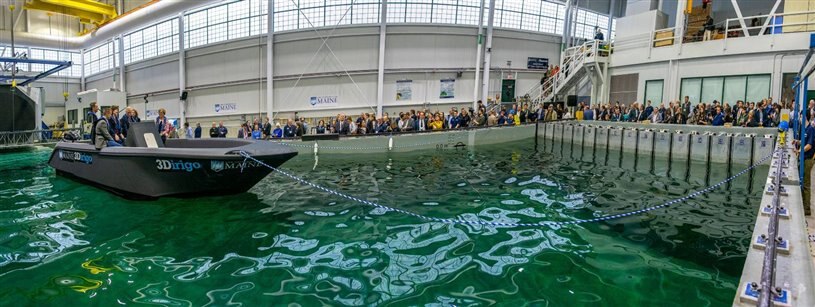
The 3D-printed patrol boat, called 3Dirigo, was tested in the Alfond W2 Ocean Engineering Laboratory.  (Image Credit: University of Maine)


In 2019, the University of Maine developed the largest 25-foot, 5,000-pound 3D-printed boat, called 3Dirigo. The entire process took over three days and was tested in the Alfond W2 Ocean Engineering Laboratory, which contains a highly efficient wind machine over a multidirectional wave basin. The team broke three Guinness World Records for this project: “the world’s largest prototype polymer 3D printer, largest solid 3D-printed object, and largest 3D-printed boat.” The objective was to determine if wood and plastic could be combined for 3D printing.


The 3D printer can fabricate 100 feet long x 22 feet wide x 10 feet high objects and prints at 500 pounds per hour. It also develops biobased feedstocks using cellulose collected from wood. Sustainability can be achieved by incorporating wood instead of metal into large-scale 3D printers. Metal is often used when creating large objects due to its strength and rigidity. Wood provides the same parameters at an affordable cost.


Cellulose nanofibers (CNF) allow conventional 3D-printing polymers to be utilized with wood. The tiny fibers found within CNF can be integrated with thermoplastics, which results in a stronger material. CNF is durable, lightweight, sustainable, environmentally friendly, and has thermal exposure parameters similar to glass.


To showcase the 3D printer’s capabilities, UMaine printed a 25-foot patrol boat containing a hull form built by Navatek. It only took 72 hours to print the 5,000-pound patrol boat. The 3D printer, which has additive and precise subtractive manufacturing capabilities, also allows quick prototyping for defense and civilian applications.


“Biobased feedstocks are recyclable and economical, providing competitive advantages for Maine’s manufacturing industries, including boatbuilding. The UMaine Composites Center received $500,000 from the Maine Technology Institute (MTI) to form a technology cluster to help Maine boatbuilders explore how large-scale 3D printing using economical, wood-filled plastics can provide the industry with a competitive advantage.” UMaine says in the press release. “The cluster brings together the expertise of UMaine researchers and marine industry leaders to further develop and commercialize 3D printing to benefit boatbuilders in the state. By 3D printing plastics with 50% wood, boat molds and parts can be produced much faster and are more economical than today’s traditional methods.”


This is a huge step for other ambitious projects. Now that 3D printing has entered the spotlight, the focus has shifted toward researching and integrating sustainable materials with certain properties to create larger designs. The U.S. Department of energy rewarded UMaine with a $2.8 million funding to build a more environmentally-friendly technique to 3D print wind turbine blade molds with this massive 3D printer.


You don't have permission to edit metadata of this video.
Edit media
x
image
Upload Preview
image


Have a story tip? Message me at: http://twitter.com/Cabe_Atwell

  • Sign in to reply
element14 Community

element14 is the first online community specifically for engineers. Connect with your peers and get expert answers to your questions.

  • Members
  • Learn
  • Technologies
  • Challenges & Projects
  • Products
  • Store
  • About Us
  • Feedback & Support
  • FAQs
  • Terms of Use
  • Privacy Policy
  • Legal and Copyright Notices
  • Sitemap
  • Cookies

An Avnet Company © 2026 Premier Farnell Limited. All Rights Reserved.

Premier Farnell Ltd, registered in England and Wales (no 00876412), registered office: Farnell House, Forge Lane, Leeds LS12 2NE.

ICP 备案号 10220084.

Follow element14

  • X
  • Facebook
  • linkedin
  • YouTube