element14 Community
element14 Community
    Register Log In
  • Site
  • Search
  • Log In Register
  • Community Hub
    Community Hub
    • What's New on element14
    • Feedback and Support
    • Benefits of Membership
    • Personal Blogs
    • Members Area
    • Achievement Levels
  • Learn
    Learn
    • Ask an Expert
    • eBooks
    • element14 presents
    • Learning Center
    • Tech Spotlight
    • STEM Academy
    • Webinars, Training and Events
    • Learning Groups
  • Technologies
    Technologies
    • 3D Printing
    • FPGA
    • Industrial Automation
    • Internet of Things
    • Power & Energy
    • Sensors
    • Technology Groups
  • Challenges & Projects
    Challenges & Projects
    • Design Challenges
    • element14 presents Projects
    • Project14
    • Arduino Projects
    • Raspberry Pi Projects
    • Project Groups
  • Products
    Products
    • Arduino
    • Avnet & Tria Boards Community
    • Dev Tools
    • Manufacturers
    • Multicomp Pro
    • Product Groups
    • Raspberry Pi
    • RoadTests & Reviews
  • About Us
  • Store
    Store
    • Visit Your Store
    • Choose another store...
      • Europe
      •  Austria (German)
      •  Belgium (Dutch, French)
      •  Bulgaria (Bulgarian)
      •  Czech Republic (Czech)
      •  Denmark (Danish)
      •  Estonia (Estonian)
      •  Finland (Finnish)
      •  France (French)
      •  Germany (German)
      •  Hungary (Hungarian)
      •  Ireland
      •  Israel
      •  Italy (Italian)
      •  Latvia (Latvian)
      •  
      •  Lithuania (Lithuanian)
      •  Netherlands (Dutch)
      •  Norway (Norwegian)
      •  Poland (Polish)
      •  Portugal (Portuguese)
      •  Romania (Romanian)
      •  Russia (Russian)
      •  Slovakia (Slovak)
      •  Slovenia (Slovenian)
      •  Spain (Spanish)
      •  Sweden (Swedish)
      •  Switzerland(German, French)
      •  Turkey (Turkish)
      •  United Kingdom
      • Asia Pacific
      •  Australia
      •  China
      •  Hong Kong
      •  India
      • Japan
      •  Korea (Korean)
      •  Malaysia
      •  New Zealand
      •  Philippines
      •  Singapore
      •  Taiwan
      •  Thailand (Thai)
      • Vietnam
      • Americas
      •  Brazil (Portuguese)
      •  Canada
      •  Mexico (Spanish)
      •  United States
      Can't find the country/region you're looking for? Visit our export site or find a local distributor.
  • Translate
  • Profile
  • Settings
Industrial Automation
  • Technologies
  • More
Industrial Automation
Blog UMN researchers develop mind-controlling prosthetic technology
  • Blog
  • Forum
  • Documents
  • Quiz
  • Events
  • Polls
  • Files
  • Members
  • Mentions
  • Sub-Groups
  • Tags
  • More
  • Cancel
  • New
Join Industrial Automation to participate - click to join for free!
  • Share
  • More
  • Cancel
Group Actions
  • Group RSS
  • More
  • Cancel
Engagement
  • Author Author: Catwell
  • Date Created: 2 Jun 2022 6:04 PM Date Created
  • Views 1884 views
  • Likes 5 likes
  • Comments 0 comments
  • on_campus
  • cabeatwell
  • university
  • technology_for_the_disabled
  • prosthetics
Related
Recommended

UMN researchers develop mind-controlling prosthetic technology

Catwell
Catwell
2 Jun 2022

image

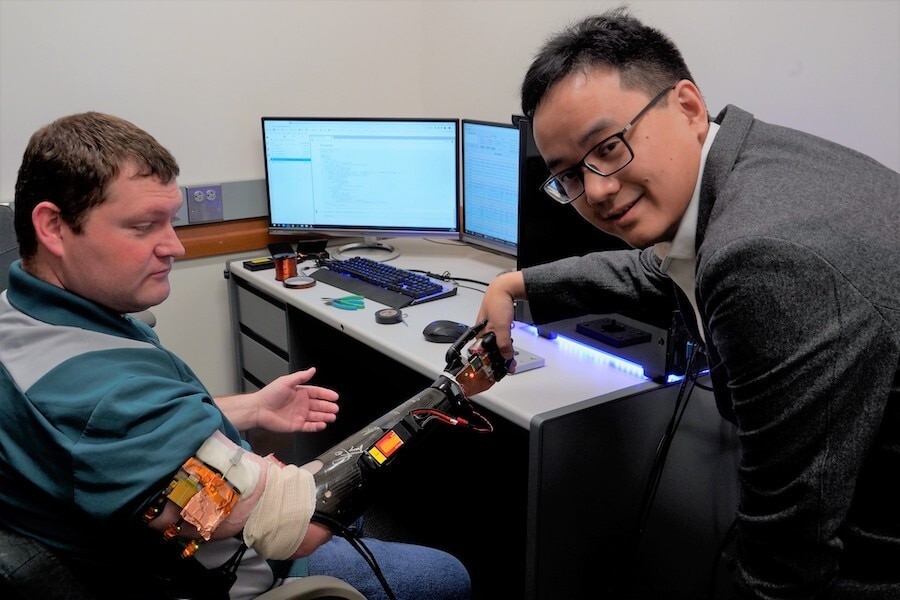
Amputees can use the new technology to control a robotic arm with their minds. (Image Credit: Neuroelectronics Lab, University of Minnesota)

Amputees around the world often face some obstacles when it comes to prosthetics controlled by muscles. Even then, high-quality parts are bulky, have a complicated design, and take patients months of training just to properly move the arm around. University of Minnesota researchers are introducing new technology that allows an amputee to use a mind-controlled prosthetic robotic arm, helping to overcome the issues they currently face.

The team developed a neuroprosthetic hand featuring a small implant that attaches to the peripheral nerve on the arm. They deployed the robotic hand with machine learning and artificial intelligence, allowing it to read and interpret brain signals so that the wearer can control the device with their thoughts.   

“It’s a lot more intuitive than any commercial system out there,” said Jules Anh Tuan Nguyen, a postdoctoral researcher and University of Minnesota College of Science and Engineering alumnus. “With other commercial prosthetic systems, when amputees want to move a finger, they don’t actually think about moving a finger. They’re trying to activate the muscles in their arm since that’s what the system reads. Our technology knows the patient’s intention. If they want to move a finger, all they have to do is think about moving that finger.”

Compared to other technologies, this system uses AI to interpret signals from the nerve, allowing the implant to operate as a neural decoder. So when the wearer thinks about moving their hand, the decoder detects these brain signals, causing the robotic arm to move in that manner. 

This system also differs from Benjamin Choi’s homemade prosthetic, which relies on two sensors to measure brain electrical activity. The data is transmitted to the arm, which also uses AI to move. His AI, integrated on a chip, can perform with 95% accuracy and contains 978 math pages, 23,000 lines of code, and seven new sub-algorithms. 

“Artificial intelligence has the tremendous capability to help explain a lot of relationships,” said Zhi Yang, an associate professor of biomedical engineering at the University of Minnesota. “This technology allows us to record human data, nerve data, accurately. With that kind of nerve data, the AI system can fill in the gaps and determine what’s going on. That’s a really big thing, to be able to combine this new chip technology with AI. It can help answer a lot of questions we couldn’t answer before.”

The team also says the technology can be used by those dealing with neurological disorders and chronic pain. Yang envisions a future without invasive brain surgeries and where peripheral nerves can supply the brain signals. However, the system currently relies on a wired connection between the skin and the external AI interface. Remotely connecting the chip to a computer would make it possible for humans to control a car or phone with their thoughts.

“Some of these things are actually happening. A lot of research is moving from what’s in the so-called ‘fantasy’ category into the scientific category,” Yang said. “This technology was designed for amputees for sure, but if you talk about its true potential, this could be applicable to all of us.”

You don't have permission to edit metadata of this video.
Edit media
x
image
Upload Preview
image

Have a story tip? Message me at: http://twitter.com/Cabe_Atwell

  • Sign in to reply
element14 Community

element14 is the first online community specifically for engineers. Connect with your peers and get expert answers to your questions.

  • Members
  • Learn
  • Technologies
  • Challenges & Projects
  • Products
  • Store
  • About Us
  • Feedback & Support
  • FAQs
  • Terms of Use
  • Privacy Policy
  • Legal and Copyright Notices
  • Sitemap
  • Cookies

An Avnet Company © 2025 Premier Farnell Limited. All Rights Reserved.

Premier Farnell Ltd, registered in England and Wales (no 00876412), registered office: Farnell House, Forge Lane, Leeds LS12 2NE.

ICP 备案号 10220084.

Follow element14

  • X
  • Facebook
  • linkedin
  • YouTube