


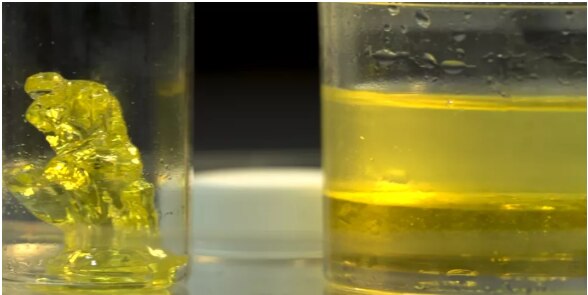
The new 3D printing technique uses gelatinous resin to create models. (Image Credit: UC Berkeley)
Researchers from the University of California at Berkeley have revealed the Replicator. A 3D printer that uses light from a digital video projector to build a solid object using a gelatinous solution. The name is inspired by the Star Trek series - more specifically after a device that produces objects out of nowhere. The technology isn't that advanced, but it is a step in the right direction towards 3D printing techniques.
The replicator works like a Computed Tomography scan (CT) but in reverse. In CT machines an X-ray tube moves around the patient while taking images of their internal organs. A computer then uses the projections to create a 3D image. The Replicator starts things off with a number of 3D-computed models which is then uploaded to a computer to help researchers design a 2D image of it from every angle. The images are then inserted into a slide projector that beams out light patterns aimed at a gelatinous resin in a jar. The resin is made of light-sensitive molecules and dissolved oxygen that is slowly spun around as light gets beamed at it.
When the light touches the liquid, the oxygen drains, allowing the molecules in the resin to form cross-links. Those cross-links are what is needed to turn liquid into a solid. It takes about two minutes for an object be created at only a few centimeters across.
The majority of 3D printers do things slightly differently. They use a layering process with the model being constructed from the ground up by creating an object in thin slices. The team has crafted numerous different objects using the new 3D printer. Models like a replica of Rodin's Thinker statue, a smooth and very flexible doughnut and a model of the lower jaw were created. The 3D printer is restricted to only creating objects within a diameter of 4 inches, and the good news is the leftover material can be used again on a different model, so it doesn't go to waste.
The printer also allows researchers to construct 3D objects around an existing structure. The team placed a screwdriver shaft inside the resin and used the printer to create a handle. Researchers believe they can improve this device for future use, allowing it to create medical components.
Have a story tip? Message me at: cabe(at)element14(dot)com
