element14 Community
element14 Community
    Register Log In
  • Site
  • Search
  • Log In Register
  • Community Hub
    Community Hub
    • What's New on element14
    • Feedback and Support
    • Benefits of Membership
    • Personal Blogs
    • Members Area
    • Achievement Levels
  • Learn
    Learn
    • Ask an Expert
    • eBooks
    • element14 presents
    • Learning Center
    • Tech Spotlight
    • STEM Academy
    • Webinars, Training and Events
    • Learning Groups
  • Technologies
    Technologies
    • 3D Printing
    • FPGA
    • Industrial Automation
    • Internet of Things
    • Power & Energy
    • Sensors
    • Technology Groups
  • Challenges & Projects
    Challenges & Projects
    • Design Challenges
    • element14 presents Projects
    • Project14
    • Arduino Projects
    • Raspberry Pi Projects
    • Project Groups
  • Products
    Products
    • Arduino
    • Avnet & Tria Boards Community
    • Dev Tools
    • Manufacturers
    • Multicomp Pro
    • Product Groups
    • Raspberry Pi
    • RoadTests & Reviews
  • About Us
  • Store
    Store
    • Visit Your Store
    • Choose another store...
      • Europe
      •  Austria (German)
      •  Belgium (Dutch, French)
      •  Bulgaria (Bulgarian)
      •  Czech Republic (Czech)
      •  Denmark (Danish)
      •  Estonia (Estonian)
      •  Finland (Finnish)
      •  France (French)
      •  Germany (German)
      •  Hungary (Hungarian)
      •  Ireland
      •  Israel
      •  Italy (Italian)
      •  Latvia (Latvian)
      •  
      •  Lithuania (Lithuanian)
      •  Netherlands (Dutch)
      •  Norway (Norwegian)
      •  Poland (Polish)
      •  Portugal (Portuguese)
      •  Romania (Romanian)
      •  Russia (Russian)
      •  Slovakia (Slovak)
      •  Slovenia (Slovenian)
      •  Spain (Spanish)
      •  Sweden (Swedish)
      •  Switzerland(German, French)
      •  Turkey (Turkish)
      •  United Kingdom
      • Asia Pacific
      •  Australia
      •  China
      •  Hong Kong
      •  India
      • Japan
      •  Korea (Korean)
      •  Malaysia
      •  New Zealand
      •  Philippines
      •  Singapore
      •  Taiwan
      •  Thailand (Thai)
      • Vietnam
      • Americas
      •  Brazil (Portuguese)
      •  Canada
      •  Mexico (Spanish)
      •  United States
      Can't find the country/region you're looking for? Visit our export site or find a local distributor.
  • Translate
  • Profile
  • Settings
Industrial Automation
  • Technologies
  • More
Industrial Automation
Blog US Marines currently testing disposable drones for supply drops
  • Blog
  • Forum
  • Documents
  • Quiz
  • Events
  • Polls
  • Files
  • Members
  • Mentions
  • Sub-Groups
  • Tags
  • More
  • Cancel
  • New
Join Industrial Automation to participate - click to join for free!
  • Share
  • More
  • Cancel
Group Actions
  • Group RSS
  • More
  • Cancel
Engagement
  • Author Author: Catwell
  • Date Created: 10 Apr 2019 1:34 AM Date Created
  • Views 979 views
  • Likes 3 likes
  • Comments 2 comments
  • transportation
  • military
  • cargo
  • drone
  • diy
  • cabeatwell
  • aerospace
  • glider
Related
Recommended

US Marines currently testing disposable drones for supply drops

Catwell
Catwell
10 Apr 2019

image

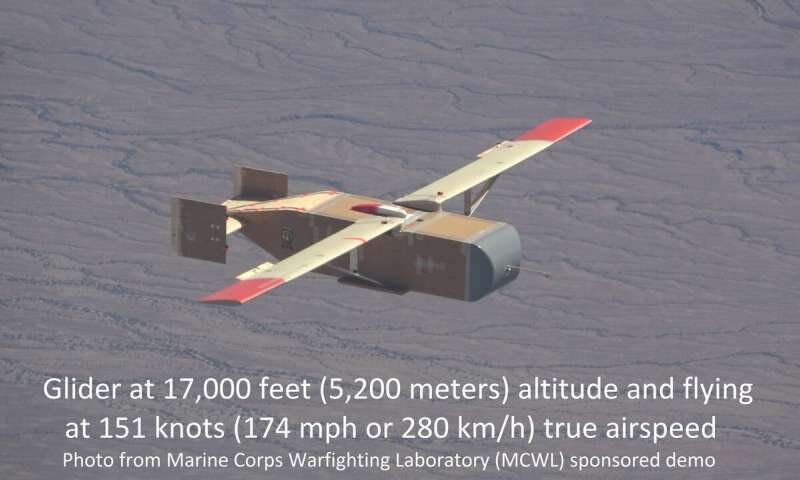
The disposable drones are made from cheap plywood and have enough space to carry over 700 kg. These gliders are essentially wooden boxes with electronics inside. (Image credit: Logistic Gliders)


I am hoping they release the designs for this. Seems like a fun DIY project. Definitely looks like one.


Most people still aren’t comfortable with the idea of delivery drones, but they could make a great impact on delivering supplies for the military. The US military is currently testing delivery drones that can carry supplies over long distances and then be tossed out after each use. Called the Tactical Air Delivery or TACAD, these drones made of cheap plywood are by Logistics Gliders, Inc. Recently, the gliders successfully completed a series of tests with US Marines.


The company is working on two different gliders: The LG-1K, which can carry roughly 300 kg, and the bigger LG-2K, which can carry over 700kg and is currently being tested by the US Marines. According to the company, each glider is basically a wooden box. It has some electronics and some servos that make up the autopilot and gas springs that help the wings deploy, but that’s it. Most of the vehicle is weather-resistant plywood that only uses about 400 parts, including all the screws. Since it’s not meant to be reused, the glider can be made for a small amount of money.


While the gliders can fly autonomously or via radio control, they have to be launched from a larger aircraft. Depending on how much space is available, the glider will either belly land or deploy a parachute for a nose landing. And since they fly at low altitudes and don’t need an airfield like landing zone, it gives them more flexibility. The unmanned aircraft is also ideal for flying into urban environments, small clearings, and through forest or jungle canopies.


“Gliders dropped from a cargo aircraft could greatly outdistance any ground-based unmanned aerial vehicle (UAV) designed for cargo logistics since the actual cargo delivery distance is the sum of the carrier aircraft's range plus the glider's range," wrote principal investigator Sarigul-Klijn in an email. "A carrier aircraft such as the C-17 can easily fly 2,000 nautical miles and back. Although most airdrop systems including parachutes are reused during training, all airdrop systems are expended during combat missions because it is almost impossible to retrieve them.”


Logistics Gliders will continue running tests with the Marines. If proven to be successful, it could be a more affordable way for the military to deliver supplies across various sites. And though the larger glider is currently being tested, the smaller version still has enough room to deliver a days’ worth of supplies to a small unit of Marines. And since multiple gliders can be launched from a single aircraft, it makes it possible to resupply units in different locations or send a lot of supplies to one location.


You don't have permission to edit metadata of this video.
Edit media
x
image
Upload Preview
image


Have a story tip? Message me at: cabe(at)element14(dot)com

http://twitter.com/Cabe_Atwell

  • Sign in to reply
Parents
  • ralphjy
    ralphjy over 6 years ago

    Pretty cool stuff.  Not sure about DIY though.  Something that carries 300kg and made of plywood must be pretty heavy.  I guess there's lots of possibilities for a scale model made of balsa wood or other lightweight material.  Maybe deployed from a powered drone or balloon.

    • Cancel
    • Vote Up 0 Vote Down
    • Sign in to reply
    • More
    • Cancel
Comment
  • ralphjy
    ralphjy over 6 years ago

    Pretty cool stuff.  Not sure about DIY though.  Something that carries 300kg and made of plywood must be pretty heavy.  I guess there's lots of possibilities for a scale model made of balsa wood or other lightweight material.  Maybe deployed from a powered drone or balloon.

    • Cancel
    • Vote Up 0 Vote Down
    • Sign in to reply
    • More
    • Cancel
Children
No Data
element14 Community

element14 is the first online community specifically for engineers. Connect with your peers and get expert answers to your questions.

  • Members
  • Learn
  • Technologies
  • Challenges & Projects
  • Products
  • Store
  • About Us
  • Feedback & Support
  • FAQs
  • Terms of Use
  • Privacy Policy
  • Legal and Copyright Notices
  • Sitemap
  • Cookies

An Avnet Company © 2025 Premier Farnell Limited. All Rights Reserved.

Premier Farnell Ltd, registered in England and Wales (no 00876412), registered office: Farnell House, Forge Lane, Leeds LS12 2NE.

ICP 备案号 10220084.

Follow element14

  • X
  • Facebook
  • linkedin
  • YouTube