


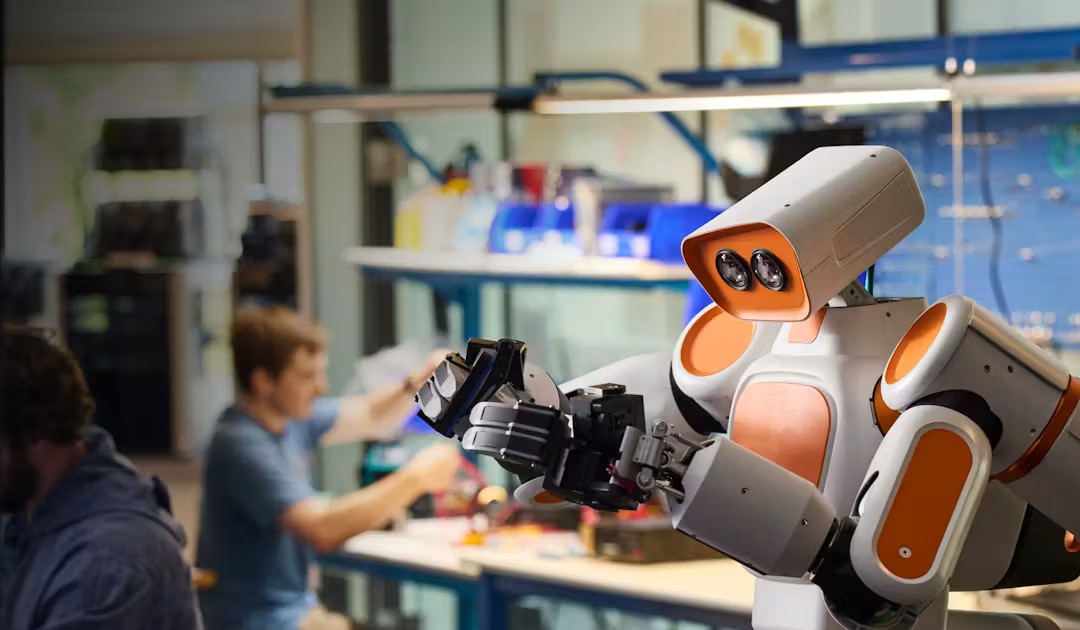
Walden’s general-purpose robot. (Image Credit: Walden Robotics)
I didn't even know they existed, but they are worth so much. Massachusetts-based startup Walden Robotics, founded from Toyota’s robotics research lab, recently emerged from stealth after securing $300 million in seed funding, giving it a $1.1 billion valuation. This investment round was led by Toyota Corp and Deviation Capital. Other companies like Boeing, NVIDIA, Samsung Ventures, AE Ventures, and CoreWeave Ventures also contributed.
“Core advances in Physical AI have made disruptive change possible,” said Dr. Russ Tedrake, co-founder and CEO of Walden, a professor at MIT, and former Senior Vice President of Large Behavior Models at Toyota Research Institute. “But providing real value to customers and building a robust and scalable business requires a deep understanding and respect for how manufacturing is done today. The best way to make fast and positive progress is by working closely together with the real experts.”
Walden Robotics has been developing wheeled humanoid robots for logistics and manufacturing industries. Instead of a bipedal design, the machines have a wheeled base with an upper body to perform complex tasks that human workers handle. According to Walden Robotics, the machines use Large Behavior Models and other foundation-model techniques to learn new manipulation tasks in manufacturing environments.
Funding sizes like these are unusual at the seed stage. A $1.1 billion valuation reflects the costs for building and manufacturing robots at scale and investors who see long-term potential in the technology. Toyota is involved in more than just the funding. The automaker is also testing the robots in production settings. NVIDIA focuses on AI hardware and computing power in advanced robotics. Boeing, Samsung Ventures, and CoreWeave want to expand the technology beyond auto manufacturing.
These funds will be used by Walden to boost robot production and introduce its new system to other industries. It wants to deploy them in aerospace, semiconductors, electronics, automotive, logistics, and life sciences. Automation is seeing more demand in these sectors due to labor shortages and domestic manufacturing expansions. The startup must scale manufacturing to move the technology from a factory to various industries. At the same time, it will need to make sure the robots can handle different workplace demands.
The funding’s arrival comes when the Boston area is paying more attention to robotics companies. With the $300 million raise, investors have shown more interest in industrial automation’s future. Hardware cost reduction, AI improvements, and labor shortages have made robot deployment more convenient in factories. However, companies will need to show that these robots are capable of various tasks other than manufacturing.
Have a story tip? Message me here at element14.