element14 Community
element14 Community
    Register Log In
  • Site
  • Search
  • Log In Register
  • Community Hub
    Community Hub
    • What's New on element14
    • Feedback and Support
    • Benefits of Membership
    • Personal Blogs
    • Members Area
    • Achievement Levels
  • Learn
    Learn
    • Ask an Expert
    • eBooks
    • element14 presents
    • Learning Center
    • Tech Spotlight
    • STEM Academy
    • Webinars, Training and Events
    • Learning Groups
  • Technologies
    Technologies
    • 3D Printing
    • FPGA
    • Industrial Automation
    • Internet of Things
    • Power & Energy
    • Sensors
    • Technology Groups
  • Challenges & Projects
    Challenges & Projects
    • Design Challenges
    • element14 presents Projects
    • Project14
    • Arduino Projects
    • Raspberry Pi Projects
    • Project Groups
  • Products
    Products
    • Arduino
    • Avnet & Tria Boards Community
    • Dev Tools
    • Manufacturers
    • Multicomp Pro
    • Product Groups
    • Raspberry Pi
    • RoadTests & Reviews
  • About Us
  • Store
    Store
    • Visit Your Store
    • Choose another store...
      • Europe
      •  Austria (German)
      •  Belgium (Dutch, French)
      •  Bulgaria (Bulgarian)
      •  Czech Republic (Czech)
      •  Denmark (Danish)
      •  Estonia (Estonian)
      •  Finland (Finnish)
      •  France (French)
      •  Germany (German)
      •  Hungary (Hungarian)
      •  Ireland
      •  Israel
      •  Italy (Italian)
      •  Latvia (Latvian)
      •  
      •  Lithuania (Lithuanian)
      •  Netherlands (Dutch)
      •  Norway (Norwegian)
      •  Poland (Polish)
      •  Portugal (Portuguese)
      •  Romania (Romanian)
      •  Russia (Russian)
      •  Slovakia (Slovak)
      •  Slovenia (Slovenian)
      •  Spain (Spanish)
      •  Sweden (Swedish)
      •  Switzerland(German, French)
      •  Turkey (Turkish)
      •  United Kingdom
      • Asia Pacific
      •  Australia
      •  China
      •  Hong Kong
      •  India
      •  Korea (Korean)
      •  Malaysia
      •  New Zealand
      •  Philippines
      •  Singapore
      •  Taiwan
      •  Thailand (Thai)
      • Americas
      •  Brazil (Portuguese)
      •  Canada
      •  Mexico (Spanish)
      •  United States
      Can't find the country/region you're looking for? Visit our export site or find a local distributor.
  • Translate
  • Profile
  • Settings
Industrial Automation
  • Technologies
  • More
Industrial Automation
Blog World’s tiniest robot, RoBeetle, runs on methanol
  • Blog
  • Forum
  • Documents
  • Quiz
  • Events
  • Polls
  • Files
  • Members
  • Mentions
  • Sub-Groups
  • Tags
  • More
  • Cancel
  • New
Join Industrial Automation to participate - click to join for free!
  • Share
  • More
  • Cancel
Group Actions
  • Group RSS
  • More
  • Cancel
Engagement
  • Author Author: Catwell
  • Date Created: 25 Aug 2020 6:40 PM Date Created
  • Views 1175 views
  • Likes 3 likes
  • Comments 0 comments
  • robotics
  • robot
  • on_campus
  • motion control
  • cabeatwell
  • university
  • power
  • biofuel
Related
Recommended

World’s tiniest robot, RoBeetle, runs on methanol

Catwell
Catwell
25 Aug 2020

image

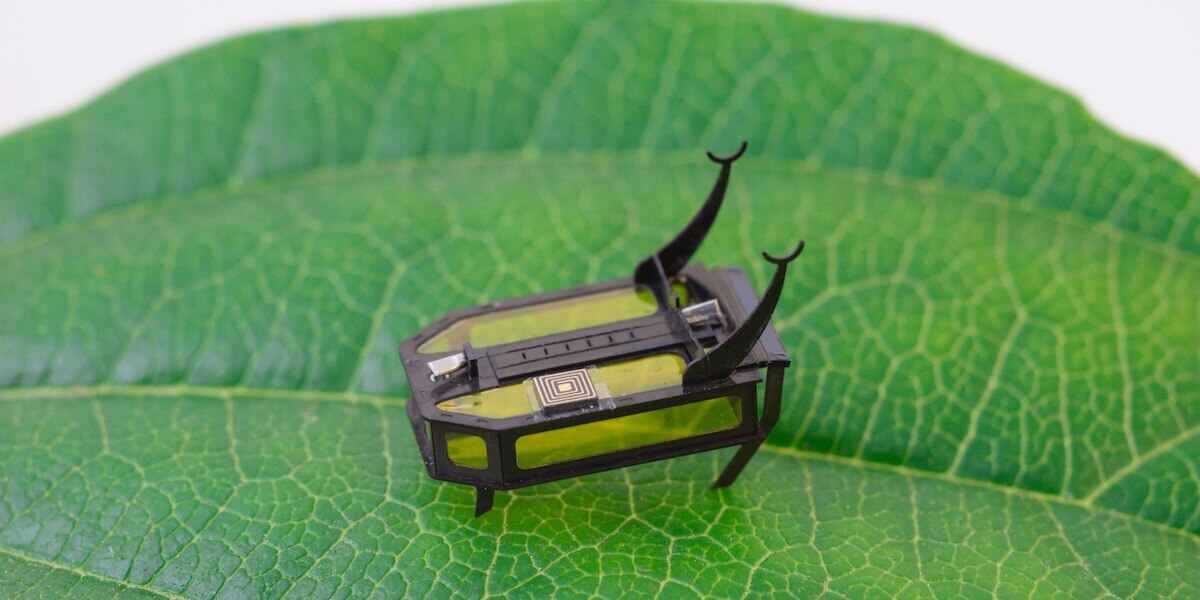
RoBeetle is the world’s lightest and smallest microbot that can run on alcohol to move forward. (Image Credit: University of Southern California)


Batteries usually power robots, but this can be problematic since they tend to have poor energy density. It can also be a bigger issue for small-scale robots. Researchers at the University of Southern California have developed RoBeetle, an 88-milligram robot that runs on methanol. It also uses a new type of actuator that acts as an artificial muscle, converting methanol vapor into forward motion.  


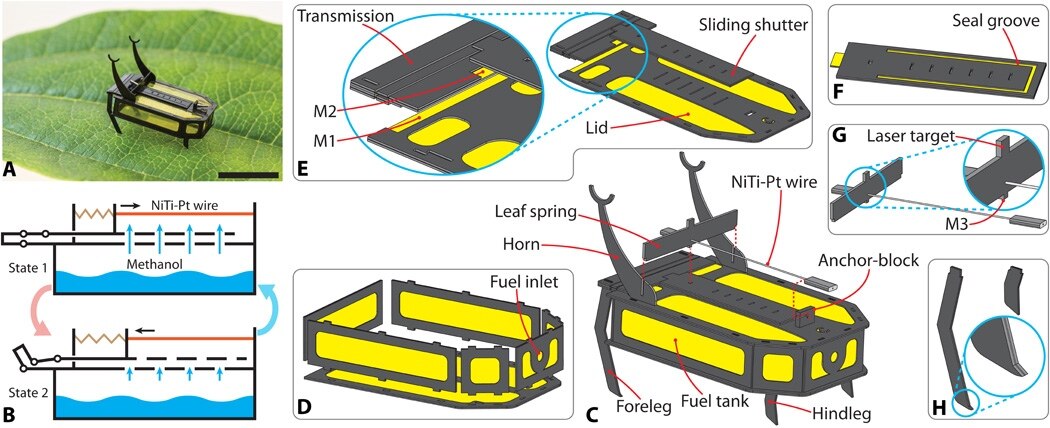
The RoBeetle contains a box-like fuel tank that can be filled with methanol by jabbing a syringe through a fuel inlet hole. It also has two joint active front legs and two fixed hind legs connected to a transmission that moves them simultaneously in a rocking forward motion. This is then followed by a backward and down motion. The transmission is attached to a leaf spring that pulls the legs backward through tension. This allows the spring and transmission to keep the front legs vertical when the robot isn’t being actuated, which enables it to stand. The horns, which have hooks to carry objects, hold the leaf spring in place.
 

image
The illustration shows the design of RoboBeetle. (Image Credit: Science Robotics)


The actuator is a nickel-titanium shape-memory alloy wire coated in a platinum powder that causes the methanol vapor to burn more quickly. This generates heat, causing the wire in the robot’s legs to contract, and when it cools down, the wire extends. As a result, it causes the microbot to move.

One end of the SMA wire is connected to the middle of the leaf spring, and the other end runs above the robot’s back. The SMA wire is short enough for the leaf spring to pull back, which jolts the legs forward and up. The final component of the robot is the sliding vent. It’s attached to the transmission, allowing the vent to open when the SMA wire is cold, and the leaf spring gets pulled back.  It closes when the SMA wire warms up, and the leaf spring is relaxed


The actuation cycle that causes the robot to walk starts with a full fuel tank and a cold SMA wire. Tension on the leaf spring causes the transmission to pull back, which results in the legs rocking forward and upward. Additionally, the transmission pulls the sliding vent open, and from there, methanol vapor escapes from the fuel tank and into the air. Afterward, it floats past the SMA wire that runs above the vent. 


Environmental factors such as a gentle breeze can improve the robot’s speed. This is due to the quicker cool-down effect from the air moving above the SMA wire. It also blows away residual methane surrounding the vents, which helps to stop the reaction. RoBeetle can haul objects up to 2.6 times its own weight, and it can carry 95 milligrams of fuel, which takes 155 minutes for it to completely evaporate from the tank. It can also climb slopes and navigate on surfaces with different textures such as a concrete sidewalk, glass, and a foam sleeping pad.


However, RoBeetle has some limitations. It can’t steer or move backward, and its speed can’t be adjusted. Not only that, but it only stops walking if it either breaks or runs out of fuel. The team notes that increasing the speed of fuel delivery by using propane or butane could enhance the actuator output frequency. Additionally, the SMAs frequency, amplitude, and efficiency can be significantly increased by “arranging multiple fiber-like thin artificial muscles in hierarchical configurations similar to those observed in sarcomere-based animal muscle.”


You don't have permission to edit metadata of this video.
Edit media
x
image
Upload Preview
image


Have a story tip? Message me at: cabe(at)element14(dot)com

http://twitter.com/Cabe_Atwell

  • Sign in to reply
element14 Community

element14 is the first online community specifically for engineers. Connect with your peers and get expert answers to your questions.

  • Members
  • Learn
  • Technologies
  • Challenges & Projects
  • Products
  • Store
  • About Us
  • Feedback & Support
  • FAQs
  • Terms of Use
  • Privacy Policy
  • Legal and Copyright Notices
  • Sitemap
  • Cookies

An Avnet Company © 2025 Premier Farnell Limited. All Rights Reserved.

Premier Farnell Ltd, registered in England and Wales (no 00876412), registered office: Farnell House, Forge Lane, Leeds LS12 2NE.

ICP 备案号 10220084.

Follow element14

  • X
  • Facebook
  • linkedin
  • YouTube