element14 Community
element14 Community
    Register Log In
  • Site
  • Search
  • Log In Register
  • Community Hub
    Community Hub
    • What's New on element14
    • Feedback and Support
    • Benefits of Membership
    • Personal Blogs
    • Members Area
    • Achievement Levels
  • Learn
    Learn
    • Ask an Expert
    • eBooks
    • element14 presents
    • Learning Center
    • Tech Spotlight
    • STEM Academy
    • Webinars, Training and Events
    • Learning Groups
  • Technologies
    Technologies
    • 3D Printing
    • FPGA
    • Industrial Automation
    • Internet of Things
    • Power & Energy
    • Sensors
    • Technology Groups
  • Challenges & Projects
    Challenges & Projects
    • Design Challenges
    • element14 presents Projects
    • Project14
    • Arduino Projects
    • Raspberry Pi Projects
    • Project Groups
  • Products
    Products
    • Arduino
    • Avnet & Tria Boards Community
    • Dev Tools
    • Manufacturers
    • Multicomp Pro
    • Product Groups
    • Raspberry Pi
    • RoadTests & Reviews
  • About Us
    About the element14 Community
  • Store
    Store
    • Visit Your Store
    • Choose another store...
      • Europe
      •  Austria (German)
      •  Belgium (Dutch, French)
      •  Bulgaria (Bulgarian)
      •  Czech Republic (Czech)
      •  Denmark (Danish)
      •  Estonia (Estonian)
      •  Finland (Finnish)
      •  France (French)
      •  Germany (German)
      •  Hungary (Hungarian)
      •  Ireland
      •  Israel
      •  Italy (Italian)
      •  Latvia (Latvian)
      •  
      •  Lithuania (Lithuanian)
      •  Netherlands (Dutch)
      •  Norway (Norwegian)
      •  Poland (Polish)
      •  Portugal (Portuguese)
      •  Romania (Romanian)
      •  Russia (Russian)
      •  Slovakia (Slovak)
      •  Slovenia (Slovenian)
      •  Spain (Spanish)
      •  Sweden (Swedish)
      •  Switzerland(German, French)
      •  Turkey (Turkish)
      •  United Kingdom
      • Asia Pacific
      •  Australia
      •  China
      •  Hong Kong
      •  India
      •  Japan
      •  Korea (Korean)
      •  Malaysia
      •  New Zealand
      •  Philippines
      •  Singapore
      •  Taiwan
      •  Thailand (Thai)
      •  Vietnam
      • Americas
      •  Brazil (Portuguese)
      •  Canada
      •  Mexico (Spanish)
      •  United States
      Can't find the country/region you're looking for? Visit our export site or find a local distributor.
  • Translate
  • Profile
  • Settings
Internet of Things
  • Technologies
  • More
Internet of Things
Blog Old meets new, the 1-Wire Weather Station on the SPARK Core. (part 6)
  • Blog
  • Forum
  • Documents
  • Quiz
  • Events
  • Polls
  • Members
  • Mentions
  • Sub-Groups
  • Tags
  • More
  • Cancel
  • New
Join Internet of Things to participate - click to join for free!
  • Share
  • More
  • Cancel
Group Actions
  • Group RSS
  • More
  • Cancel
Engagement
  • Author Author: gpolder
  • Date Created: 6 Feb 2015 9:05 PM Date Created
  • Views 2318 views
  • Likes 1 like
  • Comments 10 comments
  • battery_charger
  • internet_of_things
  • solar_power
  • weather_stations
  • iot
  • usb_chargers
  • usb_powered
  • solar
Related
Recommended

Old meets new, the 1-Wire Weather Station on the SPARK Core. (part 6)

gpolder
gpolder
6 Feb 2015

Now we have a running 1-Wire Weather Station on the SPARK Core, as described in Old meets new, the 1-Wire Weather Station on the SPARK Core. (part 5), we now come to the next step, as the station needs to be powered outside. We need to put the weather station somewhere in the backyard, where no external power is available. Commercial wireless weather stations mainly use a low power 433 or 868 link which transmits weather data once per minute or less and runs for months, if not years on a pair of AA batteries. Compared to this the power need of the SPARK Core is huge. Therefore I decided to use a solar panel for powering.

A small panel of 5 Watt should be enough. Some electronics between the bare solar panel and the SPARK Core are needed since the Core needs to be powered with 5V DC. Also a battery and a charger circuit is needed for operating when no sunlight is available.


Parts list:

  1. Solar panel 5W
  2. SPARK Battery Shield (mustache board)
  3. Richtek EVB_RT7275GQW Evaluation Board, modified for 5V.


Solar Panel

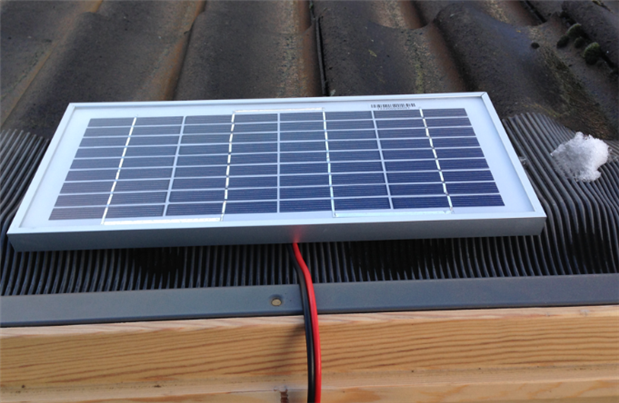
The solar panel I planned to use for this project is a small 5W panel with a Voc of 21V and Vpm of 17V.
image


SPARK Battery Shield (mustache board)

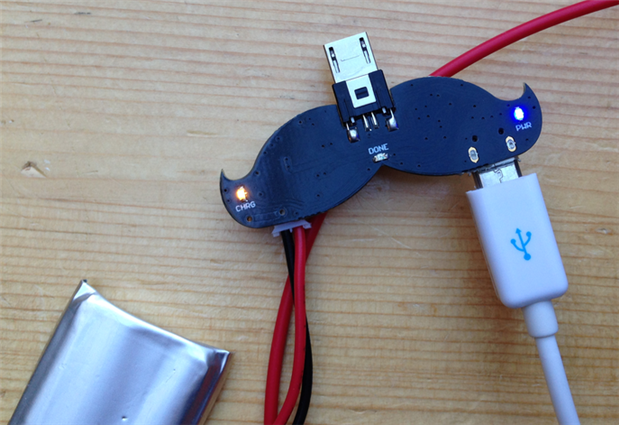
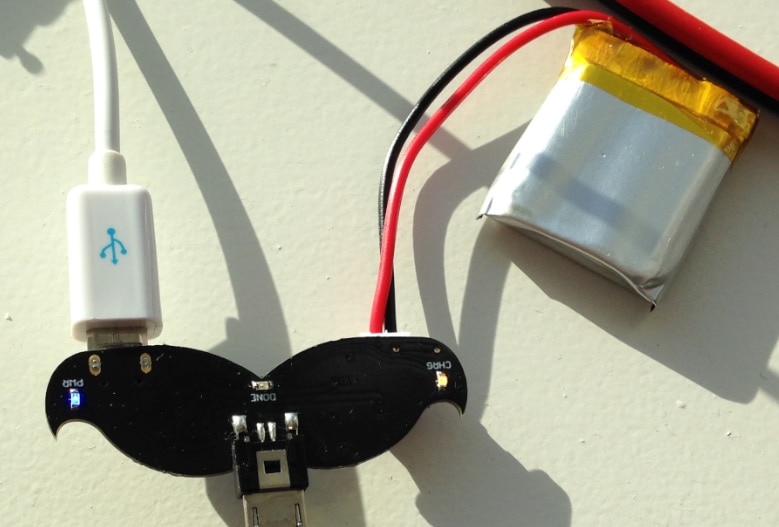
For powering the SPARK Core the SPARK Battery Shield (Spark Docs | Shields and kits)  is used. The battery shield is a LiPo battery charger and voltage regulator combined into one pcb with a weird form factor. You can use it to power your Core with any 3.7V LiPo battery and charge it at the same time via the USB port. The shield is built around Microchip's MCP73871 battery charge management controller and TI's TPS61200 boost converter for up converting 3.7V to 5.0V. The battery shield comes with a small 3.7V 450mAH battery.
image

Input for this board is 5V mini usb, designed for connecting to a 5V power outlet. This will not work with the voltage provided with the solar panel, so a second circuit is needed to convert the varying voltage output of the solar panel to a steady 5V. A traditional 7805 voltage regulator should work, but then to much power will be lost into heat. Luckily I recently did a review of the Richtek EVB_RT7275GQW Evaluation Board , which  is perfectly suitable to do the job.


Richtek EVB_RT7275GQW Evaluation Board

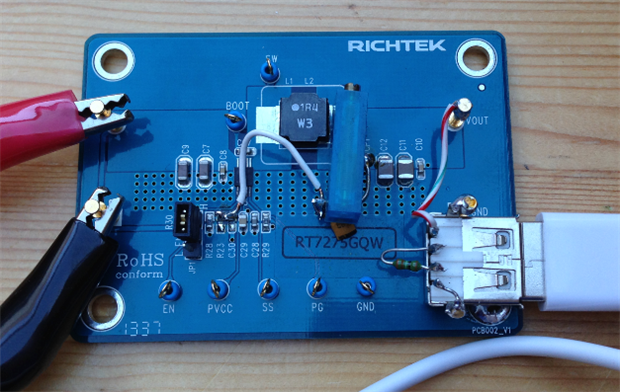
Originally the evaluation board is designed for 1.05V output. In my review (Richtek EVB_RT7275GQW Evaluation Board), you can find a description of the modification to 5V output by replacing one of the resistors by a potentiometer, as can be seen in the picture below. An USB connector was added to connect to the battery shield. A 100Ω resistor connects D+ and D-.  This is according to the USB battery charging specification, which requires a resistance of less than 200Ω between the data pins to indicate the USB port can be used for charging.
image


First tests

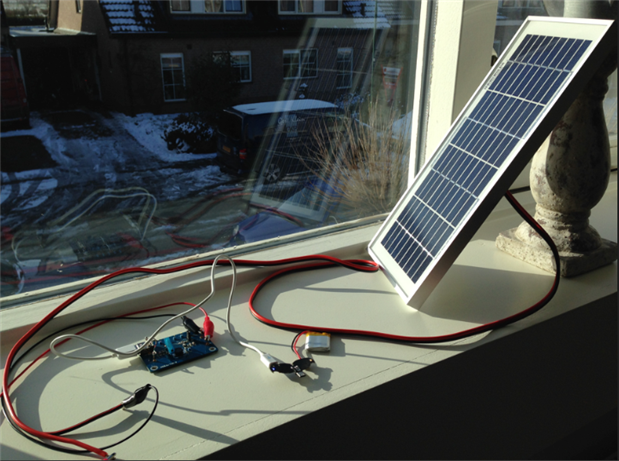
After these modifications All components were connected and the solar panel was placed in the window for some initial testing.
image

image

As can be seen in the picture above, the power and charge leds lights up, indicating that everything works as expected. The same is the case for the voltages measured at the input and output of the Richtek evaluation board.

As you can see in the image above the tests are taking place in winter conditions, meaning a long period of dark, and a short daytime period and low solar elevation. Furthermore we have lots of dark cloudy days during winter.

For the final setup the 450mAH battery will be replaced with an 1300 mAH version. Hopefully sunlight during daytime will be enough to charge this battery fully, and optimization of the software on the SPARK Core will make it run a full night on this capacity.


Stay tuned for further experiments and results.

Please let me know when you have any questions.

  • Sign in to reply

Top Comments

  • mcb1
    mcb1 over 11 years ago in reply to bwelsby +1
    In theory the charger will be current limited. Adafruit have one that can be set to 500mA. https://www.adafruit.com/products/1905 You should be able to measure the voltage across the solar panel, and see…
  • mcb1
    mcb1 over 11 years ago in reply to gpolder +1
    So maybe its better to reduce the charging current, in order to make longer use of the solar pannel when lighting conditions are worse Thats an interesting thought. You could try simulating what happens…
  • mcb1
    mcb1 over 10 years ago in reply to gpolder +1
    Gerrit I had forgotten this conversation ... All things with solar are 'variable' since the angle v where the sun is, the amount of sunlight, etc can vary. You have a 5w panel and if you assume for calculations…
  • mcb1
    mcb1 over 11 years ago in reply to bwelsby

    In theory the charger will be current limited.

    Adafruit have one that can be set to 500mA.

    https://www.adafruit.com/products/1905


    You should be able to measure the voltage across the solar panel, and see if its high which indicates all the current is not being used.

    Hadley has a good writeup on just how much you need.

    https://nicegear.co.nz/blog/what-size-solar-panel-and-battery-do-i-need/


    Mark

    • Cancel
    • Vote Up +1 Vote Down
    • Sign in to reply
    • More
    • Cancel
  • bwelsby
    bwelsby over 11 years ago in reply to gpolder

    Good series of posts.

    The concern about charging is interesting, do you know the normal power consumption for your setup?

    Would it be possible to reduce this by perhaps turning wifi off between readings?

    • Cancel
    • Vote Up 0 Vote Down
    • Sign in to reply
    • More
    • Cancel
  • gpolder
    gpolder over 11 years ago in reply to DAB

    good question, but currently there even wasn't enough sunshine during a whole day to fully charge the 450mAH battery.

    This worries me more than the unused energy I will get during summer.


    Gerrit

    • Cancel
    • Vote Up 0 Vote Down
    • Sign in to reply
    • More
    • Cancel
  • DAB
    DAB over 11 years ago

    I am curious about the efficiency of the charging circuit.


    I know the solar array can provide an continuous output, but the charger only uses a fraction of the power to charge the battery.

    How much energy is going unused from the solar panel?


    Just a thought,

    DAB

    • Cancel
    • Vote Up 0 Vote Down
    • Sign in to reply
    • More
    • Cancel
  • clem57
    clem57 over 11 years ago

    Great setup! Thanks for the pictures and write u.

    Clem

    • Cancel
    • Vote Up 0 Vote Down
    • Sign in to reply
    • More
    • Cancel
<
element14 Community

element14 is the first online community specifically for engineers. Connect with your peers and get expert answers to your questions.

  • Members
  • Learn
  • Technologies
  • Challenges & Projects
  • Products
  • Store
  • About Us
  • Feedback & Support
  • FAQs
  • Terms of Use
  • Privacy Policy
  • Legal and Copyright Notices
  • Sitemap
  • Cookies

An Avnet Company © 2026 Premier Farnell Limited. All Rights Reserved.

Premier Farnell Ltd, registered in England and Wales (no 00876412), registered office: Farnell House, Forge Lane, Leeds LS12 2NE.

ICP 备案号 10220084.

Follow element14

  • X
  • Facebook
  • linkedin
  • YouTube