element14 Community
element14 Community
    Register Log In
  • Site
  • Search
  • Log In Register
  • Community Hub
    Community Hub
    • What's New on element14
    • Feedback and Support
    • Benefits of Membership
    • Personal Blogs
    • Members Area
    • Achievement Levels
  • Learn
    Learn
    • Ask an Expert
    • eBooks
    • element14 presents
    • Learning Center
    • Tech Spotlight
    • STEM Academy
    • Webinars, Training and Events
    • Learning Groups
  • Technologies
    Technologies
    • 3D Printing
    • FPGA
    • Industrial Automation
    • Internet of Things
    • Power & Energy
    • Sensors
    • Technology Groups
  • Challenges & Projects
    Challenges & Projects
    • Design Challenges
    • element14 presents Projects
    • Project14
    • Arduino Projects
    • Raspberry Pi Projects
    • Project Groups
  • Products
    Products
    • Arduino
    • Avnet & Tria Boards Community
    • Dev Tools
    • Manufacturers
    • Multicomp Pro
    • Product Groups
    • Raspberry Pi
    • RoadTests & Reviews
  • About Us
    About the element14 Community
  • Store
    Store
    • Visit Your Store
    • Choose another store...
      • Europe
      •  Austria (German)
      •  Belgium (Dutch, French)
      •  Bulgaria (Bulgarian)
      •  Czech Republic (Czech)
      •  Denmark (Danish)
      •  Estonia (Estonian)
      •  Finland (Finnish)
      •  France (French)
      •  Germany (German)
      •  Hungary (Hungarian)
      •  Ireland
      •  Israel
      •  Italy (Italian)
      •  Latvia (Latvian)
      •  
      •  Lithuania (Lithuanian)
      •  Netherlands (Dutch)
      •  Norway (Norwegian)
      •  Poland (Polish)
      •  Portugal (Portuguese)
      •  Romania (Romanian)
      •  Russia (Russian)
      •  Slovakia (Slovak)
      •  Slovenia (Slovenian)
      •  Spain (Spanish)
      •  Sweden (Swedish)
      •  Switzerland(German, French)
      •  Turkey (Turkish)
      •  United Kingdom
      • Asia Pacific
      •  Australia
      •  China
      •  Hong Kong
      •  India
      •  Japan
      •  Korea (Korean)
      •  Malaysia
      •  New Zealand
      •  Philippines
      •  Singapore
      •  Taiwan
      •  Thailand (Thai)
      •  Vietnam
      • Americas
      •  Brazil (Portuguese)
      •  Canada
      •  Mexico (Spanish)
      •  United States
      Can't find the country/region you're looking for? Visit our export site or find a local distributor.
  • Translate
  • Profile
  • Settings
Open Source Hardware
  • Technologies
  • More
Open Source Hardware
Forum The PAM8403 amplifier is very noisy
  • Blog
  • Forum
  • Documents
  • Events
  • Polls
  • Members
  • Mentions
  • Sub-Groups
  • Tags
  • More
  • Cancel
  • New
Join Open Source Hardware to participate - click to join for free!
Actions
  • Share
  • More
  • Cancel
Forum Thread Details
  • Replies 21 replies
  • Subscribers 326 subscribers
  • Views 1304 views
  • Users 0 members are here
  • PAM8403
  • ws2812
Related

The PAM8403 amplifier is very noisy

me_Cris
me_Cris 3 months ago

Hi!

I was thinking of participating in a challenge but I ran into another challenge. Sweat smile
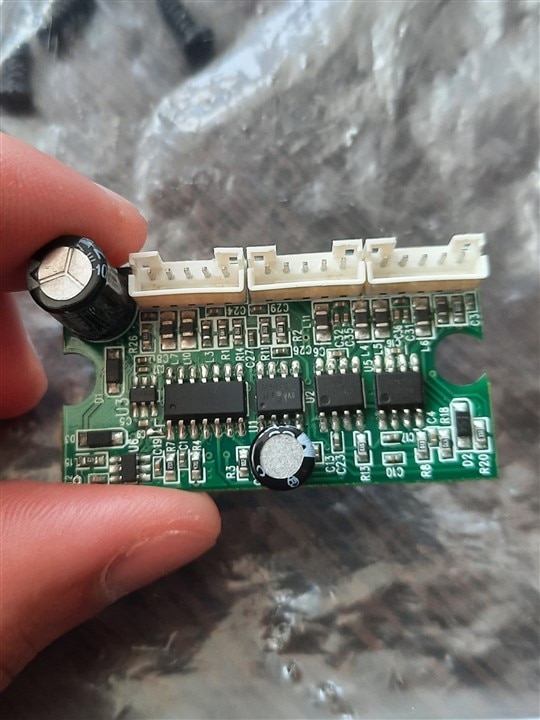
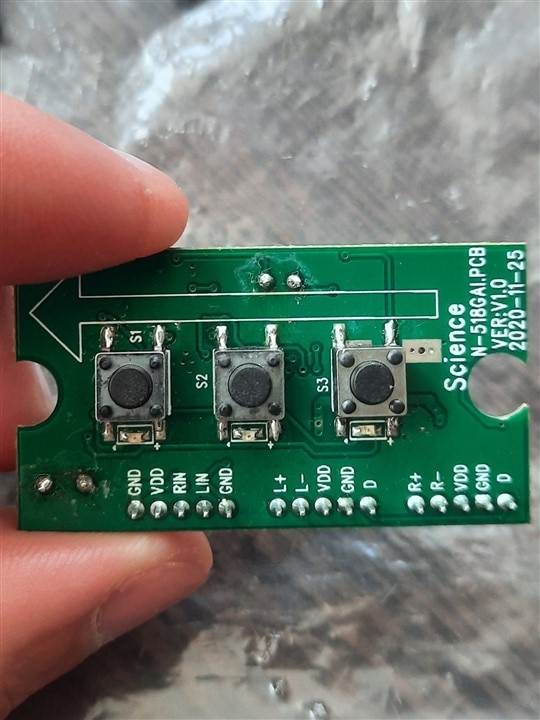
I'm using a small circuit with PAM8403 as a replacement for some speakers with dead audio circuit. In addition, I also have addressable LEDs in the case (this how they came) and I was thinking of using an MCU to control them. But I just noticed a very sharp and annoying noise produced when I power the LEDs, and it doesn't go away even when playing music.
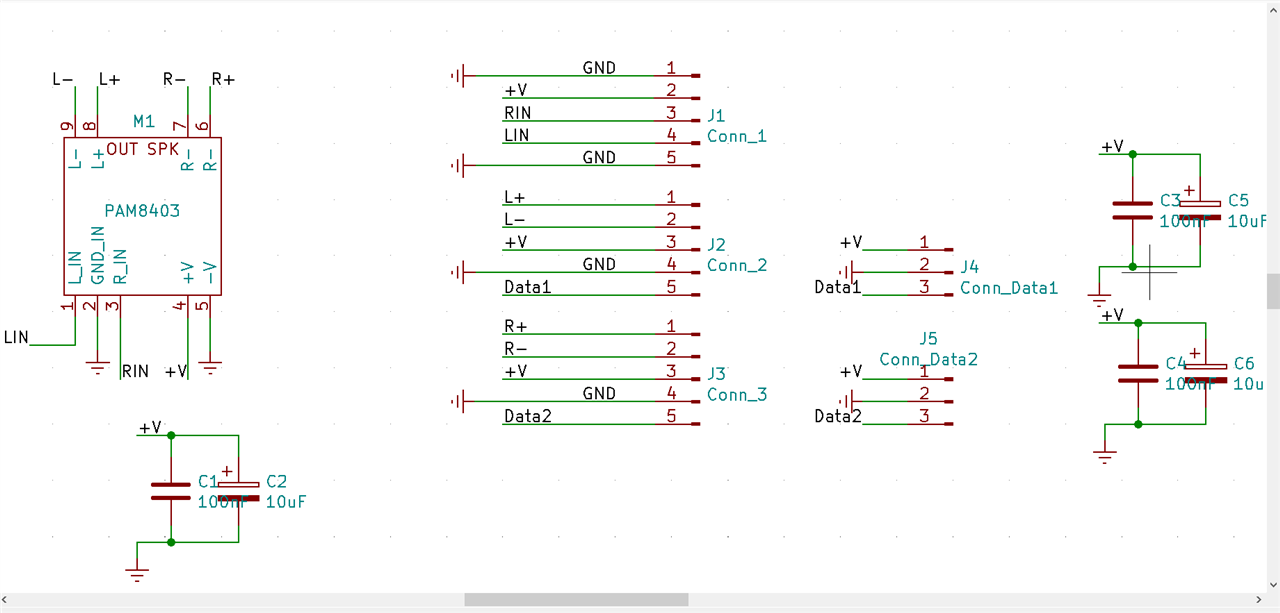
I made a msall PCB, the schematic is below. The power supply is at 5V [USB]. I placed some capacitors in the idea to support the supply voltage.
What ideas do you have? What could I improve? 

Thanks!

The schematic:
image

The layout:

image

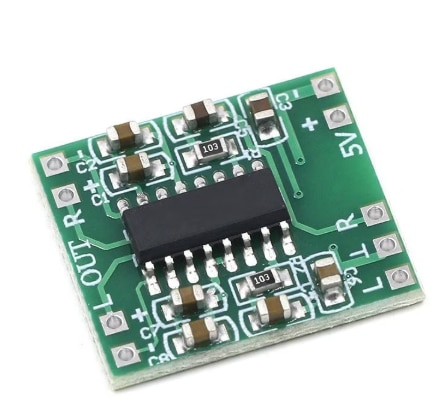
PAM8403 module:


image
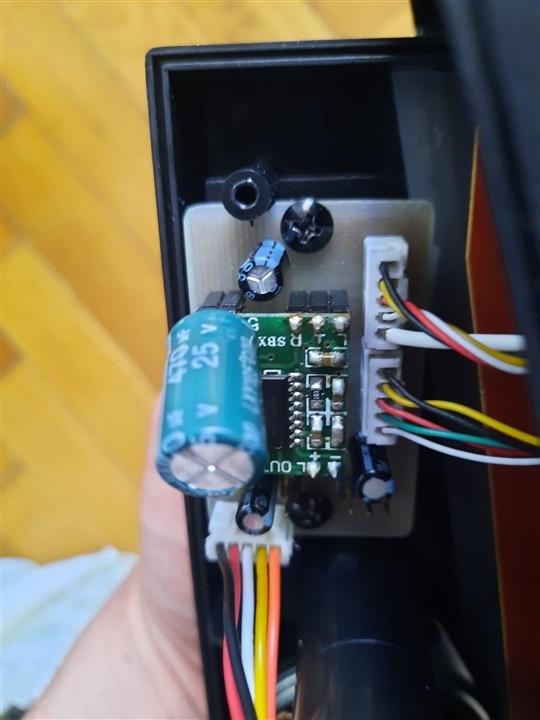
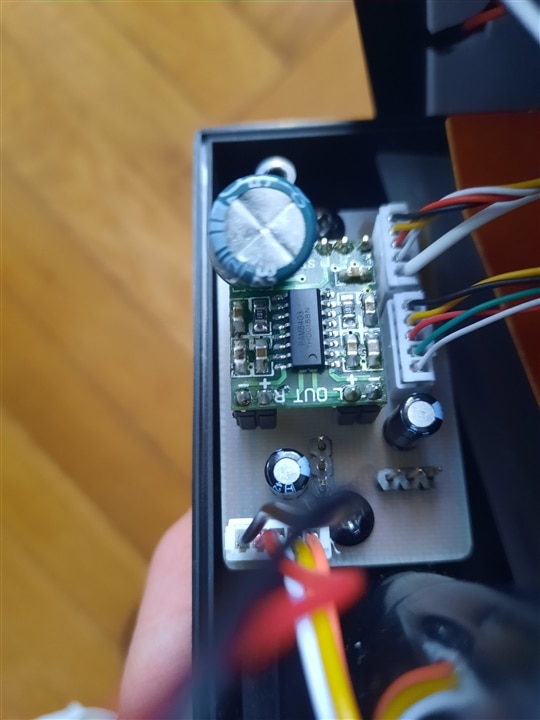
The initial amplifier + controller board:
image
image

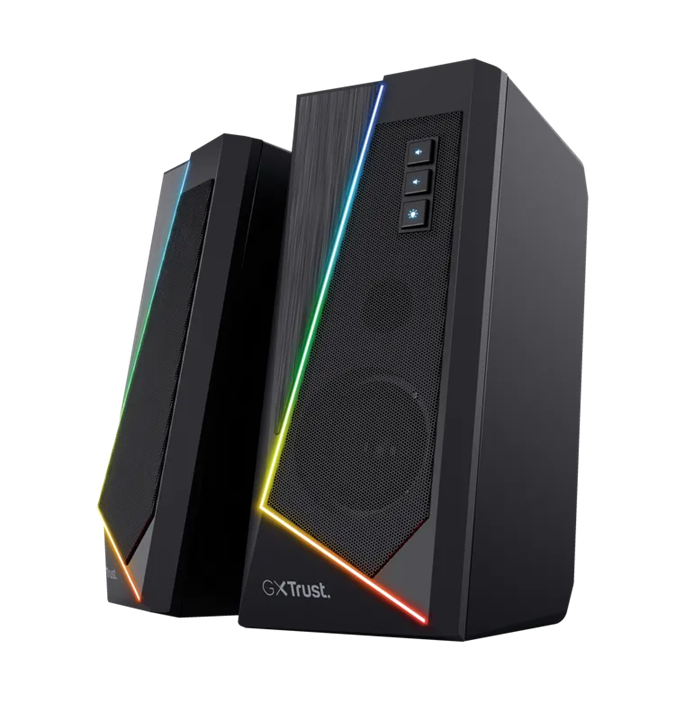
The speakers:
image

My assembly:

image

image


  • Sign in to reply
  • Cancel

Top Replies

  • shabaz
    shabaz 3 months ago +4
    Decided to quickly try that amp board, my results won't necessarily help at all since my setup is completely different and I don't have LEDs/microcontroller attached. I'm not near 'scope so I couldn't…
  • michaelkellett
    michaelkellett 3 months ago +3
    Do you have an oscilloscope. It will be much easier to fix the problem if you know what it is causing it. Since the noise happens when the LED is on it should be easy to see what is changing on the…
  • geralds
    geralds 3 months ago in reply to shabaz +2
    You're welcome. Oh, yes me too - I also have toys I can't remember why I have it. :) You mentioned the Vref _pin and -capacitor: It is important to know that this pin is a bi-directional pin. In…
Parents
  • shabaz
    shabaz 3 months ago

    Decided to quickly try that amp board, my results won't necessarily help at all since my setup is completely different and I don't have LEDs/microcontroller attached. I'm not near 'scope so I couldn't grab any traces.

    I'm using a very high quality audio cable (double shield), but there is about 3 cm bare at the board end. Speaker is 8 ohm (I only wired to the right channel).

    For the power supply, I plugged into an Anker mains-to-USB adapter.

    It's quite a noisy amp, there's reasonably noticeable hiss. With the 3.5 mm plug unplugged, I hear mains buzz; it needs to be shorted for that to go away, leaving just the hiss.

    Then I plugged the audio cable into a battery-powered MP3 player. It sounded fine.

    However, then I attached the audio cable to my laptop instead, which was powered from another port on the same Anker adapter. It was intolerable, lots of electronic noise sounds. If I unplugged the laptop and let it run on batteries, then the sound became acceptable again.  

    image

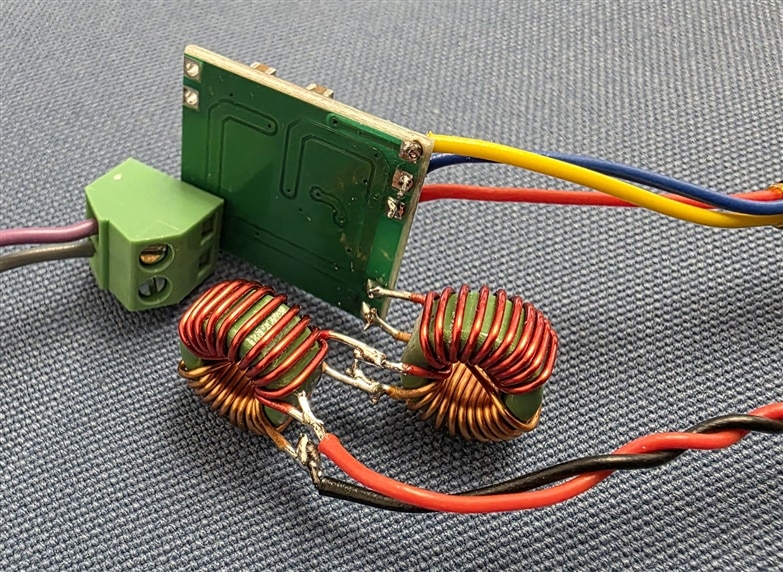
    I tried a few things; additional decoupling (220uF electrolytic cap on the power rails, no difference. Then added a choke preceding that (a 1 mH common-mode choke with the windings wired together to be a normal single choke), still no difference. Then removed the electrolytic and re-soldered the choke as common-mode, then tried two of them : ) and also tried adding it to the audio connections too. Still no difference.

    image

    Then I remembered I was not using the official laptop charger - I attached the laptop to the correct charger, and the amplifier remained on the Anker one. Noises gone. The official laptop one has 1k resistance from the USB shield to the earth pin. The Anker one doesn't have an earth connection (i.e. SELV).

    I'm guessing perhaps the laptop puts enough noise into the charger, that it egresses on all the other ports (common-mode or differential or both - don't know, guessing both!), and the filtering I was doing wasn't sufficient - I should have tried both differential and common-mode simultaneously but I didn't get a chance.

    • Cancel
    • Vote Up +4 Vote Down
    • Sign in to reply
    • Cancel
Reply
  • shabaz
    shabaz 3 months ago

    Decided to quickly try that amp board, my results won't necessarily help at all since my setup is completely different and I don't have LEDs/microcontroller attached. I'm not near 'scope so I couldn't grab any traces.

    I'm using a very high quality audio cable (double shield), but there is about 3 cm bare at the board end. Speaker is 8 ohm (I only wired to the right channel).

    For the power supply, I plugged into an Anker mains-to-USB adapter.

    It's quite a noisy amp, there's reasonably noticeable hiss. With the 3.5 mm plug unplugged, I hear mains buzz; it needs to be shorted for that to go away, leaving just the hiss.

    Then I plugged the audio cable into a battery-powered MP3 player. It sounded fine.

    However, then I attached the audio cable to my laptop instead, which was powered from another port on the same Anker adapter. It was intolerable, lots of electronic noise sounds. If I unplugged the laptop and let it run on batteries, then the sound became acceptable again.  

    image

    I tried a few things; additional decoupling (220uF electrolytic cap on the power rails, no difference. Then added a choke preceding that (a 1 mH common-mode choke with the windings wired together to be a normal single choke), still no difference. Then removed the electrolytic and re-soldered the choke as common-mode, then tried two of them : ) and also tried adding it to the audio connections too. Still no difference.

    image

    Then I remembered I was not using the official laptop charger - I attached the laptop to the correct charger, and the amplifier remained on the Anker one. Noises gone. The official laptop one has 1k resistance from the USB shield to the earth pin. The Anker one doesn't have an earth connection (i.e. SELV).

    I'm guessing perhaps the laptop puts enough noise into the charger, that it egresses on all the other ports (common-mode or differential or both - don't know, guessing both!), and the filtering I was doing wasn't sufficient - I should have tried both differential and common-mode simultaneously but I didn't get a chance.

    • Cancel
    • Vote Up +4 Vote Down
    • Sign in to reply
    • Cancel
Children
  • geralds
    geralds 3 months ago in reply to shabaz

    Hi  shabaz 

    Here are the datasheet and an app-note. The PAM8403 is obsolete, the PAM8406 is recommended.

    As I mentioned you will need filtering on the output to the speakers. Also, the PCB needs improved routing.

    In the PAM8406 schematics BOM list you have the values of the components.

     A huge problem is a GND loop, -ringing and -bouncing.

    -> Poweranalog is now part of Diodes:

    https://www.diodes.com/search?q=pam&action_results=Go&start=20

    Regards Gerald

    • Cancel
    • Vote Up +1 Vote Down
    • Sign in to reply
    • Cancel
  • shabaz
    shabaz 3 months ago in reply to geralds

    Hi Gerald,

    Thanks for the info, that part looks much better than the 8403. No reason to use that old part anymore. I can't recall the reason I had the 8403 board, I think I got it several years ago.

    • Cancel
    • Vote Up 0 Vote Down
    • Sign in to reply
    • Cancel
  • geralds
    geralds 3 months ago in reply to shabaz

    You're welcome.

    Oh, yes me too - I also have toys I can't remember why I have it. :)

    You mentioned the Vref _pin and -capacitor:

    It is important to know that this pin is a bi-directional pin.

    In the datasheet is descripted you need a X7R cer. cap. between 470n to 1u.

    >>> Analog Reference Bypass Capacitor (CBYP)
    The Analog Reference Bypass Capacitor (CBYP) is the most critical capacitor and serves several important functions. During start-up or recovery from shutdown mode, CBYP determines the rate at which the amplifier starts up. The second function is to reduce noise caused by the power supply coupling into the output drive signal. This noise is from the internal analog reference to the amplifier, which appears as degraded PSRR and THD+N.
    A ceramic bypass capacitor (CBYP) with values of 0.47μF to 1.0μF is recommended for the best THD and noise performance. Increasing the bypass capacitor reduces clicking and popping noise from power on/off and entering and leaving shutdown.

    >>>

    But on the EMB is mounted a 100n X7R cap. This value is too small.

    This pin, Vref can modulate the signal through the signal path if that Vref value is not stabile. 
    Noise and popping noise signals are going to the amplifier.
    This cap. must be mounted very close to the pin and the GND must be a polygon field. - The polygon should be around the IC as well.

    • Cancel
    • Vote Up +2 Vote Down
    • Sign in to reply
    • Cancel
  • me_Cris
    me_Cris 2 months ago in reply to shabaz

    I'm waiting for the PAM8406 version which should not be so noisy.
    I didn't achieve much using the ferrite bead + capacitors filter.

    • Cancel
    • Vote Up 0 Vote Down
    • Sign in to reply
    • Cancel
  • geralds
    geralds 2 months ago in reply to me_Cris

    Can you make photos of your assembled amp., that show us details about your built? 

    • Cancel
    • Vote Up 0 Vote Down
    • Sign in to reply
    • Cancel
  • me_Cris
    me_Cris 2 months ago in reply to geralds

    Of course, you can see in the post.

    • Cancel
    • Vote Up 0 Vote Down
    • Sign in to reply
    • Cancel
element14 Community

element14 is the first online community specifically for engineers. Connect with your peers and get expert answers to your questions.

  • Members
  • Learn
  • Technologies
  • Challenges & Projects
  • Products
  • Store
  • About Us
  • Feedback & Support
  • FAQs
  • Terms of Use
  • Privacy Policy
  • Legal and Copyright Notices
  • Sitemap
  • Cookies

An Avnet Company © 2026 Premier Farnell Limited. All Rights Reserved.

Premier Farnell Ltd, registered in England and Wales (no 00876412), registered office: Farnell House, Forge Lane, Leeds LS12 2NE.

Follow element14

  • X
  • Facebook
  • linkedin
  • YouTube