


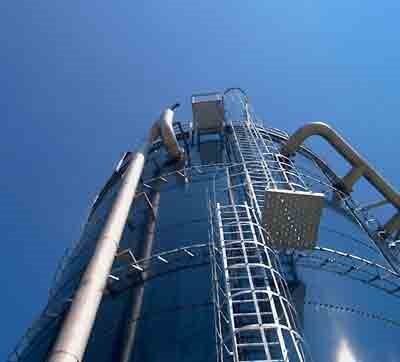
A brewery million gallon waste bioreactor
Among the waste water being turned into biofuels, Anheuser-Busch's beer facility has a sludge that looks quite potential to researchers. Cornell University's Largus T. Angenent and Jeffery J. Werner took samples at the InBev location around the USA to get a glimpse at the bacterial communities in the factory's bioreactors. From 9 locations they found thousands of species of bacteria.
Using genome analyzing software, the team took a look at 400,00 gene sequences of the microbes. 145 types were unique to each of the 9 facilities. "The cool thing we found was that if you're looking at these thousands of species of bacteria, it's a very dynamic system with things dying off and replacing them," Werner said. "There are certain signature populations that are resilient. Even if they get disturbed, they come right back up." In the million gallon tanks, the team plans to alter the environment to make the bacteria perform new functions.
One member of these bacterial communities currently produce high amounts of methane. Anheuser-Busch harness this byproduct to offset their heating bill by 20%, saving the company millions a year. However, the team wants to prevent the bacteria from producing methane, and make the colonies product carboxylates, a key component in alkanes of fuel. The hope is the biofuels produced will outstrip the energy potential of the methane produced. If it is accomplished, the thousands of distilleries globally may be large part of the emerging biofuel markets.
The Cornell team is also working with the University of Colorado in Boulder and Washington University in St. Louis. See more in the abstract.
Eavesdropper