


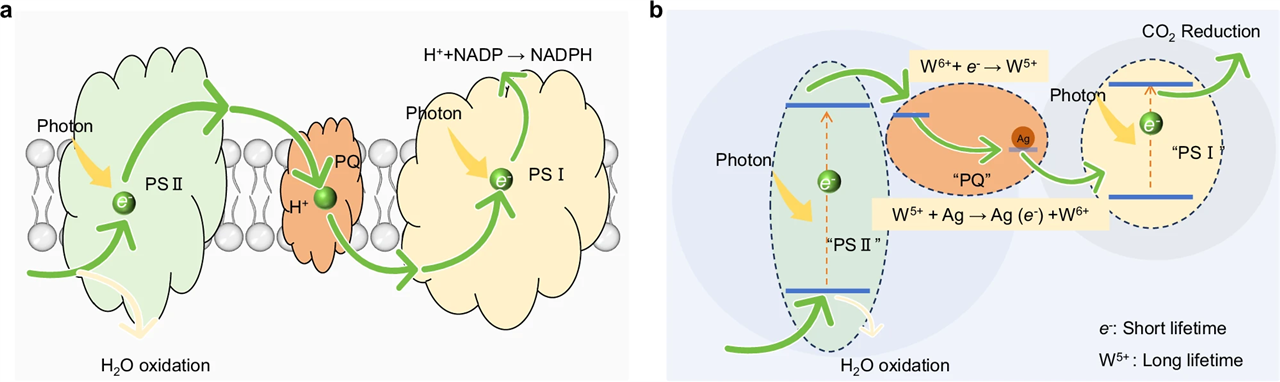
Diagram on the left represents a natural photosynthesis system. Meanwhile, the diagram on the right represents the team’s proposed catalyst system. (Image Credit: nature communications)
Researchers at the Chinese Academy of Sciences created a new catalyst system that harnesses sunlight and stores charge. It also helps convert water and carbon dioxide into a fuel molecule. The team says their catalyst system could have applications in solar fuel production.
Inspired by natural photosynthesis, the researchers’ system uses a tungsten-based reservoir that stores and distributes electrons, leading to efficient light-generated charges. In this setup, the artificial analogue’s job involves decoupling photocarrier degeneration from carbon dioxide conversion. This enables the independent optimization of charge separation and storage.
It’s also based on a tungsten oxide charge reservoir combined with a molecular CO2-reduction catalyst. Under hydrothermal conditions, tungsten trioxide (WO3) is synthesized from tungsten hexachloride (WCl6) in ethanol. Afterward, it’s calcined in air for the oxide phase production. The team prepared Ag/WO3 via photoassisted reduction. This involved irradiating the WO3 dispersion under Ar to produce reduced W5+ sites. They then added AgNO3 before washing, drying, and calcining the product. With this step, the team fabricated a tungsten-oxide solution capable of storing and releasing charge while adding silver into the final material.
They completed the CO2-reduction catalyst by coupling Ag/WO3 with cobalt phthalocyanine (CoPc). To create the composite CoPC/Ag/WO3, the team dissolved CoPc in ethanol, mixing it with Ag/WO3, before sonicating, ball milling, and drying it. These steps were carried out to prepare other catalysts like CoPc/WO3. Control studies used composites with Cu20 and C3N4.
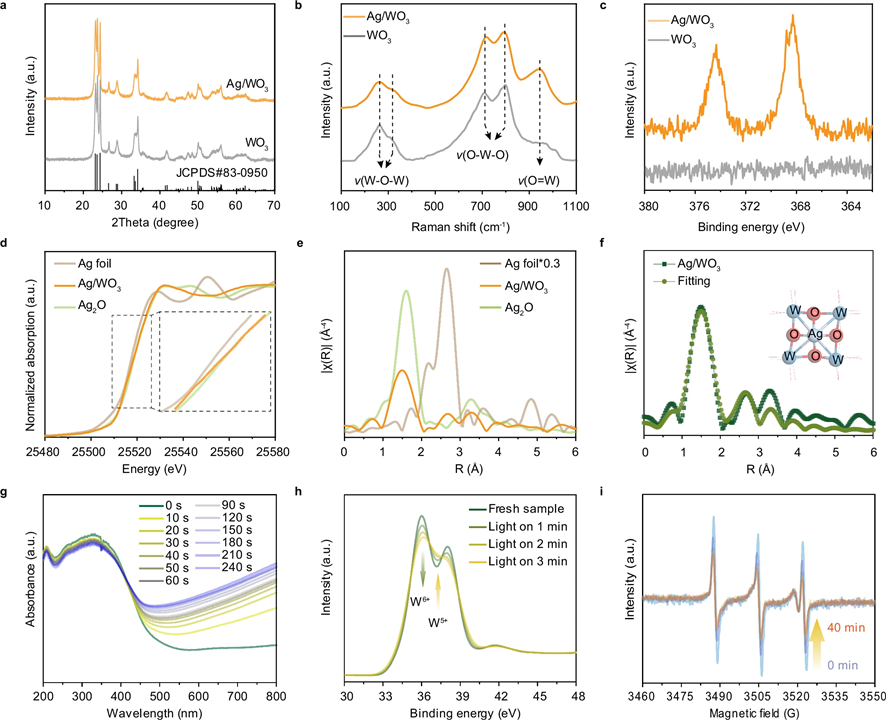
Measurements showing that Ag/WO3 has the correct structure, silver environment, light-induced charge behavior, and charge electrons required to function as a charge reservoir. (Image Credit: nature communications)
When the team subjected the tungsten-based charge reservoir to light, the tungsten cycled between W6+ and W5+, enabling temporary electron storage rather than losing it to recombination. The stored charge then helps remove photogenerated holes from the CoPc side, preserving a high electron density at the CO2 sites. The team used XRD, Raman, XPS, EPR, XAFS, UV-Vis, DRS, and transient absorption to verify the charge-reservoir structure and oxidation states.
A charge management technique like this makes the system highly effective. Decoupling charge storage from catalytic turnover allows the reservoir to help the molecular catalyst function more efficiently under irradiation. According to the paper, the CoPc/Ag/WO3 catalyst achieves a CO production rate of ~1.5 mmol gCoPc−1 h−1, approximately 100 times higher than CopC alone.
Additionally, the paper says that Ag/WO3 greatly boosts CO2 conversion when coupled with various catalysts. This suggests the charge reservoir effect is useful instead of a one-time result. The team also says the main CoPc system achieves a stable run over six cycles and three days with no deactivation. Post-reaction characterization reveals that the structure remained the same.
The team believes this system could be useful for solar fuel production as it helps reduce charge loss and enhance CO2 conversion. This may even work with other catalysts that lose efficiency due to electrons recombining too quickly.
Have a story tip? Message me here at element14.
