element14 Community
element14 Community
    Register Log In
  • Site
  • Search
  • Log In Register
  • Community Hub
    Community Hub
    • What's New on element14
    • Feedback and Support
    • Benefits of Membership
    • Personal Blogs
    • Members Area
    • Achievement Levels
  • Learn
    Learn
    • Ask an Expert
    • eBooks
    • element14 presents
    • Learning Center
    • Tech Spotlight
    • STEM Academy
    • Webinars, Training and Events
    • Learning Groups
  • Technologies
    Technologies
    • 3D Printing
    • FPGA
    • Industrial Automation
    • Internet of Things
    • Power & Energy
    • Sensors
    • Technology Groups
  • Challenges & Projects
    Challenges & Projects
    • Design Challenges
    • element14 presents Projects
    • Project14
    • Arduino Projects
    • Raspberry Pi Projects
    • Project Groups
  • Products
    Products
    • Arduino
    • Avnet & Tria Boards Community
    • Dev Tools
    • Manufacturers
    • Multicomp Pro
    • Product Groups
    • Raspberry Pi
    • RoadTests & Reviews
  • About Us
  • Store
    Store
    • Visit Your Store
    • Choose another store...
      • Europe
      •  Austria (German)
      •  Belgium (Dutch, French)
      •  Bulgaria (Bulgarian)
      •  Czech Republic (Czech)
      •  Denmark (Danish)
      •  Estonia (Estonian)
      •  Finland (Finnish)
      •  France (French)
      •  Germany (German)
      •  Hungary (Hungarian)
      •  Ireland
      •  Israel
      •  Italy (Italian)
      •  Latvia (Latvian)
      •  
      •  Lithuania (Lithuanian)
      •  Netherlands (Dutch)
      •  Norway (Norwegian)
      •  Poland (Polish)
      •  Portugal (Portuguese)
      •  Romania (Romanian)
      •  Russia (Russian)
      •  Slovakia (Slovak)
      •  Slovenia (Slovenian)
      •  Spain (Spanish)
      •  Sweden (Swedish)
      •  Switzerland(German, French)
      •  Turkey (Turkish)
      •  United Kingdom
      • Asia Pacific
      •  Australia
      •  China
      •  Hong Kong
      •  India
      •  Korea (Korean)
      •  Malaysia
      •  New Zealand
      •  Philippines
      •  Singapore
      •  Taiwan
      •  Thailand (Thai)
      • Americas
      •  Brazil (Portuguese)
      •  Canada
      •  Mexico (Spanish)
      •  United States
      Can't find the country/region you're looking for? Visit our export site or find a local distributor.
  • Translate
  • Profile
  • Settings
Power & Energy
  • Technologies
  • More
Power & Energy
Alt Energy Solutions & Tech High-performance capacitor could lead to more efficient technology
  • Blog
  • Forum
  • Quiz
  • Documents
  • Polls
  • Events
  • Mentions
  • Sub-Groups
  • Tags
  • More
  • Cancel
  • New
  • Share
  • More
  • Cancel
Group Actions
  • Group RSS
  • More
  • Cancel
Engagement
  • Author Author: Eavesdropper
  • Date Created: 27 Jan 2011 1:24 AM Date Created
  • Views 478 views
  • Likes 0 likes
  • Comments 0 comments
  • capacitor
  • alternative_energy
  • supercapacitor
  • ultracapacitor
Related
Recommended

High-performance capacitor could lead to more efficient technology

Eavesdropper
Eavesdropper
27 Jan 2011
image
 
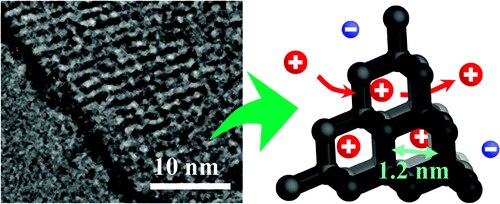
In order to develop next-generation electric vehicles, solar energy systems, and other clean energy technologies, researchers need an efficient way to store the energy. One of the key energy storage devices for these applications and others is a supercapacitor, also called an electric double-layer capacitor. In a recent study, scientists have investigated the possibility of using a material called zeolite-templated carbon for the electrode in this type of capacitor, and found that the material’s unique pore structure greatly improves the capacitor's overall performance. Recently, scientists have been testing materials with pores of various sizes and structures to try to achieve both quick ion transport and high adsorption ion density. But the two requirements are somewhat contradictory, since ions can travel more quickly through larger nanopores, but large nanopores make the electrode density low and thus decrease the adsorbed ion density. The scientists decided to use zeolite-templated carbon to seemingly overcome this problem. Zeolite-templated carbon consists of nanopores that are 1.2 nm in diameter and that have a very ordered structure. The nanopores’ small size makes the adsorbed ion density high, while the ordered structure (described as a diamond-like framework) allows the ions to quickly pass through the nanopores. In a previous study, the researchers showed that zeolite-templated carbon with nanopores smaller than 1.2 nm cannot enable fast ion transport, suggesting that this size may provide the optimal balance between high rate performance and high volumetric capacitance. In tests, the zeolite-templated carbon’s properties exceeded those of other materials, demonstrating its potential to be used as an electrode for high-performance electric double-layer capacitors. For more information please visit: http://pubs.acs.org/doi/abs/10.1021/ja108315p
 
Eavesdropper


  • Sign in to reply
element14 Community

element14 is the first online community specifically for engineers. Connect with your peers and get expert answers to your questions.

  • Members
  • Learn
  • Technologies
  • Challenges & Projects
  • Products
  • Store
  • About Us
  • Feedback & Support
  • FAQs
  • Terms of Use
  • Privacy Policy
  • Legal and Copyright Notices
  • Sitemap
  • Cookies

An Avnet Company © 2025 Premier Farnell Limited. All Rights Reserved.

Premier Farnell Ltd, registered in England and Wales (no 00876412), registered office: Farnell House, Forge Lane, Leeds LS12 2NE.

ICP 备案号 10220084.

Follow element14

  • X
  • Facebook
  • linkedin
  • YouTube