


Energy storage is a major issue when dealing with intermittent alternative energy such as wind or solar. With standard energy generation storage of energy is simple, let it sit in its raw form. Coal, oil, wood in its basic form is energy ready to burn. With a renewable source, energy has to be stored elsewhere. A tried and true way to store energy is via pumped-storage hydroelectricity. This works by pumping water to a high elevation. On demand the water can then be dropped through turbines, providing up to 85% efficiency. There is one major caveat, the location of the storage facility has to provide an elevation difference as well as a large area to hold water. This is not a convenient way to store other forms of renewable energy.
There are a few other options for storing energy from renewable sources. Batteries are simple method, but have proven to be quite expensive. Utsira, off the coast of Norway, use excess energy to separate hydrogen and oxygen to be stored in fuel cells. Precious metals in fuel cells make this option less attractive for most generation plants. Compressed air energy storage (CAES) uses energy generated to compress air placed in large storage tanks. CAES has been used in Huntorf Germany since 1978 and McIntosh Alabama from 1991. The size of these containers can be quite cumbersome and expensive to keep pressurized.
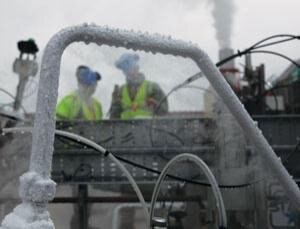
Now enters a new option. In Slough, UK, energy firm Scottish and Southern, at the Highview Power Storage facility, is storing energy from a 100-megawatt biomass plant in the form of liquid air, or cryogen. The generated energy from the plant is used to chill air to -190 °C and stored in a tank at regular atmospheric pressure, 1 bar. Then the energy is needed, the cryogen is pressurized to 70 bars and heated. The result is a high pressure gas used to spin turbines. On average the efficiency is 50%, but with using waste heat from another source efficiency goes up to 70%. This system is small enough to be placed anywhere, and the cost beats any other storage option.
A new liquefaction plant will be build on site, at Highview, in late march to produce its own cryogen. A large scale 2.5-megawatt station will be constructed by late 2012, and a 10-megawatt by 2014.
Eavesdropper
Pic via Jez Coulson at the Highview plant