element14 Community
element14 Community
    Register Log In
  • Site
  • Search
  • Log In Register
  • Community Hub
    Community Hub
    • What's New on element14
    • Feedback and Support
    • Benefits of Membership
    • Personal Blogs
    • Members Area
    • Achievement Levels
  • Learn
    Learn
    • Ask an Expert
    • eBooks
    • element14 presents
    • Learning Center
    • Tech Spotlight
    • STEM Academy
    • Webinars, Training and Events
    • Learning Groups
  • Technologies
    Technologies
    • 3D Printing
    • FPGA
    • Industrial Automation
    • Internet of Things
    • Power & Energy
    • Sensors
    • Technology Groups
  • Challenges & Projects
    Challenges & Projects
    • Design Challenges
    • element14 presents Projects
    • Project14
    • Arduino Projects
    • Raspberry Pi Projects
    • Project Groups
  • Products
    Products
    • Arduino
    • Avnet & Tria Boards Community
    • Dev Tools
    • Manufacturers
    • Multicomp Pro
    • Product Groups
    • Raspberry Pi
    • RoadTests & Reviews
  • About Us
  • Store
    Store
    • Visit Your Store
    • Choose another store...
      • Europe
      •  Austria (German)
      •  Belgium (Dutch, French)
      •  Bulgaria (Bulgarian)
      •  Czech Republic (Czech)
      •  Denmark (Danish)
      •  Estonia (Estonian)
      •  Finland (Finnish)
      •  France (French)
      •  Germany (German)
      •  Hungary (Hungarian)
      •  Ireland
      •  Israel
      •  Italy (Italian)
      •  Latvia (Latvian)
      •  
      •  Lithuania (Lithuanian)
      •  Netherlands (Dutch)
      •  Norway (Norwegian)
      •  Poland (Polish)
      •  Portugal (Portuguese)
      •  Romania (Romanian)
      •  Russia (Russian)
      •  Slovakia (Slovak)
      •  Slovenia (Slovenian)
      •  Spain (Spanish)
      •  Sweden (Swedish)
      •  Switzerland(German, French)
      •  Turkey (Turkish)
      •  United Kingdom
      • Asia Pacific
      •  Australia
      •  China
      •  Hong Kong
      •  India
      •  Korea (Korean)
      •  Malaysia
      •  New Zealand
      •  Philippines
      •  Singapore
      •  Taiwan
      •  Thailand (Thai)
      • Americas
      •  Brazil (Portuguese)
      •  Canada
      •  Mexico (Spanish)
      •  United States
      Can't find the country/region you're looking for? Visit our export site or find a local distributor.
  • Translate
  • Profile
  • Settings
Power & Energy
  • Technologies
  • More
Power & Energy
Alt Energy Solutions & Tech New composite material that resembles peapods could improve lithium-ion batteries
  • Blog
  • Forum
  • Quiz
  • Documents
  • Polls
  • Events
  • Mentions
  • Sub-Groups
  • Tags
  • More
  • Cancel
  • New
  • Share
  • More
  • Cancel
Group Actions
  • Group RSS
  • More
  • Cancel
Engagement
  • Author Author: Eavesdropper
  • Date Created: 15 Feb 2011 6:25 PM Date Created
  • Views 386 views
  • Likes 1 like
  • Comments 0 comments
  • alternative_energy
  • lithium_ion
  • battery
  • carbon_fiber
  • university
  • innovation
Related
Recommended

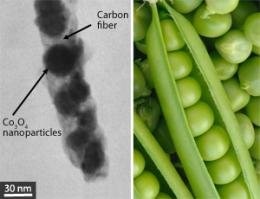
New composite material that resembles peapods could improve lithium-ion batteries

Eavesdropper
Eavesdropper
15 Feb 2011
image

Lithium-ion batteries lose lithium over each charge and discharge, and it's ability to hold a charge. At the A*STAR Institute of Chemical and Engineering Sciences, Yu Wang and team have demonstrated new materials in a battery to help reduce the over loss of energy storage capabilities. Cobalt oxide nanoparticles embedded in carbon fiber is a stong replacement material for anodes in Li-on batts due to its abilitiy to hold ions versus other regularly used tin. The same material can be lithium-cobalt oxide, currently used in cathodes. Researchers heat cobalt  carbonate hydroxide nanobelts coated with layers of polymerized glucose  in an inert atmosphere at 700 degrees Celcius and then in air at 250  degrees Celsius, a end up with a peopod like structure. The prototype batteries show that over 50 charge-recharge cycles, it can still hold 91%. How much do the old batteries lose in comparison? 


Wang, speaking about the achievement in manufacturing, said"it is the first time that such isolated magnetic nanoparticles embedded in hollow fibers have been produced. Scanning electron microscopy revealed that the peapod composite exhibits a uniform morphology, with pod lengths of up to several micrometers and pod diameters of as small as 50 nanometers." Wang and team plan to take the manufacturing technique beyond lithium-ion batteries, into gene engineering, capacitors, and magnets.


Eavesdropper
  • Sign in to reply
element14 Community

element14 is the first online community specifically for engineers. Connect with your peers and get expert answers to your questions.

  • Members
  • Learn
  • Technologies
  • Challenges & Projects
  • Products
  • Store
  • About Us
  • Feedback & Support
  • FAQs
  • Terms of Use
  • Privacy Policy
  • Legal and Copyright Notices
  • Sitemap
  • Cookies

An Avnet Company © 2025 Premier Farnell Limited. All Rights Reserved.

Premier Farnell Ltd, registered in England and Wales (no 00876412), registered office: Farnell House, Forge Lane, Leeds LS12 2NE.

ICP 备案号 10220084.

Follow element14

  • X
  • Facebook
  • linkedin
  • YouTube