element14 Community
element14 Community
    Register Log In
  • Site
  • Search
  • Log In Register
  • Community Hub
    Community Hub
    • What's New on element14
    • Feedback and Support
    • Benefits of Membership
    • Personal Blogs
    • Members Area
    • Achievement Levels
  • Learn
    Learn
    • Ask an Expert
    • eBooks
    • element14 presents
    • Learning Center
    • Tech Spotlight
    • STEM Academy
    • Webinars, Training and Events
    • Learning Groups
  • Technologies
    Technologies
    • 3D Printing
    • FPGA
    • Industrial Automation
    • Internet of Things
    • Power & Energy
    • Sensors
    • Technology Groups
  • Challenges & Projects
    Challenges & Projects
    • Design Challenges
    • element14 presents Projects
    • Project14
    • Arduino Projects
    • Raspberry Pi Projects
    • Project Groups
  • Products
    Products
    • Arduino
    • Avnet & Tria Boards Community
    • Dev Tools
    • Manufacturers
    • Multicomp Pro
    • Product Groups
    • Raspberry Pi
    • RoadTests & Reviews
  • About Us
  • Store
    Store
    • Visit Your Store
    • Choose another store...
      • Europe
      •  Austria (German)
      •  Belgium (Dutch, French)
      •  Bulgaria (Bulgarian)
      •  Czech Republic (Czech)
      •  Denmark (Danish)
      •  Estonia (Estonian)
      •  Finland (Finnish)
      •  France (French)
      •  Germany (German)
      •  Hungary (Hungarian)
      •  Ireland
      •  Israel
      •  Italy (Italian)
      •  Latvia (Latvian)
      •  
      •  Lithuania (Lithuanian)
      •  Netherlands (Dutch)
      •  Norway (Norwegian)
      •  Poland (Polish)
      •  Portugal (Portuguese)
      •  Romania (Romanian)
      •  Russia (Russian)
      •  Slovakia (Slovak)
      •  Slovenia (Slovenian)
      •  Spain (Spanish)
      •  Sweden (Swedish)
      •  Switzerland(German, French)
      •  Turkey (Turkish)
      •  United Kingdom
      • Asia Pacific
      •  Australia
      •  China
      •  Hong Kong
      •  India
      • Japan
      •  Korea (Korean)
      •  Malaysia
      •  New Zealand
      •  Philippines
      •  Singapore
      •  Taiwan
      •  Thailand (Thai)
      • Vietnam
      • Americas
      •  Brazil (Portuguese)
      •  Canada
      •  Mexico (Spanish)
      •  United States
      Can't find the country/region you're looking for? Visit our export site or find a local distributor.
  • Translate
  • Profile
  • Settings
Power & Energy
  • Technologies
  • More
Power & Energy
Alt Energy Solutions & Tech Solar-cells go on a diet with the help of aluminum
  • Blog
  • Forum
  • Quiz
  • Documents
  • Polls
  • Events
  • Mentions
  • Sub-Groups
  • Tags
  • More
  • Cancel
  • New
  • Share
  • More
  • Cancel
Group Actions
  • Group RSS
  • More
  • Cancel
Engagement
  • Author Author: Eavesdropper
  • Date Created: 10 Feb 2011 4:31 PM Date Created
  • Views 401 views
  • Likes 0 likes
  • Comments 0 comments
  • research
  • alternative_energy
  • solar
  • solar_cell
  • aluminum
Related
Recommended

Solar-cells go on a diet with the help of aluminum

Eavesdropper
Eavesdropper
10 Feb 2011
image
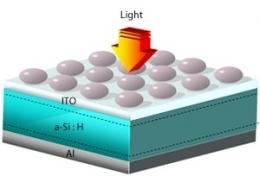
Solar cells are a key technology in the drive toward cleaner energy production. Unfortunately, solar technology is not yet economically competitive and the cost of solar cells needs to be brought down. One way to overcome this problem is to reduce the amount of expensive semiconductor material used, but thin-film solar cells tend to have lower performance compared with conventional solar cells. Yuriy Akimov and Wee Shing Koh at the A*STAR Institute of High Performance Computing (Singapore) have now improved the light conversion efficiency of thin-film solar-cells by depositing aluminum particles on the cell surface. Metallic nanoparticles can direct light better into the solar cell and prevent light from escaping. In conventional ‘thick-film’ solar cells, the nanoparticles would have little effect because all the light is absorbed by the film due to its thickness. For thin films, however, the nanoparticles can make a big difference. Their scattering increases the duration the light stays in the film, bringing the total absorption of light up to a level comparable with that for conventional solar-cells. The researchers modeled the light absorption efficiency of solar cells for various nanoparticle materials and sizes. In particular, they compared the properties of silver versus aluminum nanoparticles. In most studies on the subject, silver particles have been preferred. These have optical resonances in the visible part of the spectrum that are even better at focusing the light into the solar cell. Unfortunately, there is a tradeoff: the optical resonances also cause the absorption of light by the nanoparticles, which means the solar cell is less efficient. In the case of silver, this resonance is right in the key part of the solar spectrum, so that light absorption is considerable. But not so for aluminum nanoparticles, where these resonances are outside the important part of the solar spectrum. Furthermore, the aluminum particles handle oxidation well and their properties change little with variations in shape and size. And more importantly, their scattering properties are robust in comparison with silver nanoparticles.

Eavesdropper
  • Sign in to reply
element14 Community

element14 is the first online community specifically for engineers. Connect with your peers and get expert answers to your questions.

  • Members
  • Learn
  • Technologies
  • Challenges & Projects
  • Products
  • Store
  • About Us
  • Feedback & Support
  • FAQs
  • Terms of Use
  • Privacy Policy
  • Legal and Copyright Notices
  • Sitemap
  • Cookies

An Avnet Company © 2026 Premier Farnell Limited. All Rights Reserved.

Premier Farnell Ltd, registered in England and Wales (no 00876412), registered office: Farnell House, Forge Lane, Leeds LS12 2NE.

ICP 备案号 10220084.

Follow element14

  • X
  • Facebook
  • linkedin
  • YouTube