


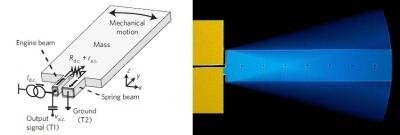
Steam engines, combustion engines, and diesel engines are all different types of heat engines, which operate by converting heat energy into mechanical work. Although heat engines have existed for a long time, reducing their size down to the microscale is very difficult since both their efficiency and power density greatly decrease when their size decreases. In a new study, scientists have designed and built a miniature heat engine with a displacement volume of just 0.34 cubic micrometers, possibly making it the smallest heat engine ever built. The basis of the heat engine is a solid piece of micrometer-sized silicon crystal that has two short beams jutting out from one end. When 1.2 milliamps of DC current is applied to one of the beams, the beam heats up as a consequence of its electrical resistance, and expands due to thermal expansion. As a result of the piezoresistive effect, the resistance of the beam decreases when it expands so that it cools again, forcing it to contract. The mechanical power from the beam’s expanding and contracting is used to drive the entire silicon crystal into sustained up-and-down oscillation. As a result of its small dimensions, the crystal oscillates at a high frequency of 1.3 MHz, moving back and forth more than a million times per second. The researchers found that the new heat engine has a very good power density if calculated using the engine displacement volume. The power density is almost 1,000 times higher than that of a modern car engine, meaning that, if a car engine and its power were scaled down to the same volume as the silicon beam, the silicon heat engine would generate 1,000 times more power. As the researchers explained, the tiny heat engine could have applications as a small clock or mechanical oscillator. Currently, most accurate clocks are made of a quartz crystal that determines the frequency in combination with a circuit of transistors in a silicon crystal that generate the oscillation power from a battery. The advantage of using the silicon heat engine as a clock is that both the quartz crystal and the transistors are not needed, thus making the device much smaller, simpler and cheaper to produce. In addition to watches, the small clocks could be used to generate high-frequency RF signals for wireless communication devices or to generate the clock-frequency of a microprocessor in a computer chip.
Zero