


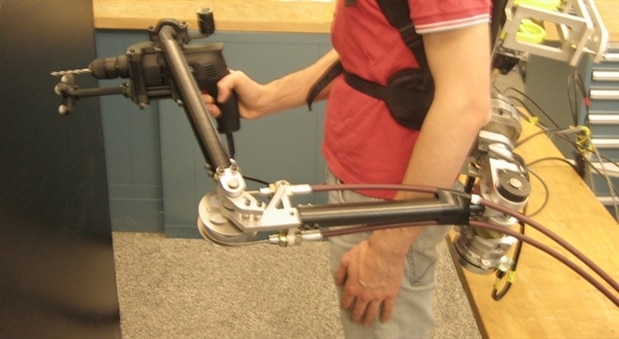
MIT’s Supernumerary Robotic Limbs (SRLs): Because everybody needs extra limbs. (via MIT)
Scientists have already designed some interesting robotic prosthetics for people with disabilities, including some that can be controlled by the user’s brain. However, what about those of us who just want to have some extra limbs to help us through every-day, monotonous, tough, difficult tasks?
Researchers from MIT have us covered with their new Supernumerary Robotic Limbs (SRLs), which were designed to do just that, actually there are two versions designed for certain tasks. For example, there are shoulder-mounted SLRs for doing work over the wearer’s head or for performing work where an extra pair of hands would come in handy, such as hanging sheets of drywall or hanging heavy ceiling tiles. The SLRs feature two arms whose reaction-forces are aligned with the wearer’s spine, making them able to bear weight.
Each features 5-DOF and are interchangeable with customized arm attachments for different jobs. While the arms are indeed useful, getting them to function without using your own was a different ball game altogether. Instead of connecting directly with the wearer’s nervous system through the spine (like in the movie), it uses sensors to ‘predict’ the movements of the user. Situated on the wearer’s wrists are a pair of IMUs that monitors movement and a third, which is housed beneath the shoulder mount, tracks the orientation and overall motion of the SRLs.
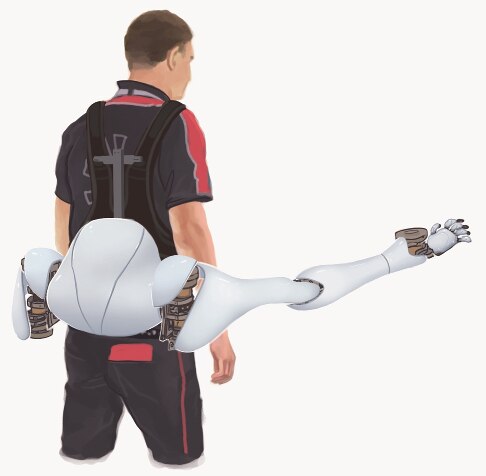
The arms garner movement data from learning the wearer’s motions while performing certain tasks. The learning model is then combined with the data gathered from the gyro and accelerometer IMUs to make the predicted movements. The end result is surprisingly effective and is executed in almost real-time. The researchers are also working on a waist-mounted version for holding objects as well as acting as a brace to provide stability in awkward positions, much like a second set of legs. Strangely enough, Boeing (and other companies) is a leading sponsor of the SRL project and hopes that the robotic limbs will help its aging workforce of aircraft builders from being injured while on the job. No matter what their intended use is, we can all benefit from them even if it’s a life of crime.
C
See more news at:
http://twitter.com/Cabe_Atwell

