


Unnecessarily eerie digital double of a model’s face and eyes (via Disney)
Do you wish your Disney animated characters were more creepily realistic? The computer graphics scientists at Disney Research Zurich have found a way to more accurately depict the human eye and make on-screen characters seem more life-like.

From human model to digital mod
The researchers at Disney developed a new technology, called PAPILLON, to scan and reconstruct the eyes of human models by capturing the eye with multiple cameras and under varied conditions of light movement and brightness. This new technique, they say, will better represent the nuanced individual variation of the eye and therefore render more believable character faces.
Typical approaches for depicting the human eye assume regular geometric shapes for the sclera (the white part), iris (the colored part surrounding the pupil), and cornea (the transparent bulb covering the iris).
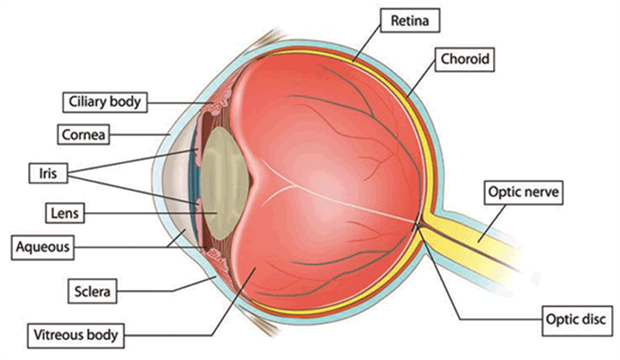
The anatomy of the human eye (via glaucoma.org)
These traditional models often render the sclera and cornea as two perfectly round, intersecting spheres, and the iris as a flat disc or cone. However, researchers at Disney point out that each of these eye features has its own uniquely irregular 3D shape, and the eye as a whole is asymmetrical and heterogeneous, with many surface details and imperfections. Furthermore, they remark that many traditional approaches do not use real eyes as models for their renderings, so these individualistic features cannot be captured.

Idealized (b) vs. realistic (c) models of the human eye
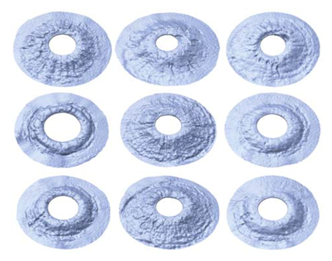
The unique, 3-D shapes of nine irises
To create replicas more true-to-life, PAPILLON captured nine eyes from six different models. They adjusted lighting to prompt the iris dilator muscle to contract and relax, causing pupil constriction and dilation, respectively. The resulting digital models accurately portray the transparency of the cornea, the imperfections of the sclera, and the constrictions and dilations of the iris.
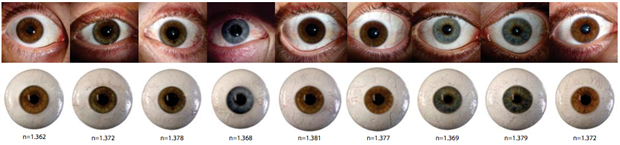
Top: human models; bottom: computer renderings. Even two eyes from the same person are not quite the same. (via Disney)
This technology, which will undoubtedly start showing up in Disney’s animated films very soon, is key for creating more realistic and even more relatable characters. Besides this, the researchers hope that their technology will be useful in other fields, with potential applications in ophthalmology.
C
See more news at: