element14 Community
element14 Community
    Register Log In
  • Site
  • Search
  • Log In Register
  • Community Hub
    Community Hub
    • What's New on element14
    • Feedback and Support
    • Benefits of Membership
    • Personal Blogs
    • Members Area
    • Achievement Levels
  • Learn
    Learn
    • Ask an Expert
    • eBooks
    • element14 presents
    • Learning Center
    • Tech Spotlight
    • STEM Academy
    • Webinars, Training and Events
    • Learning Groups
  • Technologies
    Technologies
    • 3D Printing
    • FPGA
    • Industrial Automation
    • Internet of Things
    • Power & Energy
    • Sensors
    • Technology Groups
  • Challenges & Projects
    Challenges & Projects
    • Design Challenges
    • element14 presents Projects
    • Project14
    • Arduino Projects
    • Raspberry Pi Projects
    • Project Groups
  • Products
    Products
    • Arduino
    • Avnet & Tria Boards Community
    • Dev Tools
    • Manufacturers
    • Multicomp Pro
    • Product Groups
    • Raspberry Pi
    • RoadTests & Reviews
  • About Us
  • Store
    Store
    • Visit Your Store
    • Choose another store...
      • Europe
      •  Austria (German)
      •  Belgium (Dutch, French)
      •  Bulgaria (Bulgarian)
      •  Czech Republic (Czech)
      •  Denmark (Danish)
      •  Estonia (Estonian)
      •  Finland (Finnish)
      •  France (French)
      •  Germany (German)
      •  Hungary (Hungarian)
      •  Ireland
      •  Israel
      •  Italy (Italian)
      •  Latvia (Latvian)
      •  
      •  Lithuania (Lithuanian)
      •  Netherlands (Dutch)
      •  Norway (Norwegian)
      •  Poland (Polish)
      •  Portugal (Portuguese)
      •  Romania (Romanian)
      •  Russia (Russian)
      •  Slovakia (Slovak)
      •  Slovenia (Slovenian)
      •  Spain (Spanish)
      •  Sweden (Swedish)
      •  Switzerland(German, French)
      •  Turkey (Turkish)
      •  United Kingdom
      • Asia Pacific
      •  Australia
      •  China
      •  Hong Kong
      •  India
      • Japan
      •  Korea (Korean)
      •  Malaysia
      •  New Zealand
      •  Philippines
      •  Singapore
      •  Taiwan
      •  Thailand (Thai)
      • Vietnam
      • Americas
      •  Brazil (Portuguese)
      •  Canada
      •  Mexico (Spanish)
      •  United States
      Can't find the country/region you're looking for? Visit our export site or find a local distributor.
  • Translate
  • Profile
  • Settings
Robotics
  • Technologies
  • More
Robotics
Blog Halley VI Antarctic Research Station, posh living in the arctic
  • Blog
  • Forum
  • Documents
  • Quiz
  • Events
  • Polls
  • Members
  • Mentions
  • Sub-Groups
  • Tags
  • More
  • Cancel
  • New
Join Robotics to participate - click to join for free!
  • Share
  • More
  • Cancel
Group Actions
  • Group RSS
  • More
  • Cancel
Engagement
  • Author Author: Catwell
  • Date Created: 6 Feb 2013 8:30 PM Date Created
  • Views 456 views
  • Likes 2 likes
  • Comments 1 comment
  • research
  • transportation
  • industrial
  • industry
  • manufacturing
  • field_tech
  • cabeatwell
  • prototyping
  • field_technician
  • mro
  • automation
  • sensor
  • Architecture
  • innovation
  • antarctic
Related
Recommended

Halley VI Antarctic Research Station, posh living in the arctic

Catwell
Catwell
6 Feb 2013

imageimage

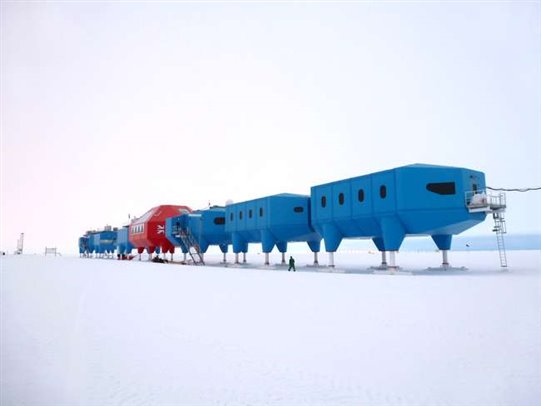
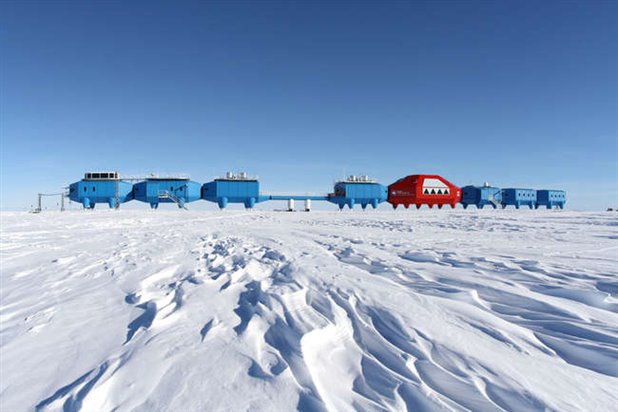
Halley VI in action (via Hugh Burghton Architects & British Antarctic Survey)


February 5th, 2013 marked the grand opening of the newly designed Halley VI Antarctic research station. For years, scientists that chose to endure year-long research exploits in the Antarctic struggled to stay sane while managing to fend off the onslaught of snow, moving ice, and frigid temperatures wreaking havoc to their home base. Now, an ingenious approach to Halley’s construction by the Hugh Broughton Architects has been built to extend the research facility’s life span while keeping the 50 or so scientists inside productive, cozy, and entertained.


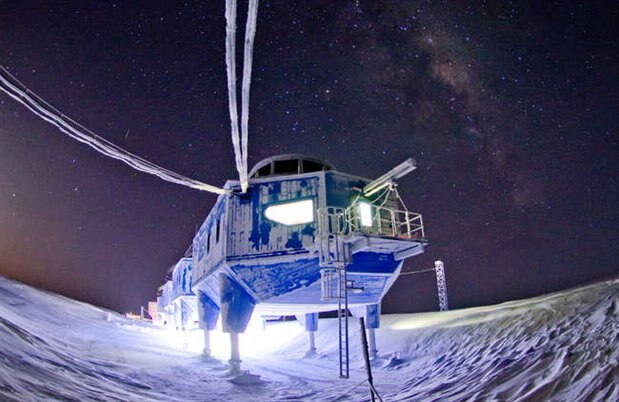
The new Halley VI research station is reminiscent of a caravan of Walkers from the Star Wars movie franchise. Though the station can’t walk, each of the station’s 8 interconnected modules is equipped with 4 retractable hydraulic legs with giant skis fitted as shoes. In order to overcome the Antarctic ice, which piles up at a rate of three feet per year, the legs are placed above three feet of snow and retract upward over the consecutive year. The skis allow the entire research station to be pulled along the ice with the help of a bulldozer - this was a crucial part of the design since the melting ice shelf flows toward the ocean at a quarter mile-per-year. The station is also oriented perpendicular to the direction of the wind, allowing the howling Antarctic breezes to drive snow away from its base.
 

image

Setting up  in the evening (via Hugh Burghton Architects & British Antarctic Survey)


Seven of the modules are painted blue, while a red module rests as a common area near the center of the research convoy. All modules are constructed of glass-reinforced plastic, to keep -60-degree weather outside, and linked together by flexible corridors.


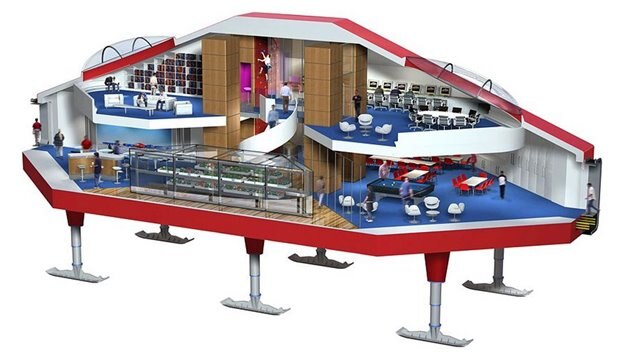
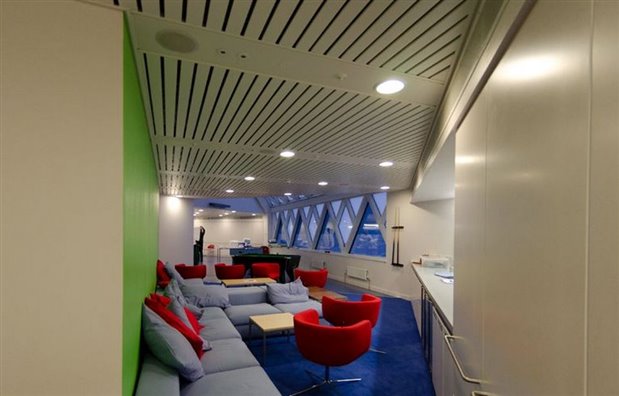
The red module is also one of the key components of the design. The platform serves as a social space for scientists to hang out and relax, consoling each other from the harsh winter blues. Battling the sub-zero temperatures, 100+ mph winds, and permanent darkness can cause scientists to experience “winter-over syndrome” - a depression and stress-filled state caused by the extreme environment. The remedy? A hydroponic salad garden for healthy eats and garden hobbyists, a climbing wall for an exciting workout, and Lebanese cedar lined walls for its pleasant scent. The architects also worked with color psychologists to design a shades for bedside lamps that simulate the rising sun.
 

imageimage

(Left) Red module concept (Right) Inside picture of final design (via Hugh Burghton Architects & British Antarctic Survey)


In addition to the common space, the research station also accommodates for air traffic controls, an operating theater, and a power plant. The renovation of the Halley VI research was a masterfully crafted feat that is now set for its life in the lonely and cold Antarctic. It is now in the hands of the many brave scientists that dare to weather the harsh environment and make use of its state-of-the-art construction. Though, it does sound cozy in there, it shouldn’t be all that bad.


Cabe

http://twitter.com/Cabe_e14

  • Sign in to reply
  • DAB
    DAB over 12 years ago

    In many ways, this design is a good starting point for both Lunar and Martian habitats.


    Face it, being in the Arctic or Antarctic is just as hazardous as being on the Moon or Mars.


    Plus you can study human dynamics of a closed society working for long periods of time far away from immediate help.


    Just a thought,

    DAB

    • Cancel
    • Vote Up 0 Vote Down
    • Sign in to reply
    • More
    • Cancel
element14 Community

element14 is the first online community specifically for engineers. Connect with your peers and get expert answers to your questions.

  • Members
  • Learn
  • Technologies
  • Challenges & Projects
  • Products
  • Store
  • About Us
  • Feedback & Support
  • FAQs
  • Terms of Use
  • Privacy Policy
  • Legal and Copyright Notices
  • Sitemap
  • Cookies

An Avnet Company © 2026 Premier Farnell Limited. All Rights Reserved.

Premier Farnell Ltd, registered in England and Wales (no 00876412), registered office: Farnell House, Forge Lane, Leeds LS12 2NE.

ICP 备案号 10220084.

Follow element14

  • X
  • Facebook
  • linkedin
  • YouTube