element14 Community
element14 Community
    Register Log In
  • Site
  • Search
  • Log In Register
  • Community Hub
    Community Hub
    • What's New on element14
    • Feedback and Support
    • Benefits of Membership
    • Personal Blogs
    • Members Area
    • Achievement Levels
  • Learn
    Learn
    • Ask an Expert
    • eBooks
    • element14 presents
    • Learning Center
    • Tech Spotlight
    • STEM Academy
    • Webinars, Training and Events
    • Learning Groups
  • Technologies
    Technologies
    • 3D Printing
    • FPGA
    • Industrial Automation
    • Internet of Things
    • Power & Energy
    • Sensors
    • Technology Groups
  • Challenges & Projects
    Challenges & Projects
    • Design Challenges
    • element14 presents Projects
    • Project14
    • Arduino Projects
    • Raspberry Pi Projects
    • Project Groups
  • Products
    Products
    • Arduino
    • Avnet & Tria Boards Community
    • Dev Tools
    • Manufacturers
    • Multicomp Pro
    • Product Groups
    • Raspberry Pi
    • RoadTests & Reviews
  • About Us
  • Store
    Store
    • Visit Your Store
    • Choose another store...
      • Europe
      •  Austria (German)
      •  Belgium (Dutch, French)
      •  Bulgaria (Bulgarian)
      •  Czech Republic (Czech)
      •  Denmark (Danish)
      •  Estonia (Estonian)
      •  Finland (Finnish)
      •  France (French)
      •  Germany (German)
      •  Hungary (Hungarian)
      •  Ireland
      •  Israel
      •  Italy (Italian)
      •  Latvia (Latvian)
      •  
      •  Lithuania (Lithuanian)
      •  Netherlands (Dutch)
      •  Norway (Norwegian)
      •  Poland (Polish)
      •  Portugal (Portuguese)
      •  Romania (Romanian)
      •  Russia (Russian)
      •  Slovakia (Slovak)
      •  Slovenia (Slovenian)
      •  Spain (Spanish)
      •  Sweden (Swedish)
      •  Switzerland(German, French)
      •  Turkey (Turkish)
      •  United Kingdom
      • Asia Pacific
      •  Australia
      •  China
      •  Hong Kong
      •  India
      • Japan
      •  Korea (Korean)
      •  Malaysia
      •  New Zealand
      •  Philippines
      •  Singapore
      •  Taiwan
      •  Thailand (Thai)
      • Vietnam
      • Americas
      •  Brazil (Portuguese)
      •  Canada
      •  Mexico (Spanish)
      •  United States
      Can't find the country/region you're looking for? Visit our export site or find a local distributor.
  • Translate
  • Profile
  • Settings
Robotics
  • Technologies
  • More
Robotics
Blog Magnetized Clay Stool  “Defies” Gravity
  • Blog
  • Forum
  • Documents
  • Quiz
  • Events
  • Polls
  • Members
  • Mentions
  • Sub-Groups
  • Tags
  • More
  • Cancel
  • New
Join Robotics to participate - click to join for free!
  • Share
  • More
  • Cancel
Group Actions
  • Group RSS
  • More
  • Cancel
Engagement
  • Author Author: Catwell
  • Date Created: 31 Oct 2014 4:24 AM Date Created
  • Views 465 views
  • Likes 0 likes
  • Comments 0 comments
  • gravity
  • wiel
  • magnetic
  • furniture
  • Design
  • cabeatwell
  • art
  • innovation
Related
Recommended

Magnetized Clay Stool  “Defies” Gravity

Catwell
Catwell
31 Oct 2014

image

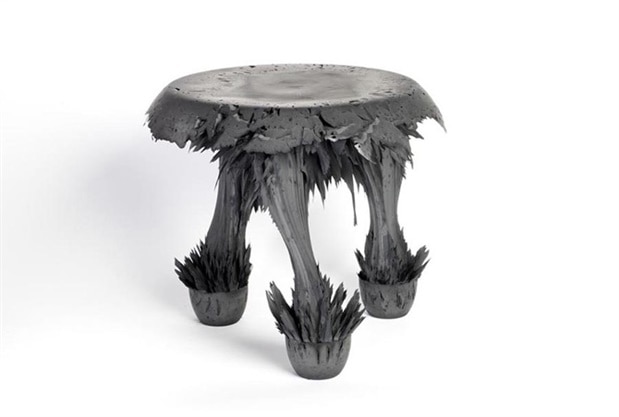
It begs to be admired... and craves to cut knees and feet. Part of the Gravity Collection (via Jolanvanderwiel.com)


Playing with magnets is fun when you're a kid but for some, like Dutch designer Jolan Van der Wiel, the fascination never ends. That's why he created the gravity stool. By using magnets, iron shavings, dye, clay and water, Wiel manipulated the gravitational pull of magnets to make a true one-of-a-kind masterpiece.


Imagine landing on Mars and seeing an upside-down icicle with a top that's just flat enough to sit on: that's the gravity chair. The galactic stool looks like something straight out of space and it is shaped by the force of gravity. Wiel designed the funky futuristic stool and believes natural forces should be used to shape more things in our modern world. Move over Frank Lloyd Wright.


The gravity stool is made by mixing iron shavings into a batch of his special clay mixture. The ratio of clay to metal is 9 to 1 and after Wiel mixes his metallic clay, he pours it into a pan. The pan (which eventually forms the seat of the stool) holds the mixture and is placed below a structure that holds three powerful magnets at just the right position to create the legs of the stool (Wiel designed the structure himself). Slowly, the now-magnetized clay in the pan begins reaching towards the magnets, bit-by-bit until it completely dries. The final product is a stone stool that was largely shaped by gravity and air pressure. Each and every stool is unique and although it's nothing you'd see at West Elm, it sure does make a great conversation piece.


Wiel's project is called Architecture meets Magnetism. While the first series of magnetic designs include funky sculptures and the gravity stool, Wiel eventually envisions entire buildings being constructed using gigantic magnets. Inspired by Gaudi's La Sagrada Familia, Wiel is set on taking his "natural" designs to the streets - and the runway--, as he hasteamed up with a fashion designer to make new, fashionable attire for the next league of space cadets. Work it R2, work it!


You don't have permission to edit metadata of this video.
Edit media
x
image
Upload Preview
image


C

See more news at:

http://twitter.com/Cabe_Atwell

  • Sign in to reply
element14 Community

element14 is the first online community specifically for engineers. Connect with your peers and get expert answers to your questions.

  • Members
  • Learn
  • Technologies
  • Challenges & Projects
  • Products
  • Store
  • About Us
  • Feedback & Support
  • FAQs
  • Terms of Use
  • Privacy Policy
  • Legal and Copyright Notices
  • Sitemap
  • Cookies

An Avnet Company © 2025 Premier Farnell Limited. All Rights Reserved.

Premier Farnell Ltd, registered in England and Wales (no 00876412), registered office: Farnell House, Forge Lane, Leeds LS12 2NE.

ICP 备案号 10220084.

Follow element14

  • X
  • Facebook
  • linkedin
  • YouTube