element14 Community
element14 Community
    Register Log In
  • Site
  • Search
  • Log In Register
  • Community Hub
    Community Hub
    • What's New on element14
    • Feedback and Support
    • Benefits of Membership
    • Personal Blogs
    • Members Area
    • Achievement Levels
  • Learn
    Learn
    • Ask an Expert
    • eBooks
    • element14 presents
    • Learning Center
    • Tech Spotlight
    • STEM Academy
    • Webinars, Training and Events
    • Learning Groups
  • Technologies
    Technologies
    • 3D Printing
    • FPGA
    • Industrial Automation
    • Internet of Things
    • Power & Energy
    • Sensors
    • Technology Groups
  • Challenges & Projects
    Challenges & Projects
    • Design Challenges
    • element14 presents Projects
    • Project14
    • Arduino Projects
    • Raspberry Pi Projects
    • Project Groups
  • Products
    Products
    • Arduino
    • Avnet & Tria Boards Community
    • Dev Tools
    • Manufacturers
    • Multicomp Pro
    • Product Groups
    • Raspberry Pi
    • RoadTests & Reviews
  • About Us
  • Store
    Store
    • Visit Your Store
    • Choose another store...
      • Europe
      •  Austria (German)
      •  Belgium (Dutch, French)
      •  Bulgaria (Bulgarian)
      •  Czech Republic (Czech)
      •  Denmark (Danish)
      •  Estonia (Estonian)
      •  Finland (Finnish)
      •  France (French)
      •  Germany (German)
      •  Hungary (Hungarian)
      •  Ireland
      •  Israel
      •  Italy (Italian)
      •  Latvia (Latvian)
      •  
      •  Lithuania (Lithuanian)
      •  Netherlands (Dutch)
      •  Norway (Norwegian)
      •  Poland (Polish)
      •  Portugal (Portuguese)
      •  Romania (Romanian)
      •  Russia (Russian)
      •  Slovakia (Slovak)
      •  Slovenia (Slovenian)
      •  Spain (Spanish)
      •  Sweden (Swedish)
      •  Switzerland(German, French)
      •  Turkey (Turkish)
      •  United Kingdom
      • Asia Pacific
      •  Australia
      •  China
      •  Hong Kong
      •  India
      • Japan
      •  Korea (Korean)
      •  Malaysia
      •  New Zealand
      •  Philippines
      •  Singapore
      •  Taiwan
      •  Thailand (Thai)
      • Vietnam
      • Americas
      •  Brazil (Portuguese)
      •  Canada
      •  Mexico (Spanish)
      •  United States
      Can't find the country/region you're looking for? Visit our export site or find a local distributor.
  • Translate
  • Profile
  • Settings
Robotics
  • Technologies
  • More
Robotics
Blog Microsoft’s Cube responds to sound and motion
  • Blog
  • Forum
  • Documents
  • Quiz
  • Events
  • Polls
  • Members
  • Mentions
  • Sub-Groups
  • Tags
  • More
  • Cancel
  • New
Join Robotics to participate - click to join for free!
  • Share
  • More
  • Cancel
Group Actions
  • Group RSS
  • More
  • Cancel
Engagement
  • Author Author: Catwell
  • Date Created: 17 Oct 2014 7:49 PM Date Created
  • Views 486 views
  • Likes 0 likes
  • Comments 0 comments
  • microsoft
  • imaging
  • Cube
  • cabeatwell
  • dev
  • art
  • machine_vision
  • kinect
Related
Recommended

Microsoft’s Cube responds to sound and motion

Catwell
Catwell
17 Oct 2014


image

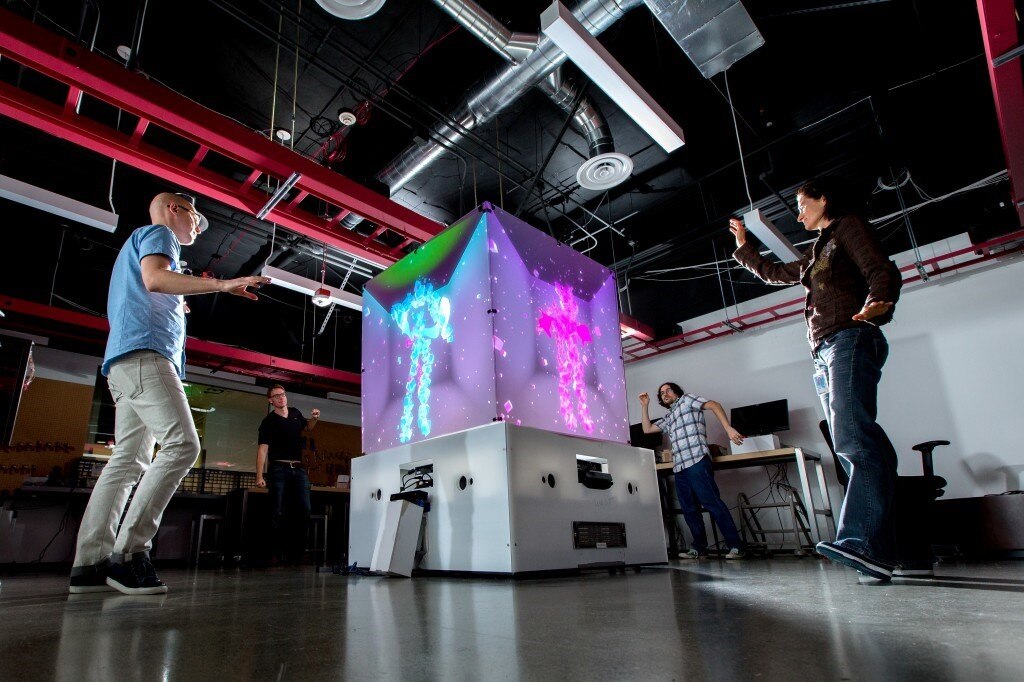
Microsoft Cube in action. Looks like a fun device for a club or art project... (via Microsoft)


Sometimes a tech company’s best intentions can go astray.  Take, for example, Microsoft’s Cube, a Kinect-powered interactive art installation that is supposed to be unlike anything you’ve ever seen… except, that you have seen it before…


The Microsoft Cube is a cube structure composed of five, four-foot-tall, clear acrylic-coated, transparent projection screens. It is an interactive art/technology installation that gives off an interactive light show that responds to sound and movement. For example, when someone dances in front of one of the cube’s screens, the shape and movement of their body is mimicked by a reflection of bright color (think old iPod commercials). The same happens when music is played near the Cube. While this idea is definitely not original as far as LED or light-centered interactive art is concerned, Microsoft’s methodology is at least notable.


The Cube is made possible by interconnecting four Kinect systems, five computers and five projection screens in such a way that all units work as a cohesive system, a project which took a team of techies months to figure out. Regardless, it is done and the finished Cube was featured at this year’s Decibel International Festival for Electronic Music, Digital Art and New Media in Seattle, WA. While in my opinion Microsoft won’t be taking the place of MIT or Google any time soon (as far as world leader in innovation goes), Microsoft was successful in creating an art installation that combined art and technology.


The purpose of the Cube was to inspire others to get more creative with technology. The project set out to pose the question ‘what could happen if technology-based innovation met art and had a baby?’ Hopefully children more useful than the Cube would be born, but at least Microsoft asked the question. Now, sit back and give the big boys (and the new kids on the block) some time to answer.


C

See more news at:

http://twitter.com/Cabe_Atwell

  • Sign in to reply
element14 Community

element14 is the first online community specifically for engineers. Connect with your peers and get expert answers to your questions.

  • Members
  • Learn
  • Technologies
  • Challenges & Projects
  • Products
  • Store
  • About Us
  • Feedback & Support
  • FAQs
  • Terms of Use
  • Privacy Policy
  • Legal and Copyright Notices
  • Sitemap
  • Cookies

An Avnet Company © 2025 Premier Farnell Limited. All Rights Reserved.

Premier Farnell Ltd, registered in England and Wales (no 00876412), registered office: Farnell House, Forge Lane, Leeds LS12 2NE.

ICP 备案号 10220084.

Follow element14

  • X
  • Facebook
  • linkedin
  • YouTube