


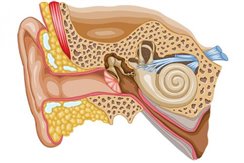


An ear, now the device install, and the actual chip created. Now if only the battery can be internal too... (via MIT)
Massachusetts Institute of Technology’s Microsystems Technology Laboratory, in collaboration with physicians from the Massachusetts Eye and Ear Infirmary and Harvard Medical School, recently announced the development of a wireless, energy-efficient, signal-processing chip that could lead to the development of a cochlear implant without external hardware.
Cochlear implants are electronic devices that electrically stimulate the auditory nerve to allow deaf persons the ability to hear. The device includes a circular transmitter that must be surgically fixed to the skull, a powered microphone that looks like a large hearing aid and a wire joining the two. The development of the new chip, however, allows for the possibility of deaf persons gaining hearing without the need for bulky equipment or a skull-based installation.
The device was revealed at the International Solid-State Circuits Conference by lead researcher Marcus Yip and colleagues Nathan Ickes and Rui Jin, all from MIT. At the conference, the research team showed a prototype charger for the device, which can be connected to a common cell phone and wirelessly recharges the signal-processing chip within approximately two minutes. The team developed the charger as a way to allow for the recharging of the device without the need for an electrical outlet. The researchers also announced that a Smart pillow charger may be in the works in the near future.
The new device works by relying on the natural microphone of the human middle ear, which is usually intact in cochlear-implant patients and eliminates the need for an external microphone. The device functions through converting electrical signals to electrodes in the cochlear through a low-power microchip implant which is surgically installed in the inner ear.
The new chip is between 20 and 30 percent more energy efficient than current cochlear implant sensor-processing chips because it uses a basic electrical signal encoded with acoustic information that effectively stimulates the auditory nerve. It is expected to function for up to eight hours at a time on a single charge.
A cochlear implant using the new technology would involve a more complex medical procedure than existing devices, but it would also offer patients more freedom. Since the new device has no external hardware, patients do not need to remove hardware before going swimming and do not have to worry about devices getting lost or stolen. Also, the new technology offers aesthetic benefits, as the implant will not be visible to the naked eye.
There has not been any word on when we can expect to see the internal implants in practical use, but small-scale clinical studies have been conducted and were reported to have been successful.
C
See more news at: