


Research team leader, David Glanzman, holding his research subject (via UCLA)
A recent study by neuroscientists at UCLA may signal a paradigm shift in the study of long-term memory formation and storage. For a while now, brain scientists have believed that long-term memories are stored in the synapses (connections between neurons that facilitate chemical and electrical communication between the cells). However, the UCLA research team, led by David Glanzman, offers a radically different view, presenting the possibility that memories thought to be lost forever can be restored with the right tweaking.
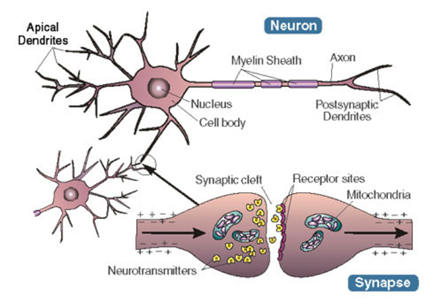
Illustration of a neural synapse. (via genius.com)
The UCLA team used a sea slug called Aplysia to examine the process of long-term memory formation. With a simple neural circuit wiring underlying its famous gill withdrawal reflex, it’s the perfect animal for studying learning and memory.

Aplysia californica, hiding its precious gill in those flaps. (via whitney.ufl.edu)
The withdrawal reflex pathway is comprised of sensory and motor neurons mediated by the neurotransmitter serotonin. The UCLA team enhanced Aplysia’s withdrawal reflex by shocking it several times. The frightened Aplysia became jumpy, withdrawing its delicate gill more enthusiastically for days after the shocks; it had formed a simple long-term memory. It is well-known that, during this process, new synapses are formed between the activated neurons. This synaptic formation, which also characterizes mammalian learning, is what led neuroscientists to conclude that memory is indeed stored in synaptic connections.
Next, the UCLA researchers replicated this memory-inducing technique in a Petri dish by removing Aplysia’s neural circuitry for the gill withdrawal reflex and plating the neurons. Instead of using shocks to induce memory formation, they added serotonin directly into the Petri dish and watched as new synaptic connections were formed, indicating that learning had occurred. However, if serotonin addition was immediately followed by the introduction of a substance that inhibited the synthesis of the proteins crucial for directing synaptic formation, the researchers discovered that new synapses were not formed. But this was only when the protein synthesis inhibitor was added immediately after; when it instead was introduced 24 hours later, the synapses still formed normally, signaling the successful establishment of a new memory.
The scientists also found that memories formed this way could be unlearned, too--at least, on the surface. They trained the neural circuitry with serotonin like before, waited 24 hours, and then pulsed serotonin through one more time to “reconsolidate” the memory, immediately following with the protein synthesis inhibitor. This seemed to cause erasure of the memory, reverting the cells back to a pre-learning state and resetting the number of synapses. But, surprisingly, the synapses that were lost by this process were not the same ones that had been formed upon learning. This randomness implies that the synapses themselves are not responsible for storing memory.
But here is the cool part--the UCLA team replicated this memory-erasing process in Aplysia, seemingly eradicating its memories. They shocked it again, but at currents known to be too low to induce long-term memory formation. However, the memory came back to Aplysia anyway, indicating that synaptic connections had re-formed between the appropriate neurons.
If memory storage takes place not in our volatile synaptic connections, but in the neurons themselves (as this study indicates), memories may be more resilient to corruption than we thought, and we may be able to restore them if forgotten. “The nervous system appears to be able to regenerate lost synaptic connections,” says Glanzman, a member of UCLA’s Brain Research Institute and a professor of integrative biology and physiology as well as neurobiology. “If you can restore the synaptic connections, the memory will come back. It won’t be easy, but I believe it’s possible.” Instead of in the synapses, Glanzman has an inkling that memories are actually stored in the nucleus of the neuron, where genetic information is kept and important proteins are synthesized.
That “lost” memories can be restored is good news for everyone, but especially those suffering from Alzheimer’s disease. Glanzman predicts that “as long as the neurons are still alive, the memory will still be there, which means you may be able to recover some of the lost memories in the early stages of Alzheimer’s.” We’ll be waiting eagerly for more discoveries about this phenomenon.
C
See more news at: