


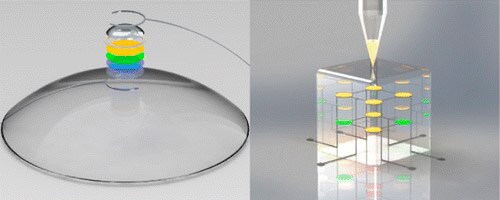
Printed LEDs from bionic nanomaterials by McAlpine Research Group (via McAlpine Research Group)
The McAlpine Research Group from Princeton University are the first to successfully 3D print fully functional quantum dot LEDs. Not only did the group successfully print LEDs, but all of the electrical components, housings, and more have been 3D printed as well, making this the first functioning electrical device to be 3D printed from scratch.
The creation of LEDs may not be as exciting as a Star Trek device that 3D prints any type of food you can think of (and yes – I do wish this existed), but it opens up new possibilities. Michael McAlpine and his team of researchers have been leading some cutting-edge scientific discoveries in the realm of nanotechnology, biomedicine, and energy sciences. Previously, the team was working on a method of generating power from bodily functions like breathing and walking.
In order to successfully harness energy from bodily functions, they created rubber films that were able to generate and capture energy from flexing as the body moves naturally. In another first, McAlpine's nanoribbons are the first to combine silicone and lead ziconate titanate (PZT) into a material 100 times thinner than a single millimeter.
Jumping off from this breakthrough, McAlpine and his team decided to take the world of 3D printing further and innovate ways of printing an entire electrical device in one go. Their final product is a box containing working quantum dot LEDs, which are 3D printed using 5 different materials.
The 3D printer was developed in six months and cost $20,000 but the ability of the machine is impressive. In particular the materials used are a variable mixture of inorganic and organic nanoparticles, metals, and polymers. Considering most 3D printers can only use plastic, powder, and possibly metal, this is very impressive. Another interesting aspect of this 3D printer is that it is able to 3D print the LEDs on a curvilinear surface. This may lend itself to the production of things like 3D printed contact lenses and biomedical implants, according to McAlpine.
The LEDs are made of five layers, of which the bottom layer is a ring of silver nanoparticles to conduct electricity which is being supplied by two polymer layers that move the electrical current to the third layer of the LED which is made of cadmium selenide nanoparticles within a zinc sulfide shell and a cathode ray layer made of eutectic gallium indium.
Put all this together and you basically have an LED that creates orange or green light by forcing electrons to crash into the quantum dots. The overall electrical design is also interesting and efficient, pointing towards new future developments in the area of 3D printing electronic devices.
The McAlpine Research team is expecting that continued efforts in 3D printing electronic devices using nanoparticles will result in biomedical implants being developed. Perhaps DARPA will use this idea to develop a microchip that is small enough to inject into soldiers' brains.
C
See more news at: