element14 Community
element14 Community
    Register Log In
  • Site
  • Search
  • Log In Register
  • Community Hub
    Community Hub
    • What's New on element14
    • Feedback and Support
    • Benefits of Membership
    • Personal Blogs
    • Members Area
    • Achievement Levels
  • Learn
    Learn
    • Ask an Expert
    • eBooks
    • element14 presents
    • Learning Center
    • Tech Spotlight
    • STEM Academy
    • Webinars, Training and Events
    • Learning Groups
  • Technologies
    Technologies
    • 3D Printing
    • FPGA
    • Industrial Automation
    • Internet of Things
    • Power & Energy
    • Sensors
    • Technology Groups
  • Challenges & Projects
    Challenges & Projects
    • Design Challenges
    • element14 presents Projects
    • Project14
    • Arduino Projects
    • Raspberry Pi Projects
    • Project Groups
  • Products
    Products
    • Arduino
    • Avnet & Tria Boards Community
    • Dev Tools
    • Manufacturers
    • Multicomp Pro
    • Product Groups
    • Raspberry Pi
    • RoadTests & Reviews
  • About Us
    About the element14 Community
  • Store
    Store
    • Visit Your Store
    • Choose another store...
      • Europe
      •  Austria (German)
      •  Belgium (Dutch, French)
      •  Bulgaria (Bulgarian)
      •  Czech Republic (Czech)
      •  Denmark (Danish)
      •  Estonia (Estonian)
      •  Finland (Finnish)
      •  France (French)
      •  Germany (German)
      •  Hungary (Hungarian)
      •  Ireland
      •  Israel
      •  Italy (Italian)
      •  Latvia (Latvian)
      •  
      •  Lithuania (Lithuanian)
      •  Netherlands (Dutch)
      •  Norway (Norwegian)
      •  Poland (Polish)
      •  Portugal (Portuguese)
      •  Romania (Romanian)
      •  Russia (Russian)
      •  Slovakia (Slovak)
      •  Slovenia (Slovenian)
      •  Spain (Spanish)
      •  Sweden (Swedish)
      •  Switzerland(German, French)
      •  Turkey (Turkish)
      •  United Kingdom
      • Asia Pacific
      •  Australia
      •  China
      •  Hong Kong
      •  India
      •  Japan
      •  Korea (Korean)
      •  Malaysia
      •  New Zealand
      •  Philippines
      •  Singapore
      •  Taiwan
      •  Thailand (Thai)
      •  Vietnam
      • Americas
      •  Brazil (Portuguese)
      •  Canada
      •  Mexico (Spanish)
      •  United States
      Can't find the country/region you're looking for? Visit our export site or find a local distributor.
  • Translate
  • Profile
  • Settings
Robotics
  • Technologies
  • More
Robotics
Blog Repairing a Vendo V-80 cola dispencer of the 1950s
  • Blog
  • Forum
  • Documents
  • Quiz
  • Events
  • Polls
  • Members
  • Mentions
  • Sub-Groups
  • Tags
  • More
  • Cancel
  • New
Join Robotics to participate - click to join for free!
  • Share
  • More
  • Cancel
Group Actions
  • Group RSS
  • More
  • Cancel
Engagement
  • Author Author: Jan Cumps
  • Date Created: 16 Nov 2014 12:31 AM Date Created
  • Views 5142 views
  • Likes 4 likes
  • Comments 13 comments
  • hack
  • vintage
  • repair
Related
Recommended

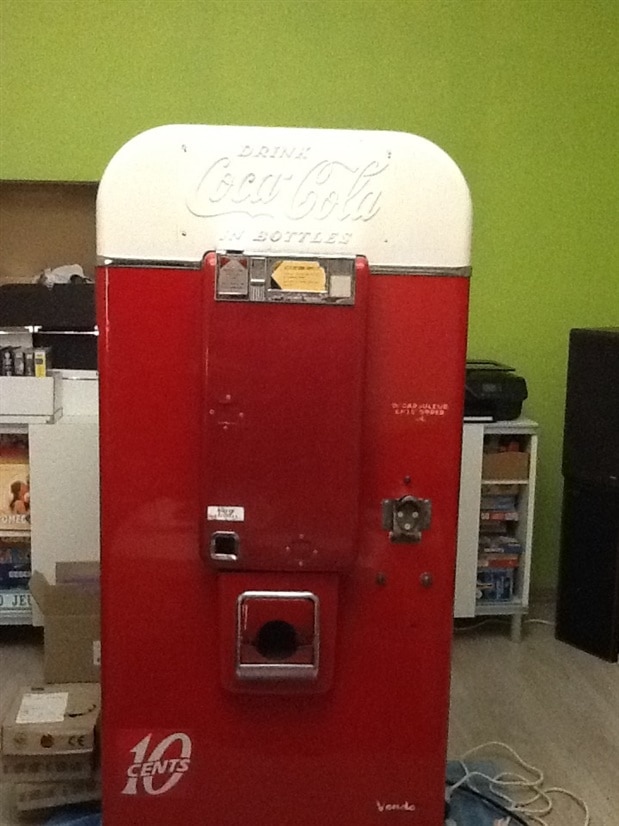
Repairing a Vendo V-80 cola dispencer of the 1950s

Jan Cumps
Jan Cumps
16 Nov 2014

One of my friends has bought a soft drink bottle cooler as a present for his partner.

The outside of the machine is agreeable, but the state of the electr(on)ics is bad. More than 20 wires have been cut off by previous owners and restorers. The only part that still works is the refrigerator.
image

At this moment I'm assessing the damage done by previous repairs, and building a plan to make the cooler dispense bottles in some way.


My current assessment:

- the motor that activates the vending cycle is toast. So is the gear box of that motor.

- the coin validation mechanism is incomplete and doesn't work anymore.

- everywhere I look wires are cut and bodged together in a seemingly random way. Someone had a go at it, but I think that person was not restricted by any relevant knowledge image


I'm planning to decipher the circuit (I purchased a service manual on-line), get the basic mechanism working again, and replace the coin detector by  an optical interrupter.


I'm on a deadline. The cooler is for the girlfriend's birthday. And I'm invited late to the party. My design decisions will be guided by time and 'having the parts available at home' more than efficient solutions.

  • Sign in to reply

Top Comments

  • Jan Cumps
    Jan Cumps over 10 years ago +3
    Epilogue: The girl left. Expensive gifts don't guarantee good relations.
  • gadget.iom
    gadget.iom over 10 years ago in reply to Jan Cumps +2
    Well thats a testament to good workmanship!
  • Robert Peter Oakes
    Robert Peter Oakes over 11 years ago in reply to doctorcdf +1
    The Internet of Cola , publish temp, use, stock qty etc on line for all to see, maybe even a WEB cam to post who is at the machine
  • gadget.iom
    gadget.iom over 11 years ago

    It's great to see old classics being restored. Good work!

    • Cancel
    • Vote Up +1 Vote Down
    • Sign in to reply
    • More
    • Cancel
  • Jan Cumps
    Jan Cumps over 11 years ago

    As a wrap up for my work, a few thoughts on why I went for this particular solution, and a capture of coin detect test and final test with motor and bottles.


    I could have taken a number of other approaches. A microcontroller is not needed for this kind of functionality. But I have been working with constraints.

    We did not know what was all defect. We knew coin detection did not work, and that the whole machine with bypassed coin detector didn't work either. A µC gave me more flexibility to also solve issues with other detectors and actuators.

    Time: It was a present from someone to someone for her birthday. I focused on things that I had lying around. All components are second hand (Arduino, power adapter, relais, protoboard, caps) or recovery (IR opto-coupler, led's, resistors, semiconductors and trimpot).


    video: review the coin handler

    You don't have permission to edit metadata of this video.
    Edit media
    x
    image
    Upload Preview
    image


    I don't know that making a dedicated circuit would have been more economical for a one-off like this. That doesn't mean a lot though if you compare it to the price of the motor revision.

    image

    We achieved our main goal. The vending machine is ready in time. We'll be packing it and hide it in the garage. The lucky one will get an envelope with a single coin without explanation, and we'll walk her to the garage with that. She can then buy the first botle.


    Us celebrating the working machine:


    You don't have permission to edit metadata of this video.
    Edit media
    x
    image
    Upload Preview
    image


    Hooray!

    • Cancel
    • Vote Up +1 Vote Down
    • Sign in to reply
    • More
    • Cancel
  • Jan Cumps
    Jan Cumps over 11 years ago

    The machine is back to functional.During the time that the motor was under revision, I've built in the coin detector. Also the re-wiring of the circuit has been reviewed and fixed where needed.


    image


    image


    The motor is now back (the costs to rewind the coils and have the gear box fixed are significant). And we have done successful tests.

    In the video below, taken at the time I was reviewing the machine's state, you don't see all of that yet. It's covering the review of what's wrong.


    You don't have permission to edit metadata of this video.
    Edit media
    x
    image
    Upload Preview
    image

    • Cancel
    • Vote Up 0 Vote Down
    • Sign in to reply
    • More
    • Cancel
  • doctorcdf
    doctorcdf over 11 years ago in reply to Jan Cumps

    Jan -


    If you're willing to blog about the project, we'll be happy to look at supplying you the parts.  The "Internet of Cola" isn't a bad title (thanks Peter!)


    Best Regards, Christian

    • Cancel
    • Vote Up 0 Vote Down
    • Sign in to reply
    • More
    • Cancel
  • Jan Cumps
    Jan Cumps over 11 years ago

    Yeah, there is a whole series of mods that can be hacked into the machine. First I could replace the mechanical switches with sensors (optical or magnetic), the cooling thermostat and motor controls are other candidates for modification.

    I can't use the current actuators for low voltage though. The state of the contacts and the amount of bounce is dazzling. It works to activate the 110 V relais, but no chance to get a decent 3.3 or 5V signal.


    Some action photos:

    measuring the motor circuit:

    image


    coin detector


    image


    detector proto


    image


    Some hardware:


       imageimage


    imageimageimage


    my proto code


    /*
    // vento V-80 controls
    // no copyright jc 2014
     */
    
    // the actuator relais that will engage when coin is detected
    #define RELAIS 8 
    // the analog input signal from IR detection circuit
    #define IR 0
    // how long is the relais actuated when coin detected
    #define PULSE_WIDTH 750
    // at this level (from 0 to 1023) we consider the IR channel interrupted
    #define THREASHOLD 450
    // status led
    #define RELAIS_STATUS_LED 12
    #define IR_STATUS_LED 10


    // the setup function runs once when you press reset or power the board
    void setup() {
      // initialize the relais pin, so thzt it always assumes not-engaged status at startup and reset
      pinMode(RELAIS, OUTPUT);
      digitalWrite(RELAIS, LOW);
      // mark the infrared detection pin as input input
      pinMode(IR, INPUT);
      // mark the status led as output
      pinMode(RELAIS_STATUS_LED, OUTPUT);
      digitalWrite(RELAIS_STATUS_LED, LOW);
      pinMode(IR_STATUS_LED, OUTPUT);
      digitalWrite(IR_STATUS_LED, LOW);
      
      
      // debug settings
      Serial.begin(9600);
    }
    
    
    // the loop function runs over and over again forever
    void loop() {
      
      // when a coin is detected, we actuate the relais for the time defined by THREASHOLD
      if (detectCoin()) {
        digitalWrite(RELAIS, HIGH);
        digitalWrite(IR_STATUS_LED, HIGH);
        digitalWrite(RELAIS_STATUS_LED, HIGH);
        delay(50); // pulse the coin detect led for a moment
        digitalWrite(IR_STATUS_LED, LOW);
        
        delay(PULSE_WIDTH - 50); // keep the relais engaged for the THREASHOLD time, minus the time that we've spent on flashing thr coin led
        digitalWrite(RELAIS, LOW);
        digitalWrite(RELAIS_STATUS_LED, LOW);
      }
    
    }


    /* 
      return TRUE when we detect that the IR channel in disturbed (i.e.: a coin is passing through it)
      That is the case when the voltage presented on analog pin IR drops below THREASHOLD.
    */  
      
    bool detectCoin() {
      // measure the voltage of the IR circuit
      int iSensorValue = analogRead(IR);
      
      // debug info
      char output[80];
      sprintf(output, "Sensor: %d\n", iSensorValue);  
      Serial.print(output); 
    
      // if the detected voltage is below THREASHOLD, a coin is passing through the channel  
      return (iSensorValue < THREASHOLD); // there is something in the IR path
    }

    • Cancel
    • Vote Up 0 Vote Down
    • Sign in to reply
    • More
    • Cancel
<>
element14 Community

element14 is the first online community specifically for engineers. Connect with your peers and get expert answers to your questions.

  • Members
  • Learn
  • Technologies
  • Challenges & Projects
  • Products
  • Store
  • About Us
  • Feedback & Support
  • FAQs
  • Terms of Use
  • Privacy Policy
  • Legal and Copyright Notices
  • Sitemap
  • Cookies

An Avnet Company © 2026 Premier Farnell Limited. All Rights Reserved.

Premier Farnell Ltd, registered in England and Wales (no 00876412), registered office: Farnell House, Forge Lane, Leeds LS12 2NE.

ICP 备案号 10220084.

Follow element14

  • X
  • Facebook
  • linkedin
  • YouTube