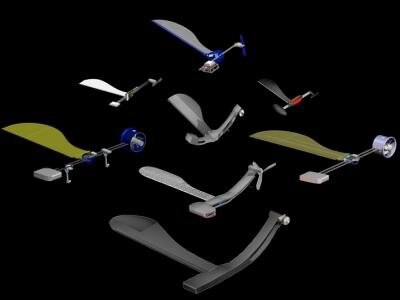
Some type of trees disperse their seeds by releasing ‘helicopters’, those single-winged seeds that are also called ‘samaras’. As these seeds fall to the ground, their wing causes them to swirl and spin in a process called autorotation, similar to man-made helicopters. In a new study, researchers have designed and built a mechanical samara whose dynamics are very similar to those of nature’s samaras. After testing the mechanical samara, the researchers then built a variety of remote-controlled robotic samaras with onboard power source. After further investigating the samara seed in order to better understand its flight dynamics, the researchers found that the winged seed is also one of nature’s most efficient fliers. The samara is a monocopter, meaning it has a single wing. For this reason, the samara has no stationary frame of reference, unlike a two-winged helicopter, and appears to fall in a complex way. However, through free-fall testing, the researchers could quantitatively measure the samara’s flight dynamics and use this information to control the samara’s autorotation and flight path. After designing and building a mechanical samara, the researchers measured its flight dynamics in free-fall by dropping it from a height of 12 meters. Then the scientists used this data to develop three different designs of powered robotic samaras, ranging in size from 7.5 cm to 0.5 m. In flight tests, they demonstrated that the carbon fiber-based robotic samaras could be remotely steered to a desired location by altering the wing pitch, which changes the radius at which the vehicles turn. The robotic samaras could also hover, climb, and translate.
The samara-inspired autorotation process has several advantages compared to other small-scale aircraft that perform vertical take-off and landing. For instance, the robotic samaras are extremely damage-tolerant. If they lose power while flying, they can autorotate down and land without sustaining any damage due to their flexible structure that deflects upon impact. The robotic samaras are also passively stable, inexpensive, mechanically simple, and have a high payload capacity. Flight time is around 30 minutes, but depends on the battery size. See more at roboseed.com
Eavesdropper