element14 Community
element14 Community
    Register Log In
  • Site
  • Search
  • Log In Register
  • Community Hub
    Community Hub
    • What's New on element14
    • Feedback and Support
    • Benefits of Membership
    • Personal Blogs
    • Members Area
    • Achievement Levels
  • Learn
    Learn
    • Ask an Expert
    • eBooks
    • element14 presents
    • Learning Center
    • Tech Spotlight
    • STEM Academy
    • Webinars, Training and Events
    • Learning Groups
  • Technologies
    Technologies
    • 3D Printing
    • FPGA
    • Industrial Automation
    • Internet of Things
    • Power & Energy
    • Sensors
    • Technology Groups
  • Challenges & Projects
    Challenges & Projects
    • Design Challenges
    • element14 presents Projects
    • Project14
    • Arduino Projects
    • Raspberry Pi Projects
    • Project Groups
  • Products
    Products
    • Arduino
    • Avnet & Tria Boards Community
    • Dev Tools
    • Manufacturers
    • Multicomp Pro
    • Product Groups
    • Raspberry Pi
    • RoadTests & Reviews
  • About Us
  • Store
    Store
    • Visit Your Store
    • Choose another store...
      • Europe
      •  Austria (German)
      •  Belgium (Dutch, French)
      •  Bulgaria (Bulgarian)
      •  Czech Republic (Czech)
      •  Denmark (Danish)
      •  Estonia (Estonian)
      •  Finland (Finnish)
      •  France (French)
      •  Germany (German)
      •  Hungary (Hungarian)
      •  Ireland
      •  Israel
      •  Italy (Italian)
      •  Latvia (Latvian)
      •  
      •  Lithuania (Lithuanian)
      •  Netherlands (Dutch)
      •  Norway (Norwegian)
      •  Poland (Polish)
      •  Portugal (Portuguese)
      •  Romania (Romanian)
      •  Russia (Russian)
      •  Slovakia (Slovak)
      •  Slovenia (Slovenian)
      •  Spain (Spanish)
      •  Sweden (Swedish)
      •  Switzerland(German, French)
      •  Turkey (Turkish)
      •  United Kingdom
      • Asia Pacific
      •  Australia
      •  China
      •  Hong Kong
      •  India
      •  Korea (Korean)
      •  Malaysia
      •  New Zealand
      •  Philippines
      •  Singapore
      •  Taiwan
      •  Thailand (Thai)
      • Americas
      •  Brazil (Portuguese)
      •  Canada
      •  Mexico (Spanish)
      •  United States
      Can't find the country/region you're looking for? Visit our export site or find a local distributor.
  • Translate
  • Profile
  • Settings
Robotics
  • Technologies
  • More
Robotics
Blog Researchers use muscle stimulants to simulate walls in VR
  • Blog
  • Forum
  • Documents
  • Quiz
  • Events
  • Polls
  • Members
  • Mentions
  • Sub-Groups
  • Tags
  • More
  • Cancel
  • New
Join Robotics to participate - click to join for free!
  • Share
  • More
  • Cancel
Group Actions
  • Group RSS
  • More
  • Cancel
Engagement
  • Author Author: Catwell
  • Date Created: 19 Apr 2017 8:58 PM Date Created
  • Views 560 views
  • Likes 0 likes
  • Comments 0 comments
  • haptic
  • research
  • touch
  • hmi
  • on_campus
  • cabeatwell
  • vr
  • school
  • interface
  • university
  • innovation
  • virtual reality
Related
Recommended

Researchers use muscle stimulants to simulate walls in VR

Catwell
Catwell
19 Apr 2017

image

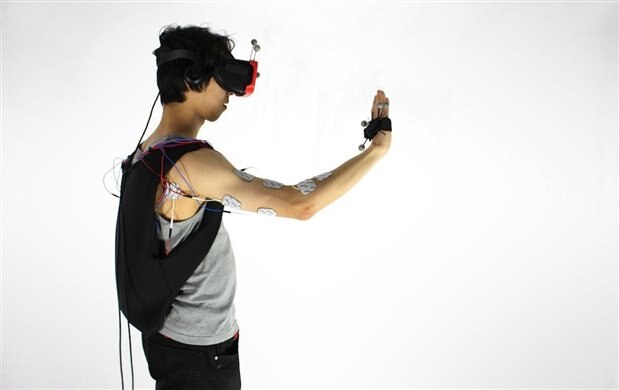
A team from Hasso-Plattner-Institut create a new wearable using muscle stimulants to create walls in VR. The muscle stimulants simulate the fulling of resistance in objects. (Photo via Hasso-Plattner-Institut)


With VR technology integrated into full body suits, robotic hands, gloves, and exoskeletons, it’s becoming easier to mimic physical sensations. Even gaming sets like the HTC Vice does a good job at making you feel like you’re actually in the game you’re playing. But one thing VR hasn’t exactly nailed is creating impressions of realistic space. A team of researcher’s from Hasso-Plattner-Institut in Potsdam are looking to bring this experience to VR with their latest haptic system.


The team, led by Pedro Lopes, created a wearable setup made out of medical grade eight channel muscle simulators (EMS) installed in a backpack. The setup is controlled by a VR system that works with Samsung GearVR via USB. It also uses hand mount trackers and a motion capture system to track your movements. The electrodes are strapped on to your forearm, bicep, tricep, and shoulder on each arm. When you touch or lift a virtual object, a mild electric shock will automatically fire off giving you the feeling of weight and resistance of an object.


It took several tries for researchers to come up with a realistic simulation. After much trial and error, they eventually developed two different simulators. For the first one, they keep the EMS intensity at a certain limit. This let users interact with simulated objects by about 10 cm, which is ideal for soft things. For the second, a short EMS pulse was used and sent the user’s hand backward, preventing them from pushing through walls or other objects. And though the idea of using electric shocks for VR sounds scary, they aren’t strong enough to hurt you.


While using muscle stimulants for the VR experience is new, the technology itself isn’t. EMS is an essential part of physical therapy and training. Other companies are even finding ways of incorporating the technology for entertainment purposes, like Teslasuit. This is a full body suit for haptics in VR that relies on EMS. Lopes himself has even used the system for other projects, like feeling physical impacts in VR and an art project that forces users to keep cranking a machine lever due to EMS electrodes. He even tried to create barriers in VR three years ago, but wasn’t satisfied with the results.


Though the new system achieved favorable results, there’s still work to be done before it’s ready for the commercial market. For one, the team wants to streamline the design. Right now, the system is easy to wear, isn’t very big, and portable, but it’s not all that nice to look at. When the system finally is ready, it will bring us a step closer to a fully immersive VR experience. Imagine playing games and actually feeling the weight of objects or the sensation of brushing up against a wall. Is it necessary? Not really, but it may serve for a better VR experience. For now, you’ll have to rely on your imagination until the system is ready.


You don't have permission to edit metadata of this video.
Edit media
x
image
Upload Preview
image


Have a story tip? Message me at: cabe(at)element14(dot)com

http://twitter.com/Cabe_Atwell

  • Sign in to reply
element14 Community

element14 is the first online community specifically for engineers. Connect with your peers and get expert answers to your questions.

  • Members
  • Learn
  • Technologies
  • Challenges & Projects
  • Products
  • Store
  • About Us
  • Feedback & Support
  • FAQs
  • Terms of Use
  • Privacy Policy
  • Legal and Copyright Notices
  • Sitemap
  • Cookies

An Avnet Company © 2025 Premier Farnell Limited. All Rights Reserved.

Premier Farnell Ltd, registered in England and Wales (no 00876412), registered office: Farnell House, Forge Lane, Leeds LS12 2NE.

ICP 备案号 10220084.

Follow element14

  • X
  • Facebook
  • linkedin
  • YouTube