element14 Community
element14 Community
    Register Log In
  • Site
  • Search
  • Log In Register
  • Community Hub
    Community Hub
    • What's New on element14
    • Feedback and Support
    • Benefits of Membership
    • Personal Blogs
    • Members Area
    • Achievement Levels
  • Learn
    Learn
    • Ask an Expert
    • eBooks
    • element14 presents
    • Learning Center
    • Tech Spotlight
    • STEM Academy
    • Webinars, Training and Events
    • Learning Groups
  • Technologies
    Technologies
    • 3D Printing
    • FPGA
    • Industrial Automation
    • Internet of Things
    • Power & Energy
    • Sensors
    • Technology Groups
  • Challenges & Projects
    Challenges & Projects
    • Design Challenges
    • element14 presents Projects
    • Project14
    • Arduino Projects
    • Raspberry Pi Projects
    • Project Groups
  • Products
    Products
    • Arduino
    • Avnet & Tria Boards Community
    • Dev Tools
    • Manufacturers
    • Multicomp Pro
    • Product Groups
    • Raspberry Pi
    • RoadTests & Reviews
  • About Us
  • Store
    Store
    • Visit Your Store
    • Choose another store...
      • Europe
      •  Austria (German)
      •  Belgium (Dutch, French)
      •  Bulgaria (Bulgarian)
      •  Czech Republic (Czech)
      •  Denmark (Danish)
      •  Estonia (Estonian)
      •  Finland (Finnish)
      •  France (French)
      •  Germany (German)
      •  Hungary (Hungarian)
      •  Ireland
      •  Israel
      •  Italy (Italian)
      •  Latvia (Latvian)
      •  
      •  Lithuania (Lithuanian)
      •  Netherlands (Dutch)
      •  Norway (Norwegian)
      •  Poland (Polish)
      •  Portugal (Portuguese)
      •  Romania (Romanian)
      •  Russia (Russian)
      •  Slovakia (Slovak)
      •  Slovenia (Slovenian)
      •  Spain (Spanish)
      •  Sweden (Swedish)
      •  Switzerland(German, French)
      •  Turkey (Turkish)
      •  United Kingdom
      • Asia Pacific
      •  Australia
      •  China
      •  Hong Kong
      •  India
      • Japan
      •  Korea (Korean)
      •  Malaysia
      •  New Zealand
      •  Philippines
      •  Singapore
      •  Taiwan
      •  Thailand (Thai)
      • Vietnam
      • Americas
      •  Brazil (Portuguese)
      •  Canada
      •  Mexico (Spanish)
      •  United States
      Can't find the country/region you're looking for? Visit our export site or find a local distributor.
  • Translate
  • Profile
  • Settings
Robotics
  • Technologies
  • More
Robotics
Blog Study Employs Ant-Sized Bots to Study How Ants Navigate through their Maze-like Networks So Well
  • Blog
  • Forum
  • Documents
  • Quiz
  • Events
  • Polls
  • Members
  • Mentions
  • Sub-Groups
  • Tags
  • More
  • Cancel
  • New
Join Robotics to participate - click to join for free!
  • Share
  • More
  • Cancel
Group Actions
  • Group RSS
  • More
  • Cancel
Engagement
  • Author Author: Catwell
  • Date Created: 4 Apr 2013 6:58 PM Date Created
  • Views 502 views
  • Likes 0 likes
  • Comments 1 comment
  • research
  • transportation
  • autonomous
  • bbc
  • robotics
  • robots
  • robot
  • behavior
  • cabeatwell
  • mimic
  • university
  • alice
  • automation
  • sensor
  • navigation
Related
Recommended

Study Employs Ant-Sized Bots to Study How Ants Navigate through their Maze-like Networks So Well

Catwell
Catwell
4 Apr 2013

imageimage

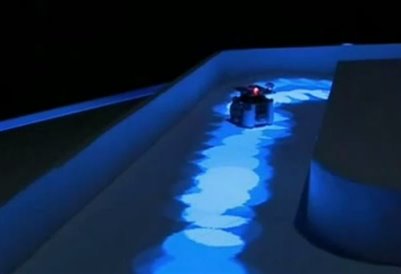
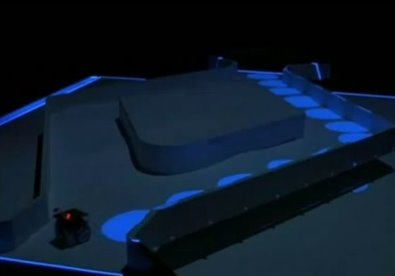
Screen capture, Alice (antbots) travelling the maze. (via BBC)


The highway traffic system can be a bit of a pain at times - rush hours leaving many heading home from work in a seemingly endless line of vehicles tiptoeing their way forward. There must be a way of achieving optimal travel, ants, for instance, seem to have it down pat. On their daily foraging missions, ant colonies efficiently travel great distances with the minimal aid of visual cues, pheromone based route tracking, sun positioning navigation, and can even count their number of steps and body rotations - not unlike many workout enthusiasts of today. But when faced with a fork in the road, it is possible that these ants use the geometric configuration of their environment to find the shortest route to the food source. This is the basis of the latest study at the New Jersey Institute of Technology’s Swarm Lab that employed an army of 10 ant-sized robots, named Alices, to do a bit of behavioral study on the matter.


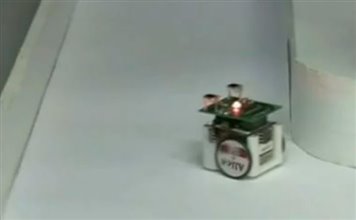
The sugar-cube sized ant robots were equipped with two light sensing antennae for the study. In addition to testing the geometric variable in their route navigation system, ants’ method of using pheromones to navigate was simulated by light-trail that was left behind by each individual robot’s path down a maze. A previous study explained that the angle created by a fork in the road determined which path the ant would take: a small incident angle led to the food source, while a larger incident angle generally led back to the nest. Thus, the study was performed on two types of mazes: one with symmetrical bifurcations (forks in the road), and one with asymmetric bifurcations (more closely resembling and networks).
 

image

Alice bot (via BBC video)


Programmed to move much like ants whom follow a relatively straight path with little desire for exploration, the 10 robots were let loose in the maze galleries as the researchers paid close attention to the relationship between their interactive movements, light-trail navigation, and the bifurcation geometries. The results of the experiment demonstrated remarkably similar patterns of movement between the ants and the Alices. It turns out that the physical angle of the forks in the road were not as important in this case; By paying attention to light-trails left by other ant-bots, each subsequent robot would prefer to take the path that had been previously travelled by another bot. In this method, once the shortest route was found, more and more ant-bots would take that same route due to its increase light “pheromone” presence.


Simon Garnier, the research team leader, wasn’t too surprised that the experimented explained ant navigation behavior as dependent on both physical layout and the presence of pheromones. Ants still prefer to move through bifurcations with angle that require the least effort to maneuver through, hence the small incident angle, but also contain a stronger pheromone scent. The result is a positive feedback loop traffic system. The research will further help scientists study how physical layouts and pheromone trails in the environment can affect the travel of other insects. Hopefully, subsequent work will be done to study how similar methods can be used to alter human-made environments for optimal travel and trade that effectively eliminates traffic clogs.


This video is unavailable.
You don't have permission to edit metadata of this video.


C

See more news at:

http://twitter.com/Cabe_e14

  • Sign in to reply
  • DAB
    DAB over 12 years ago

    I was interested until they went to an AI maze following approach.


    An ant colony uses a chemical trail for egress and ingress to the hive.  They are much more intelligent than these robots.  Everything the ants do is a very carefully choreographed system used to minimize energy consumption and maximum effect for the benefit of the hive.


    I see nothing here that has not been done to death by previous researchers.


    Just my opinion.

    DAB

    • Cancel
    • Vote Up 0 Vote Down
    • Sign in to reply
    • More
    • Cancel
element14 Community

element14 is the first online community specifically for engineers. Connect with your peers and get expert answers to your questions.

  • Members
  • Learn
  • Technologies
  • Challenges & Projects
  • Products
  • Store
  • About Us
  • Feedback & Support
  • FAQs
  • Terms of Use
  • Privacy Policy
  • Legal and Copyright Notices
  • Sitemap
  • Cookies

An Avnet Company © 2025 Premier Farnell Limited. All Rights Reserved.

Premier Farnell Ltd, registered in England and Wales (no 00876412), registered office: Farnell House, Forge Lane, Leeds LS12 2NE.

ICP 备案号 10220084.

Follow element14

  • X
  • Facebook
  • linkedin
  • YouTube