element14 Community
element14 Community
    Register Log In
  • Site
  • Search
  • Log In Register
  • Community Hub
    Community Hub
    • What's New on element14
    • Feedback and Support
    • Benefits of Membership
    • Personal Blogs
    • Members Area
    • Achievement Levels
  • Learn
    Learn
    • Ask an Expert
    • eBooks
    • element14 presents
    • Learning Center
    • Tech Spotlight
    • STEM Academy
    • Webinars, Training and Events
    • Learning Groups
  • Technologies
    Technologies
    • 3D Printing
    • FPGA
    • Industrial Automation
    • Internet of Things
    • Power & Energy
    • Sensors
    • Technology Groups
  • Challenges & Projects
    Challenges & Projects
    • Design Challenges
    • element14 presents Projects
    • Project14
    • Arduino Projects
    • Raspberry Pi Projects
    • Project Groups
  • Products
    Products
    • Arduino
    • Avnet & Tria Boards Community
    • Dev Tools
    • Manufacturers
    • Multicomp Pro
    • Product Groups
    • Raspberry Pi
    • RoadTests & Reviews
  • About Us
  • Store
    Store
    • Visit Your Store
    • Choose another store...
      • Europe
      •  Austria (German)
      •  Belgium (Dutch, French)
      •  Bulgaria (Bulgarian)
      •  Czech Republic (Czech)
      •  Denmark (Danish)
      •  Estonia (Estonian)
      •  Finland (Finnish)
      •  France (French)
      •  Germany (German)
      •  Hungary (Hungarian)
      •  Ireland
      •  Israel
      •  Italy (Italian)
      •  Latvia (Latvian)
      •  
      •  Lithuania (Lithuanian)
      •  Netherlands (Dutch)
      •  Norway (Norwegian)
      •  Poland (Polish)
      •  Portugal (Portuguese)
      •  Romania (Romanian)
      •  Russia (Russian)
      •  Slovakia (Slovak)
      •  Slovenia (Slovenian)
      •  Spain (Spanish)
      •  Sweden (Swedish)
      •  Switzerland(German, French)
      •  Turkey (Turkish)
      •  United Kingdom
      • Asia Pacific
      •  Australia
      •  China
      •  Hong Kong
      •  India
      •  Korea (Korean)
      •  Malaysia
      •  New Zealand
      •  Philippines
      •  Singapore
      •  Taiwan
      •  Thailand (Thai)
      • Americas
      •  Brazil (Portuguese)
      •  Canada
      •  Mexico (Spanish)
      •  United States
      Can't find the country/region you're looking for? Visit our export site or find a local distributor.
  • Translate
  • Profile
  • Settings
Robotics
  • Technologies
  • More
Robotics
Blog The lovable EPFL’s agile Cheetah-Cub Robot
  • Blog
  • Forum
  • Documents
  • Quiz
  • Events
  • Polls
  • Members
  • Mentions
  • Sub-Groups
  • Tags
  • More
  • Cancel
  • New
Join Robotics to participate - click to join for free!
  • Share
  • More
  • Cancel
Group Actions
  • Group RSS
  • More
  • Cancel
Engagement
  • Author Author: Catwell
  • Date Created: 21 Jun 2013 6:09 PM Date Created
  • Views 807 views
  • Likes 3 likes
  • Comments 2 comments
  • research
  • autonomous
  • nature
  • epfl
  • robotics
  • robots
  • control
  • robot
  • behavior
  • cabeatwell
  • mimic
  • automation
  • innovation
  • navigation
Related
Recommended

The lovable EPFL’s agile Cheetah-Cub Robot

Catwell
Catwell
21 Jun 2013

imageimage

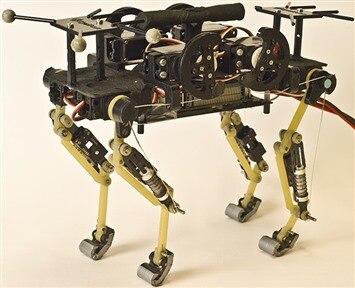
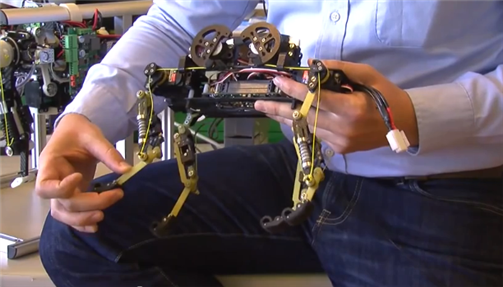
(Left) Cheetah-bot on its own showing a cute, familiar, cat-like stance. (Right) Shown for size comparison (via EPFL)


EPFL, the Swiss Federal Institute of Technology in Lausanne, has been busy of late designing several impressive biomechanical robots that intend to increase human understanding of the natural world. A previous post covered a salamander robot that mimicked the locomotive control system of a salamander using electronic controls to replace the signals normally sent up and down the animal’s spine. This time ‘round, the school’s BioRobotics laboratory enlists the help of a feline in its latest biomechanics work.


The International Journal of Robotics Research recently published a study detailing the lab’s study of a “cheetah-cub robot.” This fast and stable mechanical creature brilliantly mimics the natural movements of a housecat with much interest going into its leg design.


The reason the lab chose a cat for their design was simple - they didn’t have enough lab space to build a whole cheetah. In hopes of keeping their research focused on the biomechanical study of the undisturbed natural world, dogs were eliminated from the equation due to the high influence of human breeding in their evolution.


EPFL’s CatBot is approximately 8 inches long and 6 inches tall and is made of readily available, off the shelf components. At this stage of the research, operation is still performed via wire - though in the future, remote operation will allow for a wide range of outdoor applications. Its legs in particular mimic the movements and morphology of a housecat quite well - tendons are accounted for by spring-loaded pantograph leg design, and actuators on each leg are used in place of muscles.


As the fastest small quadruped robot of its kind, the 30kg cheetah-cub bot scurries along at a speed of 1.4 m/s that is equivalent to about seven body lengths per second. Even at its higher speeds, the leg design’s auto stabilization features allows the robot to traverse up and down obstacles up to 20% of its leg length.


Future applications will include rough terrain search and rescue operations that are generally troublesome for track and/or wheel driven robots. Studies have already shown the feline bot’s ability to manage tough terrains, and its spring loaded leg design hopes to one day enable quick and agile exploratory missions in unfriendly environments including natural disaster sites.


All in all, EPFL’s recent work on the cheetah-cub bot hopes to continue the trend of bio mimicry and biomechanically based technology use. As Auke Ijspeert, director of the institute’s BioRob Lab explains, the long-term goal is in “studying and using the principles of the animal kingdom to develop new solutions for use in robots...” In other words - when in doubt, look to nature for the answer.


Wrap this bot in fake fur, everyone will love it.


You don't have permission to edit metadata of this video.
Edit media
x
image
Upload Preview
image


C

See more news at:

http://twitter.com/Cabe_e14

  • Sign in to reply
  • billabott
    billabott over 12 years ago in reply to DAB

    Yes, they can and are building usable robots for use against people. 

    • Cancel
    • Vote Up 0 Vote Down
    • Sign in to reply
    • More
    • Cancel
  • DAB
    DAB over 12 years ago

    Very cool!


    I like the way that they combined simple mechanical features to replace some of the calculation intensive characteristics for the locomotion.

    The simple approach makes the final robot very easy to maintain and able to cope with varable terrain.


    I look forward to seeing more from this group.  I think they are moving in a very good direction to build usable robots for use with people.


    DAB

    • Cancel
    • Vote Up 0 Vote Down
    • Sign in to reply
    • More
    • Cancel
element14 Community

element14 is the first online community specifically for engineers. Connect with your peers and get expert answers to your questions.

  • Members
  • Learn
  • Technologies
  • Challenges & Projects
  • Products
  • Store
  • About Us
  • Feedback & Support
  • FAQs
  • Terms of Use
  • Privacy Policy
  • Legal and Copyright Notices
  • Sitemap
  • Cookies

An Avnet Company © 2025 Premier Farnell Limited. All Rights Reserved.

Premier Farnell Ltd, registered in England and Wales (no 00876412), registered office: Farnell House, Forge Lane, Leeds LS12 2NE.

ICP 备案号 10220084.

Follow element14

  • X
  • Facebook
  • linkedin
  • YouTube