


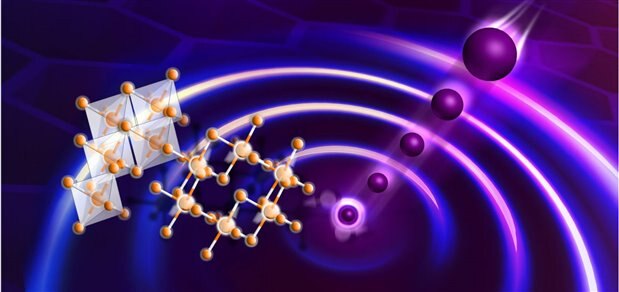
Oak Ridge National Laboratory’s take of a spin liquid on a honeycomb lattice with neutrons in ‘splash mode’ in order to see the Majorana fermion. (via Oak Ridge National Laboratory)
Magnetic states are no longer considered a ‘couple’ as researchers from several prominent academic institutions have added a third state, which makes for not only an interesting magnetic threesome but could also provide a boost for quantum computing. In a recently published paper from MIT physics professor Young Lee and colleagues from Oak Ridge National Laboratory, University of Tennessee and several others, the team successfully demonstrated a theorized third form of magnetism shown in a quantum spin liquid state using a rare mineral.

The team grew and then super cooled the mineral Herbertsmithite in order to observe each particle’s magnetic moment, which never lined up or cancelled each other out thereby creating a third state of magnetism known as quantum spin liquid.
In order to test the theory of QSL, the team needed a mineral that could exhibit a kogame lattice structure synonymous to QSL due to its unusual vertices and edges of the trihexagonal tiling, which is prominent in Herbertsmithite but not just any off-the-shelf mineral would do. The team needed to make a pure form of the crystal and so created their own technique that required them to raise and lower the temperature in a furnace, which produced thin 1-centimeter crystals. To produce the QSL, they super cooled the crystals to near zero Kelvin and used neutron scattering to observe the new state of magnetism exhibited by electron scattering, which produced fractional particles called Majorana fermions.
Unlike the other two states, ferromagnetism and antiferromagnetic, where the electrons either line up or cancel each other out, the third state’s electrons constantly change their magnetic moment- never lining up or canceling each other out thereby producing a quantum spin liquid. Something unexpected happened as sort of a byproduct during the QSL process as the team observed an effect known as long-range entanglement where a pair of widely separated particles can instantly affect each other’s magnetic moments.
This means that the QSL electrons could be beneficial in quantum computing where qubits (or quantum bits) are used to encode data rather than binary digits. Qubits are based off the quantum state of atomic particles to represent each bit of information but they are notoriously degenerative due to the impurities of the materials used, which changes that quantum state expectantly. The new QSL atomic state using the purified Herbertsmithite crystal essentially prevents the decay or prolongs it enough to be used in quantum computing, however researchers need to need to reliably produce and control the long-range entanglement effect in order for it to be implemented. While it probably won’t happen anytime soon, the prospect of quantum computing is one-step closer to becoming a reality.
Have a story tip? Message me at:
