


We're only a day away from the release of Star Wars: The Force Awakens aka the most anticipated movie of the year - maybe pf all time. The franchise is loved by millions for various reasons: the story, the action, the characters, and the technology. When audiences first saw the Millennium Falcon zipping through space or those lightsaber (laser sword) battles back in 1977, they were awestruck. You couldn't imagine any of those gadgets in real life. Almost 40 years later and much of the technology from the movie has come to life. Here are nine examples of real life instances of Star Wars tech.
Bionic Limbs
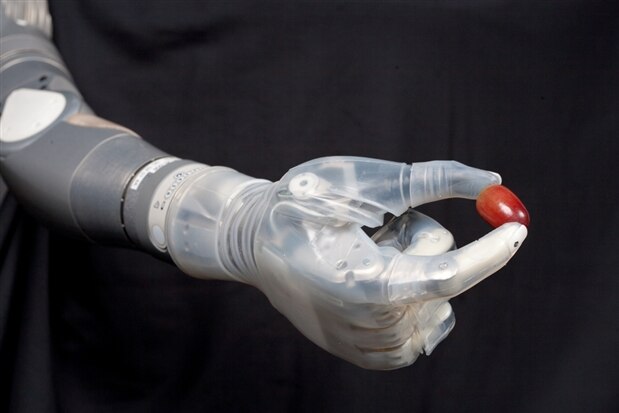
This bionic arm is named after Star Wars hero Luke Skywalker (via DEKA Research)
Not to drop any spoilers but some key characters in the Star Wars universe end up with bionic limbs after some gruesome battles. What once seemed like a reality for those in a galaxy far, far away can now be found here today. There are several bionic limbs out there and one of them is even dubbed “The Luke Arm.” This limb allows an amputee to control with his or her mind (you read that right) by using electrodes to connect the device to the nervous system. The device was created by DEKA Research and Development Corporation. Even Disney is getting in on the action with its Accelerator Program funding a startup called Open Bionics that aims to create 3D printed limbs for kids, some which will be designed after the Star Wars franchise. Not only are these prosthetics life changing, they make you feel like a true battle-scorned Jedi.
Holograms

Holographic technology is more of a reality than you think (via VoxBox)
When Princess Leia sent a holographic message to Obi Wan-Kenobi, the masses were blown away from this outer space technology. It's something we've been dreaming about since this sci-fi movie. Even the beloved cartoon series Furturama shows the wonders of the hologram. What seemed impossible became a reality most notably when a hologram of the late rapper Tupac Shakur appeared on stage at Coachella in 2012. The technology also brought back the late Michael Jackson during the 2014 Billboard Music Awards. But the technology has been around before these incidents. A professor at the University of Arizona created the first holographic message by using 16 cameras to create the source material along with two lasers that transmitted the message onto a piece of plastic to create a pattern that seems to be hovering. There's even a company called VoxBox that prints 3D images on light, which tricks the eye into thinking they're seeing something in 3D. As the technology continues to improve hopefully it'll be used for than cashing in on dead celebrities.
Speeder Bikes

The Aero-X was the brainchild of Star Wars fan Mark DeRoche (via Aero-X)
Remember the adrenaline rushing speeder bikes in Return of the Jedi that made your ten speeder look like a piece of junk? Now, those flying bikes are available to some degree. Mark DeRoche of Aerofex was such a big fan of the scene he went out and created a “low-altitude tandem duct aerial vehicle” that'll make your Skywalker dreams come true. Testing for the bike took place 2 years ago in California and videos from the test run spread all over the internet. People soon began asking when they could buy it. Turns out the company is aiming to have the bike, dubbed the Aero-X, out by 2017 with a hefty price tag of about $85,000. You gotta admit that's a lot of money to recreate your favorite Stars Wars moment.
Battle Droids
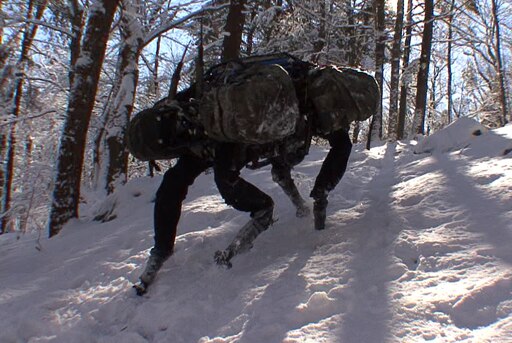
Admit it, this thing looks kind of terrifying. Maybe that's why the military is testing it. (via Boston Dynamics)
Battle Droids in the Star Wars universe are quite plentiful, useful, scourge to many a clone trooper. These guys take down their enemies in droves while sparing human lives in the heat of battle. Even though the battle droids employed by the military don't look like the bots from the movie, they're just as efficient, maybe even more so. BigDogs are remote controlled robots that the military are currently testing in real terrain. (Others to check out, AlphaDog, Petman.. very close to the Star Wars real thing). Created by Boston Dynamics, this bot walks on four legs and can navigate through tough terrains, like now, water, and muddy trails. The company also makes the Atlas, humanoid robot that walks bipedally leaving the upper limbs free to lift, carry, and manipulate the surrounding environment. These bots are actually quite useful since they can spare soldiers from navigating through dangerous or hazardous terrain. Now, if only the military would use light sabers and light guns.
Robot Companions
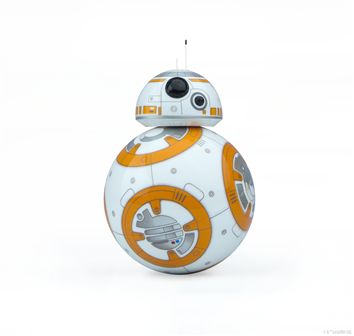
Undoubtedly the hottest toy of 2015 (via Sphero)
Star Wars has a lot of droids walking around the universe, but the two most notable are R2D2 and C3PO. These characters have been cosplayed ever since the release of the original film and people with the know how have even built real life replicas of the duo. The new movie The Force Awakens introduce a new sphero bot named BB8, which can actually be found in stores now. It doesn't have an A.I. like the fictional one, it's much smaller... never the less, it is still fun. Along with these beloved characters are actual robotic companions that do more than entertain. Several robots, such as Alpha 2 and Buddy, are made to be live in assistants that perform a wide range of tasks: reading aloud emails, tutoring, providing daily reminders, protecting the house, and even carrying objects. More companies are promoting these type of bots as must have for the elderly or those with limited mobility to help them with daily tasks. And when they're done with work for the day they can sing and dance to your delight. R2D2 may be cute, but he's never read your messages for you, has he?
Tractor Beams
An acoustic hologram projected onto a 2D space that has similar function to a tractor beam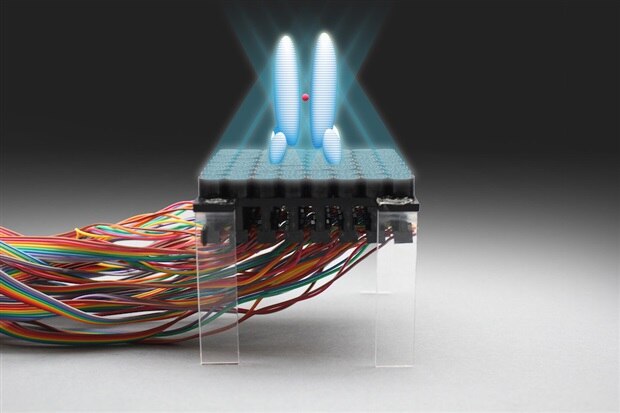
Most of the space ships in Star Wars employ a tractor beam, an invisible energy field that grabs, traps, and moves objects. Scientists have actually been creating lasers to replicate this activity, albeit on a smaller scale. They create lasers with unusual beam intensity that allows them attract and repulse tiny particles. In 2014, researchers from the Australian National University used a doughnut shaped laser to drag hollow glass spheres for up to 7.8 inches, which broke the distance record for tractor beams. Just a few months ago a team from the University of Bristol in the UK further pushed tractor beam research when they showed how sound could rival light as a source for future beams. So maybe these beams can't be attached to space ships to pull in asteroids, but as long as the technology keeps developing the possibilities are endless.
Lightsabers

And we're not talking about the kind from the toy aisle (image via Empire Strikes Back, Lucas Arts)
If there's anything fans have been salivating at getting their hands on it's the lightsaber. It's deadly, glows, and makes that iconic wooshing sound. Even if you're not a fan of the movie, you probably wanted one of these intergalactic weapons for yourself. Unfortunately, technology hasn't advanced enough to replicate the lightsabers from the film; the closest we get to those are the toys, but don't give up hope just yet. In 2013, researchers from Harvard University and the Massachusetts Institute of Technology (MIT) constructed molecules out of light, which could allow them to build objects out of photons instead of having them pass through each other. That being said the researchers are still convinced lightsabers can never be made in real life. On the other hand, scientists are working on weapons similar to the blaster guns featured in the movie. The US Navy even has a ship-based laser weapon, which can shoot drones out of the sky. Guess you'll have to go to Toys R Us for your lightsaber fix in the meantime.
Hyperspace

Han Solo and his Wookie companion travel faster than the speed of light in the Star Wars universe (via Lucas Arts)
You may remember how Han Solo hopped into the Millennium Falcon to fly between solar systems light years apart by going into hyperspace – think of it as a short cut in space. Right now it's just a theory since it's impossible to travel faster than light. But hyperspace does have a basis in real life science, according to Eric Davis, physicist at the Institute for Advanced Studies in Austin, TX. It seems the curvature of space-time, first proposed by Albert Einstein, suggest space could be manipulated to shorten the distance between two points. Some ways of doing this would be creating a wormhole or a warp drive that contacts space in front of a ship and expands it behind the vessel. One lab called Eagleworks, claimed earlier this year to have created a warp drive that creates spatial distortions in a vacuum. Sounds too good to be true, right? Well, that may be the case since their unpublished findings have been met with a lot of skepticism.
Surgery Bots
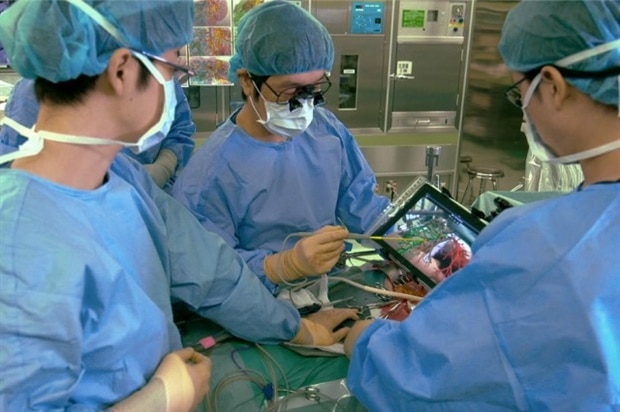
Today surgeon robots. Tomorrow, the world!
In Episode 3 of the Star Wars franchise, there's a scene where Darth Vader gets stitched up by a group of surgery bots. These bots are rapidly becoming a reality as various institutes are experimenting with robotic surgeons. One group of researchers in Zurich built nanobots to aid in delicate surgeries. And it was recently revealed that Google and Johnson & Johnson are teaming up to work on robots that can perform surgery. Under the name Verb Surgical, the company is looking to create better robotic surgical assistants and learn to make more advanced machines. The thought of robots handling surgery is still nerve wrecking for some, which is why it takes quite a while to get the technology just right. If anything, there's no guarantee these bots would completely replace human doctors. At least, let's hope not.
That's all for now... Go see Episode 7!
See more news at: