


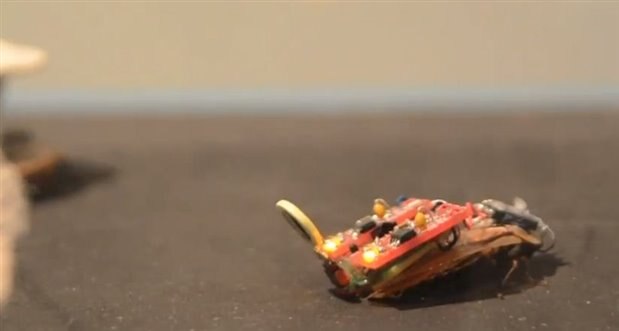
Twitter Roach. Uses an Arduino powered backpack, the roach can be controlled by sending tweets (via Brittany Ransom)
Looking for an interesting and questionable techy science project to do for fun, or a morbid curiosity for animal experimentation? Well, look no further. Brittany Ransom has taken the RoboRoach concept a step further by making some slight modifications and adding a thought-provoking artistic twist to it. Ransom, an artist, educator, and researcher residing in Dallas, TX, creates site-specific art installations that question onlookers about the relationship between humans, animals, and the environment, and pokes at the over-stimulating intrusion of technology into our lives. Her latest work was displayed at the “Life, in some form” art exhibition by the Chicago Artists Coalition.
For this project, Ransom added her own custom software and Arduino hardware to the already functional RoboRoach backpack and strapped it onto an unsuspecting cockroach. The backpack requires a brief surgery to be performed in order to attach a couple of silver electrodes to the antenna of the roach. Once this is done, the little critter can be wirelessly controlled to turn left or right by sending 55 Hz micro-stimulating biphasic pulses to its antenna nerves. Ransom’s art display builds on this by allowing visitors to send #TweetRoachLeft and #TweetRoachRight commands to the @TweetRoach account and move the little bugger around its cage. Luckily, the system is equipped with some bug protection: the cockroach only wears the backpack for a short period of time and only one tweet per 30 seconds is allowed to go through (we are mercify gods).
They may be considered pests, but they have rights too, ya know. As do many of her works, the scope of this installation is to shed some light on the controlling, over-stimulating effects the digital world (Twitter, in this case) has on the evolving human species. And much like the behavior of the Roboroach backpack (after a few minutes the roach re-gains control over itself, rendering the device temporarily ineffective), the art piece asks the question of how long it takes before either we become desensitized to digital sensory overload or we evolve to surpass our current technological capabilities. Rich in scientific and artistic meaning, Ransom’s work provides us with a sense of our current bio-manipulative capabilities, and some ideas for future art-tech projects. Hopefully the cockroach family is okay with these sorts of experiments and doesn’t start invading our homes.
Cabe

