element14 Community
element14 Community
    Register Log In
  • Site
  • Search
  • Log In Register
  • Community Hub
    Community Hub
    • What's New on element14
    • Feedback and Support
    • Benefits of Membership
    • Personal Blogs
    • Members Area
    • Achievement Levels
  • Learn
    Learn
    • Ask an Expert
    • eBooks
    • element14 presents
    • Learning Center
    • Tech Spotlight
    • STEM Academy
    • Webinars, Training and Events
    • Learning Groups
  • Technologies
    Technologies
    • 3D Printing
    • FPGA
    • Industrial Automation
    • Internet of Things
    • Power & Energy
    • Sensors
    • Technology Groups
  • Challenges & Projects
    Challenges & Projects
    • Design Challenges
    • element14 presents Projects
    • Project14
    • Arduino Projects
    • Raspberry Pi Projects
    • Project Groups
  • Products
    Products
    • Arduino
    • Avnet & Tria Boards Community
    • Dev Tools
    • Manufacturers
    • Multicomp Pro
    • Product Groups
    • Raspberry Pi
    • RoadTests & Reviews
  • About Us
  • Store
    Store
    • Visit Your Store
    • Choose another store...
      • Europe
      •  Austria (German)
      •  Belgium (Dutch, French)
      •  Bulgaria (Bulgarian)
      •  Czech Republic (Czech)
      •  Denmark (Danish)
      •  Estonia (Estonian)
      •  Finland (Finnish)
      •  France (French)
      •  Germany (German)
      •  Hungary (Hungarian)
      •  Ireland
      •  Israel
      •  Italy (Italian)
      •  Latvia (Latvian)
      •  
      •  Lithuania (Lithuanian)
      •  Netherlands (Dutch)
      •  Norway (Norwegian)
      •  Poland (Polish)
      •  Portugal (Portuguese)
      •  Romania (Romanian)
      •  Russia (Russian)
      •  Slovakia (Slovak)
      •  Slovenia (Slovenian)
      •  Spain (Spanish)
      •  Sweden (Swedish)
      •  Switzerland(German, French)
      •  Turkey (Turkish)
      •  United Kingdom
      • Asia Pacific
      •  Australia
      •  China
      •  Hong Kong
      •  India
      • Japan
      •  Korea (Korean)
      •  Malaysia
      •  New Zealand
      •  Philippines
      •  Singapore
      •  Taiwan
      •  Thailand (Thai)
      • Vietnam
      • Americas
      •  Brazil (Portuguese)
      •  Canada
      •  Mexico (Spanish)
      •  United States
      Can't find the country/region you're looking for? Visit our export site or find a local distributor.
  • Translate
  • Profile
  • Settings
Robotics
  • Technologies
  • More
Robotics
Blog U.S. Navy showcases SAFFiR, it’s firefighting biped humanoid robot
  • Blog
  • Forum
  • Documents
  • Quiz
  • Events
  • Polls
  • Members
  • Mentions
  • Sub-Groups
  • Tags
  • More
  • Cancel
  • New
Join Robotics to participate - click to join for free!
  • Share
  • More
  • Cancel
Group Actions
  • Group RSS
  • More
  • Cancel
Engagement
  • Author Author: Catwell
  • Date Created: 16 Apr 2015 8:09 PM Date Created
  • Views 372 views
  • Likes 0 likes
  • Comments 0 comments
  • firefighting
  • navy
  • us_navy
  • robotics
  • saffir
  • robot
  • drone
  • on_campus
  • emergency
  • fire
  • cabeatwell
  • university
  • innovation
Related
Recommended

U.S. Navy showcases SAFFiR, it’s firefighting biped humanoid robot

Catwell
Catwell
16 Apr 2015

imageimage

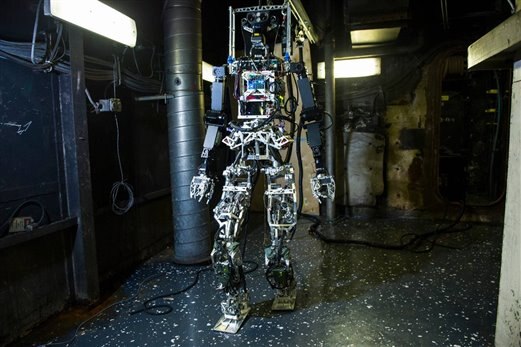
SAFFiR (via The U.S. Navy)


As robotic technology continues to expand, we see an increasingly impressive army of Artificial Intelligence-based robots gearing up to work “hand”-in-hand with humankind; like the U.S. Navy’s Shipboard Autonomous Firefighting Robot (SAFFiR), for example. Recently unveiled at the Naval Future Force Science & Technology EXPO, this firefighting biped is turning heads.


SAFFiR is quite impressive, as far as biped robotic capabilities go. In demonstrations last fall, the robot successfully walked upright on uneven floors, was able to identify equipment that was above recommended temperature through thermal imagine and was even able to extinguish a small fire. The demonstration was done aboard the decommissioned Naval vessel, the USS Shadwell, and if the robot ever makes it past trials, it would be working in a similar environment.


Researchers at Virginia Tech University developed the humanoid. It stands 5-feet-10-inches tall and weights 143 lbs. The bot features impressive stability and is also equipped with infrared stereovision, comprehensive light detection capabilities and a LIDAR laser that can cut through smoke. With this, the fancy biped has both an autonomous and human-controlled operating modes.


SAFFiR was commissioned to help monitor and prevent fire threats on naval vessels, but it is still a work in progress. While its stability and autonomous mode is impressive, it can only “walk” upright when connected to a tether. It is also relatively slow, compared to an emergency responder, and it is neither water- nor fireproof (which poses a BIG problem for a firefighting robot on a ship). The Navy, however, is aware of its setbacks and has plans to continue to enhance the robots capabilities, including enhanced intelligence for autonomous maintenance work, enhanced speed and greater computing power, to name a few. With this, the Navy hopes the bot will be fully functional without the help of its partner in crime, a tiny infrared quadrocopter.


You don't have permission to edit metadata of this video.
Edit media
x
image
Upload Preview
image

DC-21 (via Carnegie Mellon University)


While the goal is for SAFFiR to roam autonomously, it got by with a little help from its friend, a drone named Damage Control Technologies for the 21st Century (DC-21). DC-21 was developed by researchers from the Carnegie Mellon University’s Robotics Institute and a partner company, Sensible Machines and uses infrared imagine and depth perception cameras to detect fires in hard-to-reach spaces for SAFFiR.


Naval vessels are full of hard-to-reach areas that may only be 26-inches wide. As SAFFiR still lacks the mobility to successfully maneuver in tight spaces, DC-21 came to the rescue and communicated to the robot where it detected fire threats. The team had to act fast, as the DC-21 can only run for five minutes per battery charge, but they were successful together.


The Robotics Institute and Sensible Machines have plans to continue to enhance DC-21’s capabilities to allow for longer activity per charge. It’s back to the drawing board for research teams behind both the drone and SAFFiR technologies, but things look promising. In the not-so-distant future the U.S. Navy hopes SAFFiR will go live and help protect sailors from fire threats aboard ships. Maybe one day robots will also help fight domestic fires. We can only hope.


C

See more news at:

http://twitter.com/Cabe_Atwell

  • Sign in to reply
element14 Community

element14 is the first online community specifically for engineers. Connect with your peers and get expert answers to your questions.

  • Members
  • Learn
  • Technologies
  • Challenges & Projects
  • Products
  • Store
  • About Us
  • Feedback & Support
  • FAQs
  • Terms of Use
  • Privacy Policy
  • Legal and Copyright Notices
  • Sitemap
  • Cookies

An Avnet Company © 2025 Premier Farnell Limited. All Rights Reserved.

Premier Farnell Ltd, registered in England and Wales (no 00876412), registered office: Farnell House, Forge Lane, Leeds LS12 2NE.

ICP 备案号 10220084.

Follow element14

  • X
  • Facebook
  • linkedin
  • YouTube