element14 Community
element14 Community
    Register Log In
  • Site
  • Search
  • Log In Register
  • Community Hub
    Community Hub
    • What's New on element14
    • Feedback and Support
    • Benefits of Membership
    • Personal Blogs
    • Members Area
    • Achievement Levels
  • Learn
    Learn
    • Ask an Expert
    • eBooks
    • element14 presents
    • Learning Center
    • Tech Spotlight
    • STEM Academy
    • Webinars, Training and Events
    • Learning Groups
  • Technologies
    Technologies
    • 3D Printing
    • FPGA
    • Industrial Automation
    • Internet of Things
    • Power & Energy
    • Sensors
    • Technology Groups
  • Challenges & Projects
    Challenges & Projects
    • Design Challenges
    • element14 presents Projects
    • Project14
    • Arduino Projects
    • Raspberry Pi Projects
    • Project Groups
  • Products
    Products
    • Arduino
    • Avnet & Tria Boards Community
    • Dev Tools
    • Manufacturers
    • Multicomp Pro
    • Product Groups
    • Raspberry Pi
    • RoadTests & Reviews
  • About Us
  • Store
    Store
    • Visit Your Store
    • Choose another store...
      • Europe
      •  Austria (German)
      •  Belgium (Dutch, French)
      •  Bulgaria (Bulgarian)
      •  Czech Republic (Czech)
      •  Denmark (Danish)
      •  Estonia (Estonian)
      •  Finland (Finnish)
      •  France (French)
      •  Germany (German)
      •  Hungary (Hungarian)
      •  Ireland
      •  Israel
      •  Italy (Italian)
      •  Latvia (Latvian)
      •  
      •  Lithuania (Lithuanian)
      •  Netherlands (Dutch)
      •  Norway (Norwegian)
      •  Poland (Polish)
      •  Portugal (Portuguese)
      •  Romania (Romanian)
      •  Russia (Russian)
      •  Slovakia (Slovak)
      •  Slovenia (Slovenian)
      •  Spain (Spanish)
      •  Sweden (Swedish)
      •  Switzerland(German, French)
      •  Turkey (Turkish)
      •  United Kingdom
      • Asia Pacific
      •  Australia
      •  China
      •  Hong Kong
      •  India
      • Japan
      •  Korea (Korean)
      •  Malaysia
      •  New Zealand
      •  Philippines
      •  Singapore
      •  Taiwan
      •  Thailand (Thai)
      • Vietnam
      • Americas
      •  Brazil (Portuguese)
      •  Canada
      •  Mexico (Spanish)
      •  United States
      Can't find the country/region you're looking for? Visit our export site or find a local distributor.
  • Translate
  • Profile
  • Settings
Robotics
  • Technologies
  • More
Robotics
Blog UIUC makes first “bio-bots” that can walk it out
  • Blog
  • Forum
  • Documents
  • Quiz
  • Events
  • Polls
  • Members
  • Mentions
  • Sub-Groups
  • Tags
  • More
  • Cancel
  • New
Join Robotics to participate - click to join for free!
  • Share
  • More
  • Cancel
Group Actions
  • Group RSS
  • More
  • Cancel
Engagement
  • Author Author: Catwell
  • Date Created: 11 Jul 2014 8:31 PM Date Created
  • Views 702 views
  • Likes 0 likes
  • Comments 3 comments
  • robotics
  • life
  • uiuc
  • robot
  • on_campus
  • biobot
  • cabeatwell
  • university
  • medical
Related
Recommended

UIUC makes first “bio-bots” that can walk it out

Catwell
Catwell
11 Jul 2014

image

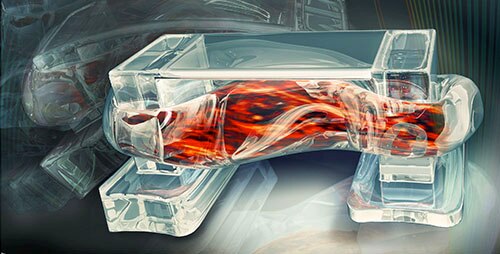
Illustration of Bashir’s new walking bio-bot (via University of Illinois at Urbana-Champaign)


Researchers at the University of Illinois at Urbana-Champaign developed one of the first classes of “bio-bots” that can walk. They are also some of the first biological robots to give bioengineers full control over their motion.

If you aren’t freaked out about the prospect of 3D-printed organs, surely this will send a tingle down your spine. A new class of biological robots, developed by Abel Bliss Professor Rashid Bashir, Head of Bioengineering at U of I, and his team of researchers developed a biological robot to stimulate the muscle-tendon-bone phenomena naturally expressed in the body. In effect, it moves on demand.


The bio-bot is made from skeletal muscle cells and 3D-printed hydrogel. Skeletal muscle is unique, in that it only responds to electric pulses. Others muscle cells, such as heart cells, contract on their own, giving researchers limited control of their function. Skeletal muscle cells, on the contrary, only respond on command.


The new bot is constructed by stretching skeletal muscle cells across a 3D-printed board made from hydrogel. The board is flexible and is held upright by two posts, which act as legs. Since the hydrogel is flexible, it allows the robot to walk. The faster the electric pulse, the faster it walks.

The structure is something Bashir has been working on for years. In 2012, he and his team of researchers created a bio-bot that could walk, but it was based on the heart cells of rats. Since heart cells contract automatically, there was no way of controlling their speed. Hence, Bashir went back to the drawing board and voile, the new bot was born.


Although they’re arguably creepy, biological robots may soon play an incredibly important role in environmental maintenance. Bio-bots are designed to respond to a particular stimulus. Bashir plans to design bots that detect, follow and neutralize particular toxins. The result? An environmental crew made of up 1cm-long biological robots. Sorry convicts, no community service hours here.


Bashir is working on making the bio-bots responsive to different stimuli. He is also working on controlling the direction in which the bots walk, making it possible to coordinate thousands towards a single purpose. If biochemists get their hands on the robots, these compact contraptions may also respond to national emergencies. The possibilities are endless.


The technology is still in the developing stages, but this won’t be the last you hear of it. Before long, bio-bots could be the first on the scene of oil spills, biochemical attacks and more. Who knows, maybe Bashir will even design bots that kill those ruthless Giant African Snails that destroy our gardens. We can only hope.  


You don't have permission to edit metadata of this video.
Edit media
x
image
Upload Preview
image


C

See more news at:

http://twitter.com/Cabe_Atwell

  • Sign in to reply
Parents
  • DAB
    DAB over 11 years ago

    Very interesting.


    I look forward to the future of this technology.  There are so many potential uses for the bots and the technology they represent.


    DAB

    • Cancel
    • Vote Up 0 Vote Down
    • Sign in to reply
    • More
    • Cancel
Comment
  • DAB
    DAB over 11 years ago

    Very interesting.


    I look forward to the future of this technology.  There are so many potential uses for the bots and the technology they represent.


    DAB

    • Cancel
    • Vote Up 0 Vote Down
    • Sign in to reply
    • More
    • Cancel
Children
No Data
element14 Community

element14 is the first online community specifically for engineers. Connect with your peers and get expert answers to your questions.

  • Members
  • Learn
  • Technologies
  • Challenges & Projects
  • Products
  • Store
  • About Us
  • Feedback & Support
  • FAQs
  • Terms of Use
  • Privacy Policy
  • Legal and Copyright Notices
  • Sitemap
  • Cookies

An Avnet Company © 2025 Premier Farnell Limited. All Rights Reserved.

Premier Farnell Ltd, registered in England and Wales (no 00876412), registered office: Farnell House, Forge Lane, Leeds LS12 2NE.

ICP 备案号 10220084.

Follow element14

  • X
  • Facebook
  • linkedin
  • YouTube