element14 Community
element14 Community
    Register Log In
  • Site
  • Search
  • Log In Register
  • Community Hub
    Community Hub
    • What's New on element14
    • Feedback and Support
    • Benefits of Membership
    • Personal Blogs
    • Members Area
    • Achievement Levels
  • Learn
    Learn
    • Ask an Expert
    • eBooks
    • element14 presents
    • Learning Center
    • Tech Spotlight
    • STEM Academy
    • Webinars, Training and Events
    • Learning Groups
  • Technologies
    Technologies
    • 3D Printing
    • FPGA
    • Industrial Automation
    • Internet of Things
    • Power & Energy
    • Sensors
    • Technology Groups
  • Challenges & Projects
    Challenges & Projects
    • Design Challenges
    • element14 presents Projects
    • Project14
    • Arduino Projects
    • Raspberry Pi Projects
    • Project Groups
  • Products
    Products
    • Arduino
    • Avnet & Tria Boards Community
    • Dev Tools
    • Manufacturers
    • Multicomp Pro
    • Product Groups
    • Raspberry Pi
    • RoadTests & Reviews
  • About Us
  • Store
    Store
    • Visit Your Store
    • Choose another store...
      • Europe
      •  Austria (German)
      •  Belgium (Dutch, French)
      •  Bulgaria (Bulgarian)
      •  Czech Republic (Czech)
      •  Denmark (Danish)
      •  Estonia (Estonian)
      •  Finland (Finnish)
      •  France (French)
      •  Germany (German)
      •  Hungary (Hungarian)
      •  Ireland
      •  Israel
      •  Italy (Italian)
      •  Latvia (Latvian)
      •  
      •  Lithuania (Lithuanian)
      •  Netherlands (Dutch)
      •  Norway (Norwegian)
      •  Poland (Polish)
      •  Portugal (Portuguese)
      •  Romania (Romanian)
      •  Russia (Russian)
      •  Slovakia (Slovak)
      •  Slovenia (Slovenian)
      •  Spain (Spanish)
      •  Sweden (Swedish)
      •  Switzerland(German, French)
      •  Turkey (Turkish)
      •  United Kingdom
      • Asia Pacific
      •  Australia
      •  China
      •  Hong Kong
      •  India
      • Japan
      •  Korea (Korean)
      •  Malaysia
      •  New Zealand
      •  Philippines
      •  Singapore
      •  Taiwan
      •  Thailand (Thai)
      • Vietnam
      • Americas
      •  Brazil (Portuguese)
      •  Canada
      •  Mexico (Spanish)
      •  United States
      Can't find the country/region you're looking for? Visit our export site or find a local distributor.
  • Translate
  • Profile
  • Settings
Robotics
  • Technologies
  • More
Robotics
Blog University of Michigan Develops Braille Display to Bring Visual Data Transmission to the Blind
  • Blog
  • Forum
  • Documents
  • Quiz
  • Events
  • Polls
  • Members
  • Mentions
  • Sub-Groups
  • Tags
  • More
  • Cancel
  • New
Join Robotics to participate - click to join for free!
  • Share
  • More
  • Cancel
Group Actions
  • Group RSS
  • More
  • Cancel
Engagement
  • Author Author: Catwell
  • Date Created: 21 Jan 2016 9:17 PM Date Created
  • Views 768 views
  • Likes 3 likes
  • Comments 1 comment
  • hmi
  • blind
  • tactile
  • on_campus
  • cabeatwell
  • university
  • tablet
  • technology_for_the_disabled
  • innovation
Related
Recommended

University of Michigan Develops Braille Display to Bring Visual Data Transmission to the Blind

Catwell
Catwell
21 Jan 2016

image

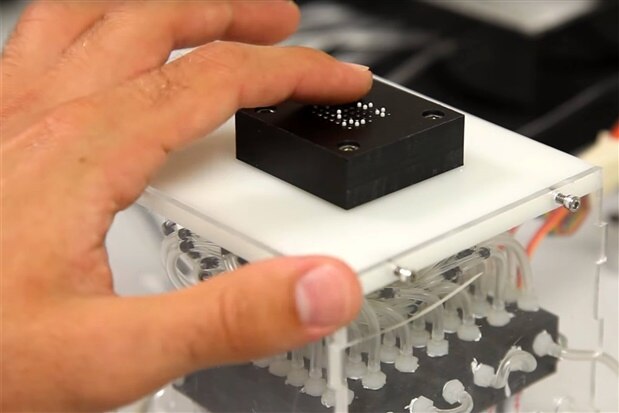
Associate Professor Sile O’Modhrain of the University of Michigan is developing a Braille display for tablets that will revolutionize data transmission for the blind community. The unit will be a fraction of the cost compared to current technology, and will also allow for the Braille display of graphical information; currently an impossible feat. (via University of Michigan)


This is one of those projects you wished you made....


To help connect the blind with the great advancement of technology, the University of Michigan is developing a Braille display that allows the blind to read and process visual imagery at a fraction of the cost. There is no word on when it might be ready for mass production, but if it hits the market, it will considerably change the way in which the blind see the world.


Sile O’Modhrain suffers from Leber’s congentital amaurosis. The condition results in the underdevelopment of the optic nerve, and does not allow the retina to be used for sight. This allows O’Modhrain to see light, with no concrete context or clarity. Despite her lack of vision, she has excelled as in her career and has dedicated her life to the development of interfaces with haptic and auditory feedback – the development of the Braille display for tablets is her latest project.


Electronic Braille displays aren’t a new concept, but they have their setbacks. For one thing, Braille displays can only exhibit one line of text at a time, meaning anything the blind read must be read line by line, with no hope of transmitting even the most simple of graphs, mathematical information or presentation slides, to name a few drawbacks. With this, the displays are also extremely costly, ranging from $3000 - $5000 per line. O’Modhrain, with the help of graduate student Alexander Russomanno, hopes to change all of that.


The new display is revolutionary for multiple reasons. First, it will allow for the display of an entire page of information, instead of the standard one line of text technology in existence. It will also enable the processing of graphical information as well, enabling the blind to ‘see’ spatial data for the first time.


The technology is based on a compact network of microfluidic bubbles. The bubbles fill with air or water on-demand, and emulate Braille bubbles the user can read. The unit is also non-electronic, allowing for energy efficient usage. And, since it is compact at roughly 2x2 inches, it can be transported anywhere. Lastly, the product will be a fraction of the cost compared to current electronic technology, at $1,000 compared to $55,000 for a comparable display using current technology.


The technology is being developed to transcribe information from tablets, but the possibilities are endless. If smartphones adopted the technology, the blind could finally experience the full breadth of the Information Age. With this, the blind will have newfound access to graphs, charts and visual data in a way that is currently non-existent. There is no telling the genius to come from simply giving the blind access to this once-closed door.


O’Modhrain did not state when the technology might be available for user testing or production, but she and Russomanno are continuing to develop the technology at the University of Michigan. They’re onto something big here. Check out a video interview with O’Modhrain below and keep a pulse on the technology’s progression at MconneX.


You don't have permission to edit metadata of this video.
Edit media
x
image
Upload Preview
image


Have a news tip? Message me at:

http://twitter.com/Cabe_Atwell

  • Sign in to reply
  • balearicdynamics
    balearicdynamics over 9 years ago

    Cabe,


    not to create a delusion but there was blind students reading text books with braille devices at the University of Turin in the middle of '80s. Good idea for sure but not so innovative. What I think is that it was time (and late too) that someone was starting again on this technology field.


    Enrico

    • Cancel
    • Vote Up 0 Vote Down
    • Sign in to reply
    • More
    • Cancel
element14 Community

element14 is the first online community specifically for engineers. Connect with your peers and get expert answers to your questions.

  • Members
  • Learn
  • Technologies
  • Challenges & Projects
  • Products
  • Store
  • About Us
  • Feedback & Support
  • FAQs
  • Terms of Use
  • Privacy Policy
  • Legal and Copyright Notices
  • Sitemap
  • Cookies

An Avnet Company © 2025 Premier Farnell Limited. All Rights Reserved.

Premier Farnell Ltd, registered in England and Wales (no 00876412), registered office: Farnell House, Forge Lane, Leeds LS12 2NE.

ICP 备案号 10220084.

Follow element14

  • X
  • Facebook
  • linkedin
  • YouTube