


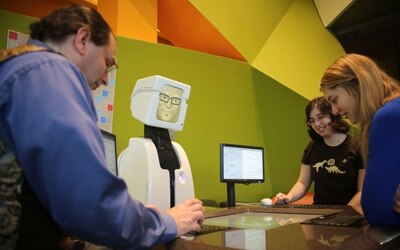
Victor crushing human players (via CMU)
Robots have been playing games against their human counterparts for some time now. They have been spotted bowling (EARL from US Bowling Congress), playing Ping-Pong (KUKA from Future Tense) and even air hockey (Chiba University’s robotic air hockey system). Sure, those are all physical games but what about games that rely heavily on using the mind to beat your opponent, such as board games? Can the human mind trump the raw number-crunching processor used for the machine brain?
To test that theory, researchers from Carnegie Mellon University Robotics Institute created Victor Gamebot to take on humans with the popular board game Scrabble. This is no ordinary robot however, as it’s prone to ‘talk trash’ against its opponents when it’s winning and becomes irate, spouting excuses when it’s losing. The research students, under the direction of robotics professor Reid Simmons, created Victor as a ‘social robot’, meant to one day interact with people on a natural scale in workplaces, shopping centers and even homes. The robot’s white fiberglass body is equipped with an actuated video display screen as the robot’s head, which shows Victor’s animated face that’s capable of showing 18 different emotions. Victor is connected to a touch-screen game board, which allows him to move and place tiles while playing against three human opponents at the same time. Players can communicate with Victor using a keyboard situated in front of each player, while the robot uses a voice box to convey his snide remarks during game play. During game play, if Victor is winning, he will spout lines such as ‘is that all you got?’ or ‘this one is going to be good’ while moving a tile into place. On the other hand, he is quite the sore loser and conveys his disappointment with phrases such as ‘dude, I let you win’ and ‘if I had a dollar for every good word I played, I would still hate you’. As far as the social aspects go, Victor is most often situated in a popular coffee bar on campus with eager students looking to play against it, meaning humans are becoming accustomed to its presence and often look forward to the time they get to play against it.
C
See more news at:
