


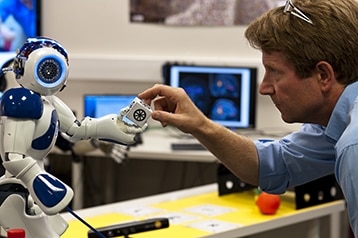
Nao learning a task (via cnrs)
We've seen these cute little Nao robots before. We know they can dance and be self-aware, but did you know they can record and relay repair instructions? Now they can thanks to researchers from the French National Centre for Scientific Research (CNRS) that have given “autobiographical memory” to their Nao robot. This is a system made to assist those on the International Space Station (ISS) during expeditions. Usually, astronauts spend six months on the ISS before being replaced by new crew members. With this technology one of them could use Nao to record himself doing some work, so that the new crew members can learn from him.
But Nao doesn't only record a video and then play it back. It also has the ability to let the user teach the robot how it can help out during the process via vocal commands, manually positioning its limbs, or having it mimic his movements using Kinect. These actions are then stored in the robot's memory ensuring it can relay to others who may need them.
The CNRS tested the system out and posted their results in a video. It shows a technician teaching Nao basic interactions, such as how to hold a smart card, and makes a plan for repair by syncing commands and instructions for the robot, including tipping its head forward to record the interaction. The technician then goes through a sample repair with the help of Nao.
“These results demonstrate the feasibility of this system, and show that such humanoid robots represent a potential solution for the accumulation and transfer of knowledge,” the CNRS said Monday in a statement.
Eventually scientists want to test the Nao robot on a space craft in zero gravity, but the team believes it can be useful on land as well. It sees the robot as an aid to the elderly for a personal memory assistant. AS of 2011, the ISS is using the Robonaut 2, which is a humanoid machine with a 40 pound payload capacity that can be controlled onboard or by the ground crew. Rather than using Nao, space agencies can always decide to port the “autobiographical memory” into the 2.
C
See more news at:

