


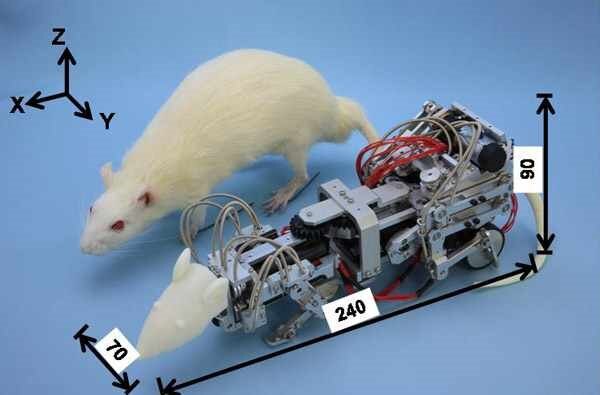
WR-3 Oppressor Robot (via Takanishi Lab/Waseda University)
The life of a lab rat is not something that is typically admired by many. Constantly under the harassment of scientists attempting to recreate human models for testing, mice and rats live a productively bleak life, to say the least. To test mental human conditions such as anxiety, schizophrenia, lab rats are often genetically modified or put through physical hardships like swimming for long periods of time. However, a social condition such as depression is more complex and requires a different approach to properly model the human disorder. The answer to this apparent dilemma? Build a robot that harasses rats into depression.
Scientists in Japan tested this theory by assuming that immobile rats are most likely to suffer from depression. By using their recently built WR-3 bot, the effects of interactive and intermittent robotic-rat attacks on two groups of lab rats and compared the results.
The WR-3 is a rat-inspired robot built specifically to monitor social interaction between rats and robots. The bot contains a total of 10 DC motors and two servomotors that turn its wheels and joints to effectively mimic the behavioral movements of rats. The four rat movements that are realized by the WR-3 are grooming, mounting, rotating, and rearing. Though the robot does not move on its four legs, its two motor driven wheels move it along at speeds capable of keeping up with the average lab rat while its arms and legs actuate for simulated interaction. A custom-built microcontroller is used to remotely control the angle of the WR-3s joints while a closed-loop servo control system turns the DC motors.
The two groups of 12 young rats were harassed by the WR-3 for a 5-day period. The first group was attacked intermittently at the sight of rat movement, while the second group suffered continuous attack by the robotic rat. Then, once the rats matured a few weeks later, the robot was reintroduced to the two groups for further aggravation. The results showed that mature rats who suffered continuous harassment in their youth were most susceptible to depression.
The next step in the research is to experimentally verify whether or not the above model truly emulates the human depression disorder. Personally, I would not sign up as a test subject for that experiment.
Cabe
This robot reminds me of some other experiments...

